

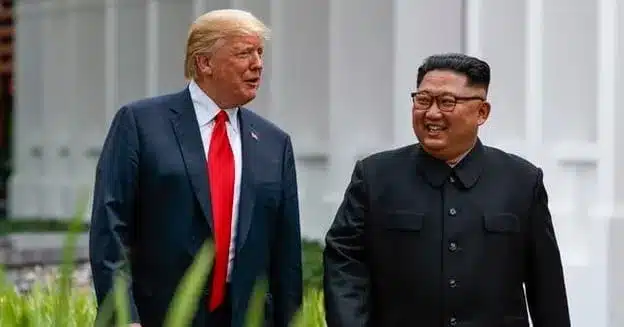
Reports indicate that former U.S. President Donald Trump is exploring the possibility of a direct meeting with North Korean leader Kim Jong Un before the end of the year. This initiative is reportedly being discussed among Trump’s associates, with a potential summit being eyed for the autumn.
Potential Meeting Amidst Diplomatic Landscape
While no official preparations for such a meeting are currently underway, discussions have privately taken place regarding a direct encounter between Trump and Kim Jong Un during Trump’s next potential trip to Asia. A significant opportunity for this meeting could arise during the Asia-Pacific Economic Cooperation (APEC) summit, scheduled to take place in China in November, prior to the summit’s conclusion.
Sources suggest that Trump views a summit-level engagement with North Korea as a signature foreign policy achievement he wishes to cultivate. This aligns with his previous efforts during his presidency to engage directly with the North Korean leadership.
Past Engagements and Diplomatic Efforts
During his single term as president, Donald Trump met with Kim Jong Un on three separate occasions. However, these summits did not result in any substantive agreements on denuclearization or other key issues. An attempt to arrange a meeting during Trump’s Asian tour last year was ultimately unsuccessful due to a packed schedule.
Since leaving office, Trump has frequently highlighted his relationship with Kim Jong Un and expressed an openness to dialogue. This past Friday, Trump cited his “very good relationship” with the North Korean leader as a reason for the significant reduction in joint military drills between the United States and South Korea. This move mirrors the preparatory steps taken before the U.S.-North Korea summits during his first term.
Background on U.S.-North Korea Relations Under Trump
The relationship between the United States and North Korea during the Trump administration was marked by periods of intense diplomatic engagement interspersed with heightened tensions. Following a period of escalating rhetoric and missile tests by North Korea in 2017, Trump shifted towards a diplomatic approach, culminating in the historic Singapore summit in June 2018.
This initial summit, the first-ever meeting between a sitting U.S. president and a North Korean leader, produced a joint statement committing to denuclearization and improved bilateral relations. However, subsequent meetings, including the Hanoi summit in February 2019 and a working-level meeting in Sweden later that year, failed to yield concrete progress on dismantling North Korea’s nuclear program.
Trump’s approach was often characterized by a focus on personal diplomacy with Kim Jong Un, believing that direct engagement could break the long-standing deadlock. He frequently referred to his personal connection with the North Korean leader, suggesting it was a key factor in maintaining communication channels.
The Role of APEC in Diplomatic Overtures
The upcoming APEC summit in November presents a potential venue for high-level diplomatic interactions. Such summits often bring together leaders from various countries in the Asia-Pacific region, creating opportunities for informal or formal bilateral meetings on the sidelines. For Trump, securing a meeting with Kim Jong Un at such a prominent international gathering could be seen as a significant diplomatic coup, reinforcing his narrative of being a dealmaker on the global stage.
The decision to pursue such a meeting, especially in the context of reduced joint military exercises, signals a continued interest from Trump’s side in engaging with North Korea. The effectiveness and potential outcomes of any such meeting remain subjects of speculation, given the historical challenges in achieving tangible progress in U.S.-North Korea denuclearization talks.
Future Implications and Considerations
The pursuit of a direct meeting between Trump and Kim Jong Un, if it materializes, would undoubtedly draw significant international attention. Analysts will be closely watching for any potential shifts in diplomatic dynamics or progress towards denuclearization. The context of such a meeting, particularly if it occurs outside of formal, structured diplomatic channels, raises questions about its potential impact on established international norms and the broader geopolitical landscape in Northeast Asia.
The success of any renewed engagement would likely hinge on the ability to move beyond symbolic gestures and achieve concrete steps towards verifiable denuclearization and improved security assurances for all parties involved. The complex history of U.S.-North Korea relations suggests that any path forward will require careful navigation and sustained diplomatic effort.
