

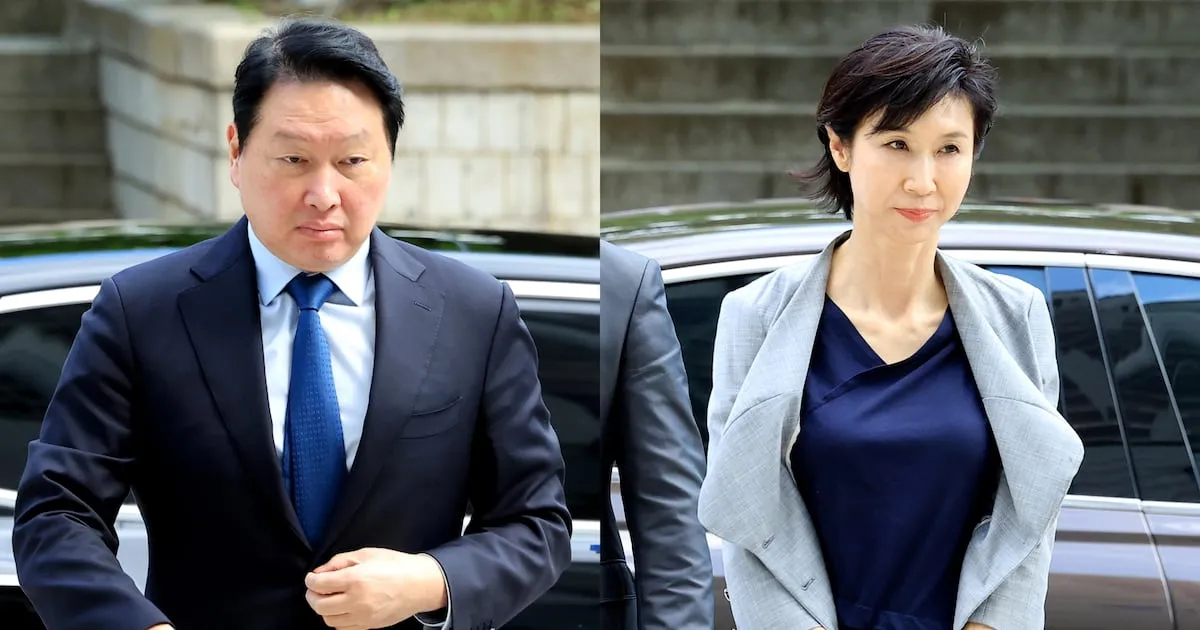
SK Group Chairman Chey Tae-won has filed an appeal against a court ruling ordering him to pay 944 billion won (approximately $680 million USD) in assets to his estranged wife, Roh Soh-yeong, an art center director. The appeal was submitted to the Seoul High Court on May 14th, signaling a continuation of the high-profile legal battle over the division of assets in their divorce proceedings.
A legal representative for Chairman Chey stated that the decision to appeal was made after careful consideration of various factors. The primary objective, they emphasized, is to minimize any negative impact on the company’s shareholders and the group’s overall business operations moving forward. This move escalates the legal dispute, which has garnered significant public attention due to the substantial sums involved and the prominent figures at its center.
Key Factors Driving the Appeal
Several critical issues are believed to have influenced Chairman Chey’s decision to pursue an appeal. These include questions surrounding the fairness of the asset division ratio determined by the court, the practical challenges of raising approximately 1 trillion won (around $730 million USD) in cash for the settlement, and the potential repercussions on the stock market and SK Group’s management. The breakdown of settlement negotiations with Director Roh’s side is also cited as a contributing factor.
Disputed Asset Division Ratio
The Seoul High Court’s Family Division 2 previously ruled on May 24th that Chairman Chey should pay 944 billion won in cash to Director Roh, establishing a division ratio of two-thirds for the Chairman and one-third for Director Roh. This ruling represented a slight decrease from the 35% share initially awarded to Director Roh by the Family Division 3 in May 2024.
Chairman Chey’s side reportedly believes that the calculation of this ratio warrants further judicial review. A significant point of contention stems from a Supreme Court decision in October of the previous year, which excluded 30 billion won (approximately $22 million USD) in support provided by former President Roh Tae-woo’s side as a factor in asset formation. Despite this exclusion, Director Roh’s share only decreased marginally from 35% to approximately 33.3%.
Furthermore, the appeal is expected to address the court’s consideration of SK Inc.’s stock price fluctuations when determining the asset division. SK Inc.’s stock, which was trading in the 800,000 won range at the time of the initial ruling, has since fallen to the 500,000 won range. Chairman Chey’s camp argues that incorporating such volatile stock price changes into the division ratio requires re-evaluation by the Supreme Court.
Minimizing Impact on Shareholders and Operations
The explicit mention of minimizing negative effects on “shareholders and group management” in the Chairman’s statement points to concerns about the financial strain of the settlement. To raise the substantial cash amount, Chairman Chey might need to leverage his SK Inc. shares, potentially through loans or partial sales. Such actions could weaken his controlling stake in the conglomerate and trigger significant market volatility due to large-scale sell-offs.
Selling a substantial portion of SK Inc. shares would also necessitate adherence to insider trading regulations, requiring disclosure of sale plans at least 30 days in advance. The potential for market overreaction and subsequent price drops, if such plans become public knowledge prematurely, is a considerable concern for the Chairman’s side.
These considerations led Chairman Chey’s team to propose alternative settlement methods, such as dividing a portion of the assets in the form of stocks, to Director Roh. However, reports indicate that these proposals were not met with agreement, as Director Roh’s side maintained its stance on receiving the full 944 billion won in cash as per the initial ruling.
Dispute Over SK Siltron’s Valuation
Another significant point of contention expected to be raised in the appeal is the inclusion and valuation of SK Siltron, a semiconductor materials company, as part of the divisible assets. Chairman Chey’s side argues that SK Siltron was acquired through a Total Return Swap (TRS) contract in 2017, after his marriage to Director Roh had reportedly become estranged and prior to any marital property claims by Director Roh. They contend that Director Roh did not participate in the contract process or contribute to the maintenance and growth of SK Siltron.
The valuation of SK Siltron at approximately 750 billion won (around $550 million USD) is also being questioned. Chairman Chey’s representatives argue that without a control premium, the actual market value might be lower. Furthermore, considering taxes and other costs associated with a potential sale, the net cash realized could be significantly less than the assessed value.
With the case now moving to the Supreme Court, Chairman Chey’s legal team is expected to present detailed arguments regarding the asset division ratio, the scope and valuation of assets, and the methods of assessment. The final outcome of this high-stakes legal battle remains pending, with the Supreme Court’s decision set to have significant implications for SK Group and its leadership.
