

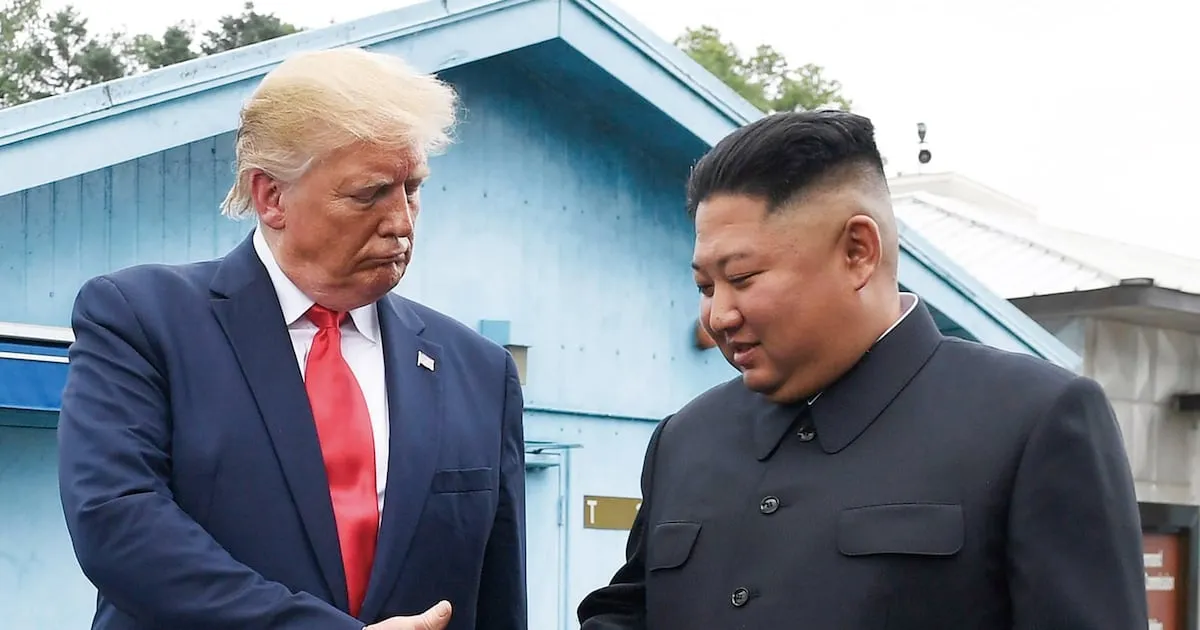
Speculation regarding a potential summit between U.S. President Donald Trump and North Korean Chairman Kim Jong Un has resurfaced, with analysts proposing new potential timelines. Victor Cha, a Korea Chair at the Center for Strategic and International Studies (CSIS) and a prominent U.S. expert on Korean Peninsula affairs, has put forth scenarios for such a meeting. Previously, in April, Cha had estimated a greater than 50% chance of a Trump-Kim summit following Trump’s visit to China in May. However, that meeting did not materialize.
Shifting Summit Timelines and Strategic Motivations
Cha’s latest analysis suggests a new potential window for a North Korea-U.S. summit: after the U.S. midterm elections in November. In an analysis posted on the CSIS website titled ‘Trump-Kim Summit Relaunch Scenario,’ Cha posits that Chairman Kim might pursue a meeting with President Trump if he adopts a ‘revisionist’ strategy rather than maintaining the status quo. This perspective hinges on the idea that Kim Jong Un would proactively seek new opportunities to solidify North Korea’s status as a nuclear-armed state.
Cha specifically identifies the period ‘potentially after the ruling party’s defeat in the U.S. midterm elections’ as a possible timing. He suggests that a summit could lead to a reaffirmation of the basic principles of the 2018 Singapore Joint Statement. Following this, detailed denuclearization issues could be delegated to working-level officials, allowing discussions on peace treaties, suspension of U.S.-South Korea joint military drills, and the end of hostile relations.
Furthermore, Cha raised the possibility that Kim Jong Un might leverage President Trump’s interest in a Nobel Peace Prize to seek tacit U.S. recognition of North Korea’s nuclear-armed status. However, this analysis is presented as a conditional scenario, dependent on various factors rather than concrete diplomatic moves or specific North Korean outreach efforts observed to date.
Conditional Scenarios and Expert Observations
Cha’s analysis repeatedly uses conditional phrasing, such as ‘if Kim Jong Un is revisionist,’ ‘could,’ and ‘possibility.’ He also framed China’s potential support for resuming North Korea-U.S. dialogue as a speculative point, stating it would ‘not be surprising if it happened.’ This follows earlier, more definitive predictions from Cha regarding summit possibilities.
Just a few months prior, at the ‘2026 Asan Platform’ press conference in Seoul in April, Cha had stated, ‘I believe there is a greater than 50% chance that President Trump will meet Chairman Kim after President Trump meets President Xi Jinping of China.’ His reasoning at the time was based on President Trump’s rhetoric. Cha noted that Trump and his administration were generally restraining their remarks about North Korea, contrasting their silence on Pyongyang with their direct responses concerning China, Russia, and Iran.
‘President Trump seems to view North Korea as a different category from China, Russia, and Iran,’ Cha observed. ‘Whether this is because he likes Chairman Kim or because North Korea already possesses nuclear weapons, it seems he is classifying North Korea separately and attempting to establish a certain level of dialogue with Chairman Kim.’ Based on this, Cha concluded, ‘President Trump definitely has the will to pursue dialogue (with North Korea), and ultimately, it will happen.’ He had previously identified the period of Trump’s state visit to China in May as a ‘practical opportunity.’
Although President Trump met with President Xi Jinping in Beijing on May 14-15, no concrete steps to support the Trump-Kim summit that Cha had predicted with over 50% probability have been publicly disclosed. Fred Fleitz, a former Chief of Staff to the Vice President under the Trump administration and a Senior Vice President at the America First Policy Institute (AFPI), also attended the April press conference with Cha. Fleitz echoed the sentiment, stating, ‘President Trump has repeatedly said he wants to restart the successful personal diplomacy of his first term.’ He added, ‘Although he is busy with issues like Iran right now, he will want to have dialogue with North Korea.’
Fleitz had also suggested the possibility of a ‘fall North Korea-U.S. summit,’ noting that during the U.S.-China summit scheduled for the following month (May), ‘President Trump could ask President Xi Jinping for his opinion.’
Challenges and Alternative Interpretations
While there is still time until the autumn, concrete actions supporting a summit have not yet emerged. Fleitz, due to his background as a former NSC staffer during Trump’s first term, is often introduced as being ‘close to Trump.’ However, he has also consistently engaged with figures in South Korea’s political spectrum who hold views critical of the current administration. He previously appeared alongside Professor Koo Tae-wan, who was investigated for allegedly fabricating evidence regarding Lee Jae-myung’s presidential candidacy, at a seminar on South Korean political issues in Washington D.C. in February of last year. Fleitz has been active within the same network as domestic critics such as former Prime Minister Hwang Kyo-ahn and former lawmaker Min Kyung-wook.
Some observers caution against ‘U.S.-centric analysis,’ particularly when analyzing countries with heavily restricted internal information, such as North Korea. This approach, which prioritizes interpreting U.S. political statements and actions to infer North Korea’s choices, risks overestimating Pyongyang’s actual intentions or misinterpreting internal dynamics, leading to significant errors in judgment.
