

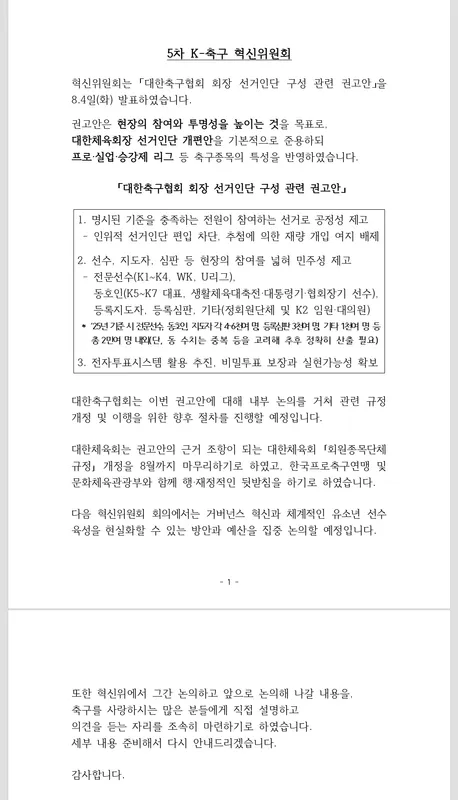
A significant reform proposal has been unveiled for the election of the Korea Football Association (KFA) president, suggesting an expanded electorate of approximately 20,000 individuals. This proposal, put forth by the KFA’s 5th Reform Committee, aims to enhance the democratic process and inclusivity in selecting the head of South Korean football.
Expanding the Electorate: A Move Towards Greater Democracy
The Reform Committee, following an extensive deliberation, presented a detailed plan to broaden the base of eligible voters for the KFA presidential election. The core of the proposal is to move away from a system perceived as potentially exclusive or based on arbitrary selection, and instead, to increase the representation of those actively involved in the sport at various levels. This includes professional players, amateur participants, coaches, and referees.
The committee’s recommendations are largely based on the framework of the Korean Sport & Olympic Committee’s (KSOC) revised election system. However, the KFA’s specific proposal incorporates the unique characteristics of different football tiers, from professional leagues to amateur and corporate leagues. The objective is to ensure that the election reflects the will of a wider football community, emphasizing transparency and participation.
Composition of the Proposed Electorate
Under the proposed structure, the electorate is envisioned to comprise around 20,000 members by 2025. This figure is broken down into several key categories:
- Professional Players: Approximately 4,000 to 6,000 individuals, encompassing players from professional leagues (K1-K4, WK League) and potentially those in elevated amateur or semi-professional divisions.
- Amateur Participants: A significant segment, also estimated between 4,000 and 6,000 individuals. This group includes representatives from K5-K7 league representative teams, as well as participants in the Presidential Cup, the National Football Championship, and the FA Cup.
- Registered Coaches: An estimated 4,000 to 6,000 registered coaches are expected to be part of the electorate.
- Registered Referees: Around 3,000 registered referees are proposed to have voting rights.
- Other Members: Approximately 1,000 individuals, including executives from K League 1 and K League 2, and members of the General Assembly.
It is acknowledged that the total number of unique voters might be slightly less than 20,000 due to potential overlaps, such as referees or coaches who might also be registered as amateur participants or have dual roles. The committee stressed that the primary goal is to ensure a higher proportion of on-site participants and to prevent arbitrary or lottery-based inclusions.
Enhancing Election Integrity
Recognizing the scale of the proposed electorate, the Reform Committee also plans to explore the implementation of an electronic voting system. This move is intended to streamline the voting process and enhance security. Furthermore, measures to ensure the confidentiality of votes will be considered to maintain the integrity of the election.
The KFA plans to conduct internal discussions regarding this proposal. Following these deliberations, the association will proceed with the necessary revisions to its regulations and establish a clear roadmap for implementation. The foundation for these changes lies in amending the KFA’s membership regulations, a process expected to be completed by August. This will be undertaken in collaboration with the Korea Professional Football League (K League) and the Ministry of Culture, Sports and Tourism, ensuring administrative and financial support.
Future Reform Agenda
Looking ahead, the Reform Committee has outlined its agenda for future meetings. Key topics will include governance reforms and the establishment of a systematic approach to nurturing talented players throughout their careers, ensuring long-term development for Korean football. The committee also intends to actively communicate the progress and outcomes of its discussions to the broader football community, seeking direct feedback and engagement through organized forums.
This comprehensive reform initiative signifies a commitment to modernizing the KFA’s electoral processes and fostering a more inclusive and representative governance structure. By expanding the electorate and focusing on the integrity of the voting system, the committee aims to strengthen the foundation of Korean football for years to come.
