

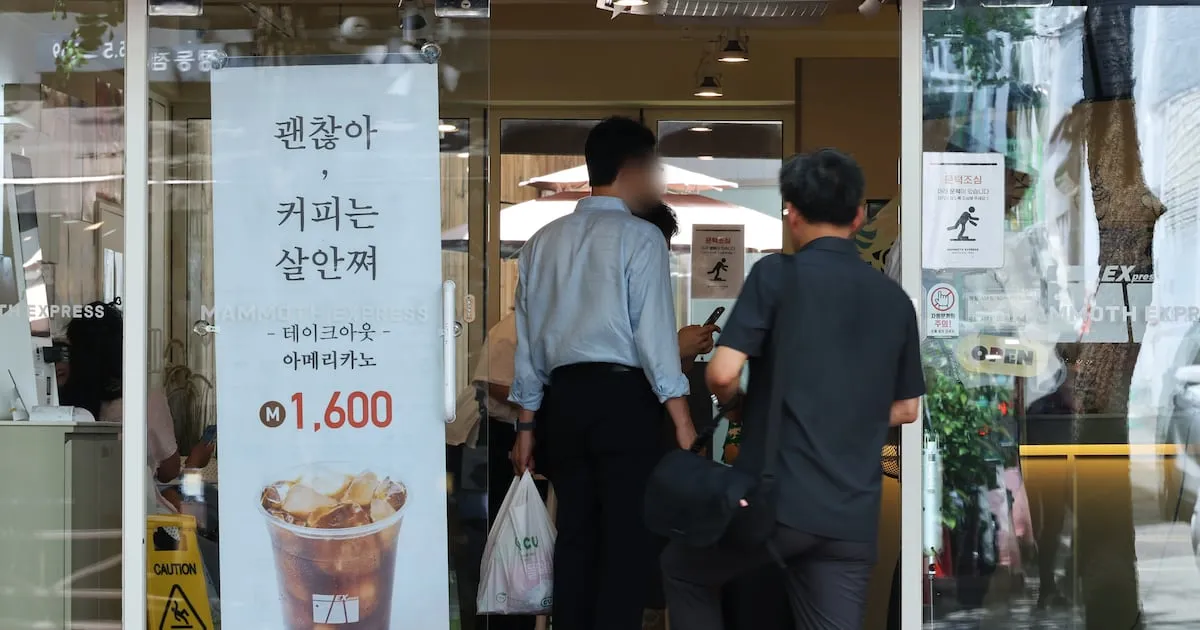
Several budget-friendly coffee brands, long known for their low prices, are now increasing their prices. This shift is attributed to a simultaneous rise in the cost of raw materials like coffee beans, labor, and general operating expenses, making it increasingly difficult for these brands to maintain their existing price points.
Major Price Adjustments Across Brands
The coffee franchise industry is seeing significant price hikes. For instance, Mega Coffee announced that starting November 11th, prices for certain iced coffee products, including iced Americano and decaffeinated iced Americano, will increase by 200 won. The small (S) size of iced Americano will see a 16.7% rise, from 1,200 won to 1,400 won. The medium (M) size will also increase by 12.5%, from 1,600 won to 1,800 won. For iced decaffeinated Americano, the small size will be adjusted from 1,900 won to 2,100 won (a 10.5% increase), and the medium size from 2,300 won to 2,500 won (an 8.7% increase). However, prices for hot Americano and large (L) size iced and hot Americano will remain unchanged.
Mega Coffee had previously raised prices on three of its beverages by 200 won each in June. The company cited rising raw material costs and increasing profitability burdens for franchisees as the reasons for these adjustments. In May, Thevenity increased prices on most of its coffee and beverage items, excluding Americano, by 100 to 500 won. Barnafresso also adjusted prices for its decaffeinated and cold brew products in March. Similarly, in the same month, Brusda Coffee modified prices for some beverages, including Americano, Cafe Latte, and Vanilla Latte. Backdabang increased prices for key menu items like Cafe Mocha and its iced version in February.
Historical Price Stagnation and New Pressures
For an extended period, budget coffee brands have been hesitant to implement price increases. Given that product price significantly influences brand selection, both the parent companies and franchisees have historically absorbed the impact of rising costs. However, with the sustained accumulation of cost pressures, an increasing number of brands are now opting to raise prices, particularly for select products.
Factors Driving the Price Hikes
Industry experts point to a confluence of factors as the primary drivers behind these price adjustments. These include the rise in international coffee bean prices, fluctuating exchange rates, increased costs for various materials, and escalating labor expenses.
Coffee Bean Price Surge
Data from the Korea Agro-Fisheries & Food Trade Corporation (aT) Food Industry Statistics Service reveals a significant increase in coffee bean prices. Between April 28 and July 28, the average price of Arabica coffee beans rose by 15.25%, from $6,492.07 per ton to $7,482.41 per ton. Robusta coffee beans also saw a price increase of 5.33% during the same period, climbing from $3,680.67 per ton to $3,877 per ton.
Labor Costs and Minimum Wage Increases
The burden of labor costs is also expected to expand. The minimum wage for 2027 has been set at 10,700 won per hour, a 3.7% increase from the current year. Budget coffee brands, which often have a high proportion of franchisees, are likely to experience increased operating costs at their outlets due to these minimum wage hikes.
Overall Inflationary Environment
Beyond specific commodity and labor costs, a broader inflationary environment is contributing to the need for price adjustments. Rising costs for rent, utilities, and other operational necessities further squeeze profit margins, compelling businesses to re-evaluate their pricing strategies to ensure sustainability.
Future Outlook
The trend of price increases among affordable coffee brands is likely to continue as long as these cost pressures persist. Consumers may need to adjust their expectations regarding the price of budget-friendly coffee, as brands work to balance affordability with the realities of rising operational expenses. The long-term impact on consumer behavior and brand loyalty remains to be seen as the market adapts to these changes.
