

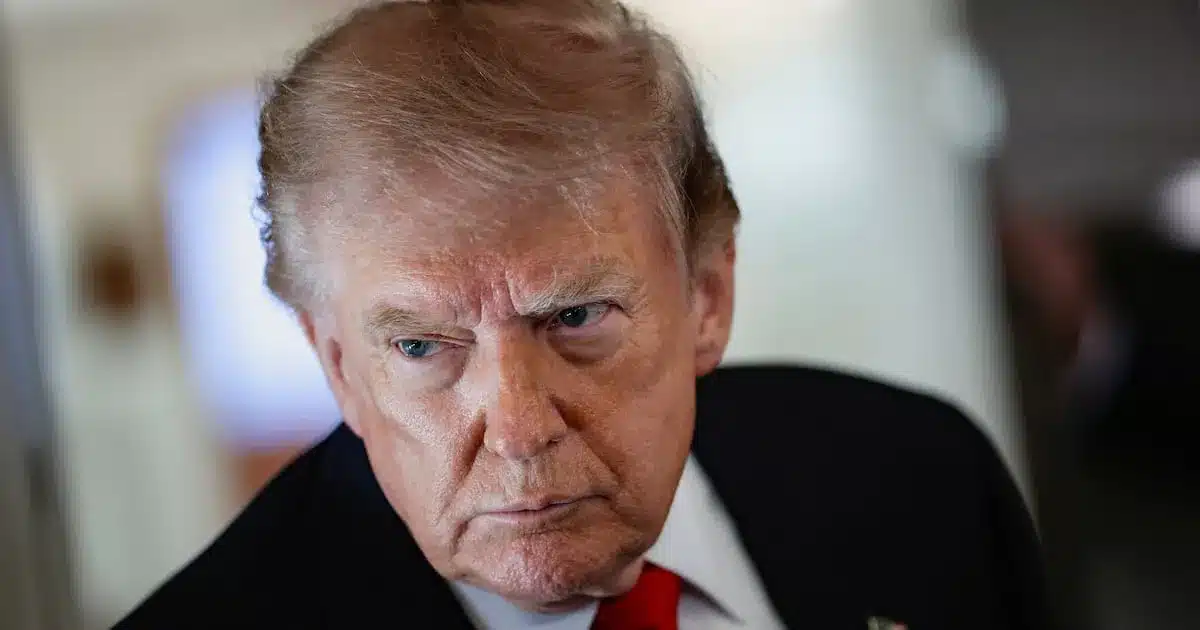
President Donald Trump has stated that Iran’s leadership has been seeking negotiations, but warned of a potentially severe military response if those talks do not yield an agreement. Speaking to reporters aboard Air Force One en route to a visit in Mississippi, Trump indicated that Iran’s desire for dialogue stems from intense pressure exerted by the United States.
Iran Negotiations and Potential Military Escalation
Trump expressed optimism about the prospects for progress in the discussions, suggesting that Iran possesses considerable patience and that a breakthrough is possible. “They want to negotiate because they’re being squeezed very hard,” Trump remarked. He added, “I think they have a lot of patience. I think they want to make a deal. If they don’t make a deal, we’ll be doing what we were doing for the last couple of weeks.”
The U.S. had been engaged in an escalating series of actions against Iran, which were reportedly paused on June 24th. The ultimate outcome of these recent exchanges and whether they will lead to a meaningful de-escalation and peace talks remains uncertain.
Trump also addressed reports suggesting that the U.S. had halted military actions against Iran due to concerns about the depletion of military supplies and the potential for escalation. While acknowledging a desire to maintain a robust military presence, he asserted that the U.S. possesses ample munitions for any situation, despite significant aid provided to Ukraine. “Frankly, we want to have more, but we’ve given so much to Ukraine,” Trump said, while also assuring that the U.S. has “far more than we need” in terms of ammunition.
Dual Diplomacy and Defense Concerns
In a separate interview made public on the same day, Trump reiterated his stance, stating, “We are in very serious negotiations.” He reiterated the threat of a “very strong military action” if the negotiations fail to produce results. Regarding the urgency for a diplomatic resolution, Trump emphasized that “time is running out,” underscoring the critical nature of the current situation.
Meeting with Israeli Prime Minister Netanyahu
Attention is also focusing on an upcoming meeting at the White House on June 28th between President Trump and Israeli Prime Minister Benjamin Netanyahu. This meeting occurs amidst growing concerns about the potential for military action and diplomatic fallout, particularly regarding Iran’s nuclear program and regional influence.
Trump conveyed to Netanyahu that had he not been president, Iran would likely have developed nuclear weapons by now, posing an existential threat to Israel. This meeting marks Netanyahu’s first visit to the White House since the current tensions with Iran began in February.
Netanyahu’s office highlighted the significance of the meeting, noting it as the eighth encounter between the leaders of the two nations since Trump took office. The Prime Minister’s office stated that Iran would be a “top priority” among the various issues to be discussed.
Regional Security and Nuclear Proliferation
Concerns have been raised in Israel regarding a recent nuclear energy agreement between the U.S. and Saudi Arabia, with some fearing it could spur a nuclear arms race and military competition in the Middle East. When asked if Saudi Arabia had signaled its intention to sign the ‘Abraham Accords,’ Trump stated that the matter had not yet been discussed. The Abraham Accords, a U.S.-backed initiative since Trump’s first term, aim to normalize relations between Israel and Arab nations.
Trump indicated that Saudi Arabia’s participation in the Abraham Accords would be a prerequisite for the final approval of the nuclear energy agreement. This linkage underscores the administration’s broader strategy for Middle East diplomacy.
Artificial Intelligence and Intellectual Property Concerns
In a separate development, President Trump addressed concerns about Chinese companies engaging in “adversarial distillation” – the practice of extracting intellectual property from U.S. artificial intelligence models. Trump characterized the situation as a competitive one, stating, “They are taking our stuff, and we are taking their stuff.” He expressed confidence in the U.S. position, asserting, “We are winning in AI, and we will continue to win.”
This issue is expected to be a significant point of discussion when Chinese President Xi Jinping is scheduled to visit Washington D.C. in September, provided the visit proceeds as planned.
