

In the aftermath of a dramatic World Cup qualifier loss, Argentina’s head coach, Lionel Scaloni, has drawn significant attention for his post-match comments, describing the team’s performance as a “great example of a great defeat.” This statement comes amidst controversy surrounding the conduct of his players immediately following the final whistle.
Match Summary and Argentina’s Performance
Argentina faced Spain on September 20th (KST) in a crucial 2026 FIFA World Cup qualifier. The match concluded with Argentina succumbing to a 0-1 defeat after extra time. The defending champions struggled offensively throughout the regulation 90 minutes, failing to register a single shot on target. The situation worsened in the second half of extra time when forward Enso Fernandez received a red card, leaving Argentina to play with ten men.
The decisive goal came late in extra time from Ferran Torres, sealing Argentina’s fate and relegating them to the runner-up position in the qualifier. Despite the loss, Scaloni expressed gratitude towards his players.
Scaloni’s Post-Match Remarks
Speaking to ‘TyC Sports’ after the game, Scaloni acknowledged the disappointment but focused on his team’s effort. “It’s sad, but we gave everything. I send eternal thanks to the players who competed again to reach the final,” he stated, commending their commitment.
His most striking comment came when he declared, “Just as we must be great in victory, we must also be great in defeat. The way the players left everything on the field today was a magnificent example for our people and our country.” He emphasized, “We proved today that we know how to lose.”
Controversy Erupts Over Player Conduct
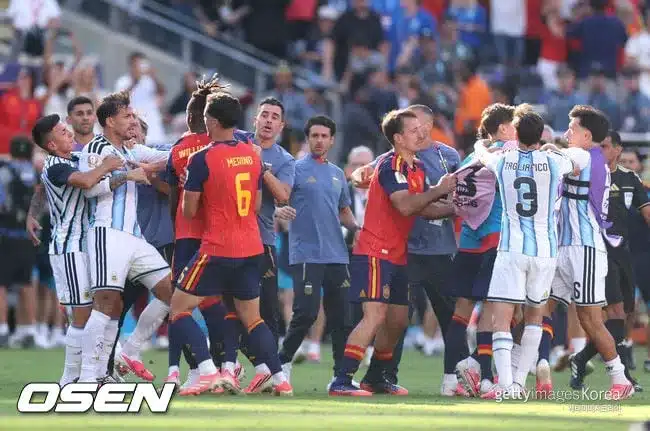
However, Scaloni’s assertion of a “model defeat” was met with widespread disbelief and criticism from football fans worldwide who witnessed the match. The actions of the Argentine players immediately after the referee’s final whistle starkly contrasted with the coach’s narrative of dignified loss. Instead of a display of sportsmanship, the pitch quickly devolved into chaos.
As soon as the defeat was confirmed, several Argentine players initiated a physical altercation with their Spanish counterparts. Shocking footage captured defender Nahuel Molina throwing punches towards Spain’s captain, Rodri. In another aggressive incident, Leandro Paredes was seen choking Spain’s young midfielder Pablo Gavi before shoving him to the ground. These violent actions transformed the pitch into a scene of pandemonium within moments.
Specific Incidents of Altercation
- Defender Nahuel Molina engaged in a physical confrontation, throwing punches at Spanish captain Rodri.
- Midfielder Leandro Paredes was seen aggressively grabbing and choking Gavi, a young Spanish player, before pushing him down.
- The immediate post-match period saw widespread pushing and shoving between players from both teams.
Spanish Coach’s Perspective
In contrast to Scaloni’s interpretation, Spain’s head coach, Luis de la Fuente, praised his team’s resilience and sportsmanship. “The journey with this generation of players has been a privilege. Our players have been a true example for Spanish sports and for young people,” he remarked.
De la Fuente also highlighted the exceptional performance of Argentina’s goalkeeper, Emiliano Martinez, whose crucial saves prevented an earlier victory for Spain. “We couldn’t decide the victory earlier due to Emiliano Martinez’s brilliant saves, and we had to endure suffering even against ten men. But we were ready to embrace that suffering,” he added, expressing satisfaction with his team’s hard-fought and clean victory.
Conclusion: A Tale of Two Narratives
The stark divergence between Lionel Scaloni’s portrayal of his team’s conduct and the actual events on the field has ignited a significant debate. While Scaloni sought to frame the loss as a learning experience and a model of how to handle defeat, the aggressive and unsportsmanlike behavior exhibited by several Argentine players overshadowed his message. The incident raises questions about player discipline and the interpretation of sportsmanship in high-stakes international football competitions.
