

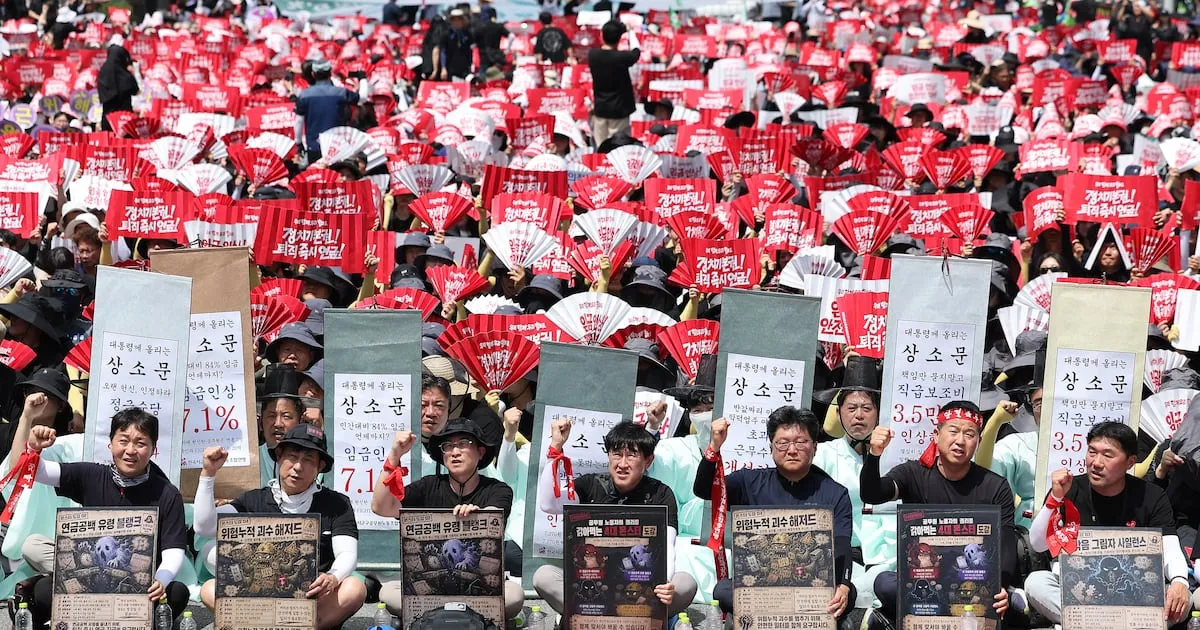
Thousands of public servants and teachers rallied in Seoul on July 11th, demanding significant improvements to their wages and working conditions. The demonstration, held under sweltering heat, highlighted growing discontent among government employees and educators regarding stagnant pay and increasing workloads.
Mass Demonstration for Better Compensation
Organized by the Joint Council for Public Servant and Teacher Livelihood Restoration, the large-scale urban rally saw an estimated 14,000 participants. The coalition includes major labor unions such as the National Public Officials’ Union (Jeonggongno), the Federation of Public Officials’ Unions of the Republic of Korea (Gongnochoong), and the National Teachers’ Union (Jeogyojo).
Braving the intense summer heat, attendees carried signs with slogans like “Stagnant wages are eating away at our lives,” “Public servants are also citizens, protect our political rights,” and “Retirement pension immediately.” They chanted calls for the protection of public servants’ livelihoods.
Calls for a 7.1% Wage Increase
Lee Hae-jun, Chairperson of Jeonggongno, addressed the crowd, offering words of comfort to colleagues who suffered injuries and hardships during recent local election duties. “We will fight to change the election system that unilaterally imposes responsibility and suffering on public servants,” Lee stated. He emphasized the historical role of public servants in times of national crisis, asserting, “When the nation is in danger, it is always our public servants who step forward first.” Lee urged a united effort to achieve a 7.1% public servant wage increase by 2027, vowing to fight until the end.
Concerns Over Low Wages and Heavy Workloads
Kim Woo-jeong, interim head of the Gongnochoong’s emergency committee, recounted past experiences, questioning the fairness of compensation. “During past elections, we were forcibly mobilized for election duties, burdened with all sorts of election-related tasks, and compensated with meager allowances that barely covered basic needs,” Kim recalled. He pointed out the stark contrast between public servant salaries and the cost of living, noting that apartment prices in neighboring cities reach 600 million won. “Even if you meticulously save your entire monthly salary, it would take over 17 years to afford such housing,” he added.
The Joint Council stressed that the current low-wage structure and excessive workload are leading to a decline in the quality of new recruits and an increase in resignations. They emphasized the necessity of realistic solutions, including salary increases and the implementation of various support systems starting next year.
Specific Demands and Teacher Welfare
Further demands raised during the rally included the abolition of the public servant pension fund’s income sharing system and the extension of the retirement age. There were also calls for improved teacher welfare and better working conditions for educators.
Park Young-hwan, Chairperson of Jeogyojo, referenced the popular drama “Diary of a Prosecutor,” which depicted the realities of the legal profession. “While no one would agree with violent resolutions, it is undeniable that the current situation is at a breaking point,” Park stated. He urged for swift resolution of issues concerning malicious complaints from citizens and the mistreatment of students, emphasizing the need to address these challenges that impact the teaching profession.
Broader Implications for Public Service
The demonstration underscores a growing national conversation about the value and compensation of public service. As economic pressures mount and the cost of living rises, public servants and educators are increasingly vocal about their need for fair remuneration and improved working environments. The unions are advocating for systemic changes that recognize the essential contributions of these professionals to society and ensure their livelihoods are sustainable.
The demands extend beyond mere salary adjustments, touching upon fundamental aspects of job security, retirement benefits, and the overall respect accorded to public servants and teachers. The unions are committed to continued advocacy until their concerns are adequately addressed by the government, aiming to foster a more supportive and equitable system for those who serve the public.
