

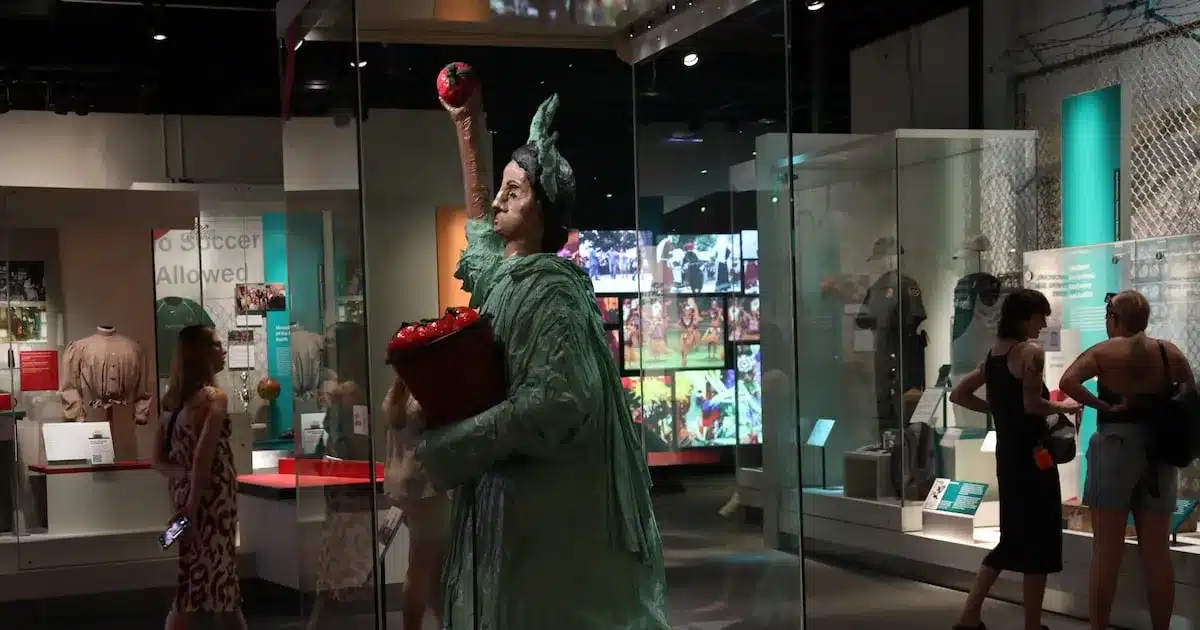
The Smithsonian Institution, America’s largest museum and research complex, is at the center of a controversy following a report accusing it of politically motivated distortions of U.S. history. The report, released by a group critical of the institution, alleges that the National Museum of American History, a part of the Smithsonian, is engaging in “extreme political activism” and attempting to erase American heritage. This has sparked a debate within academia and among historians, with many pushing back against the report’s claims.
Report Alleges Political Agenda at National Museum of American History
The 162-page report, titled “Saving America’s Story,” was released on October 5th (local time). It contends that the leadership of the National Museum of American History views American history not as a shared national inheritance but as a political tool to divide citizens and undermine national pride. The report specifically criticizes the museum’s narrative, stating that it “focuses on regret, infamy, and shame rather than the triumph of freedom and the greatness of the nation.”
This report was commissioned following an executive order issued by President Donald Trump in March of the previous year. The order directed the Smithsonian to remove “improper ideology” from its institutions. The report singles out the museum’s director, Dr. Lonnie G. Bunch III, for criticism, noting his frequent appearance in the report and accusing the museum of incorporating a progressive historical perspective into its exhibits.
Furthermore, the report argues that the museum has failed to organize comprehensive exhibits commemorating key aspects of American history, such as the nation’s founding, the Revolutionary War, the Declaration of Independence, and the drafting of the Constitution, even as the nation approached its 250th anniversary of independence. The authors of the report assert that the museum is “refusing to commemorate the nation and its history.”
Smithsonian and Historians Defend Institution’s Role
In response to the accusations, the Smithsonian Institution issued a statement defending its long-standing mission. A spokesperson stated, “For over 180 years, we have served the American people through rigorous and independent research, and we will continue to uphold that principle.”
The Organization of American Historians (OAH) also refuted the report’s claims, with its executive director, Dr. Lee Formwalt, explaining that the National Museum of American History already operates exhibits covering artifacts and figures related to the American Revolution and the leadership of George Washington. He noted that the museum has been presenting exhibits on the pre-war period and the Revolution for some time.
According to The Washington Post, the museum opened a special exhibition in May titled “In Pursuit of Life, Liberty & Happiness,” featuring 250 artifacts. These include the desk used by Thomas Jefferson when he drafted the Declaration of Independence and an 1813 flag that inspired the national anthem, “The Star-Spangled Banner.”
Scholarly Community Critiques the Report’s Premise
The broader historical community has largely rejected the report’s findings. Dr. Lauren Kessler, Executive Director of the OAH, stated, “The real problem with the report is not that the museum presents false information, but that it does not sufficiently praise America.” She elaborated, “While it appears to call for balance, it ultimately demands the imposition of a single historical interpretation.”
Philip Kennicott, a cultural critic for The Washington Post, also addressed the report in a column published on the same day. Kennicott argued that rather than demonstrating political bias at the Smithsonian, the report actually highlighted the museum’s role in presenting American history from diverse perspectives. He criticized the report for selectively presenting exhibit information or omitting context to portray American history negatively. Kennicott concluded that the report represents an attempt to force historical facts into a single national narrative.
Conclusion: A Debate on Historical Interpretation
The controversy underscores a fundamental tension in how national history should be presented and interpreted. While the report advocates for a more celebratory and unified national narrative, the Smithsonian and many historians argue for a more comprehensive and critical examination of the past, acknowledging both triumphs and failures. The ongoing debate centers on the role of museums in shaping public understanding of history and the balance between national pride and historical accuracy.
