

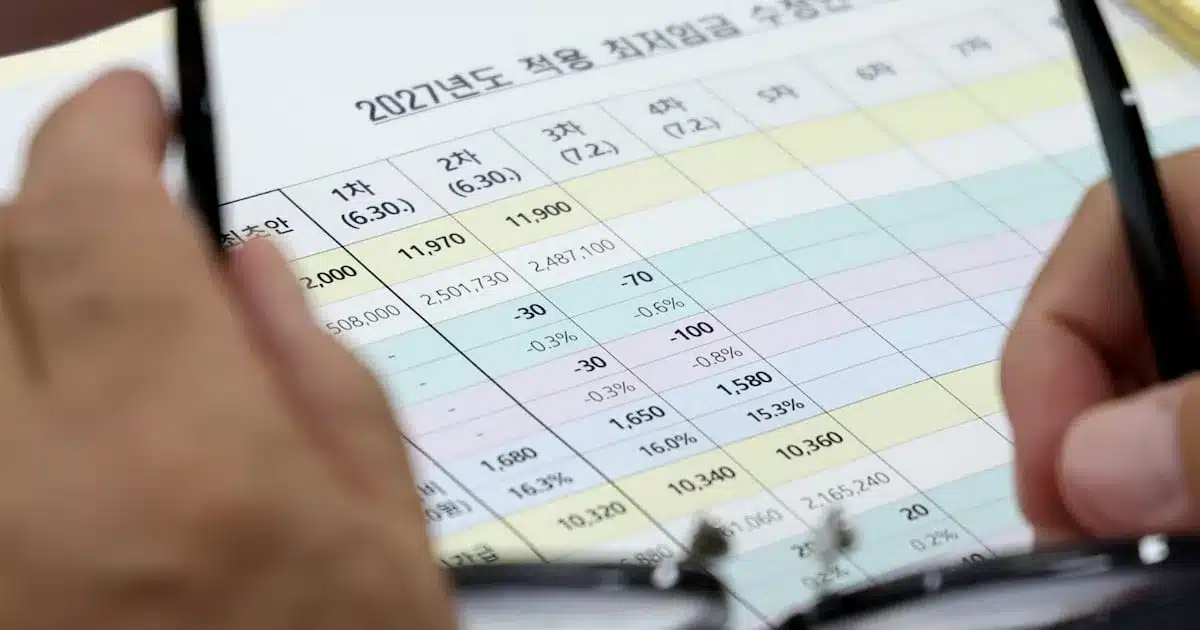
Negotiations for South Korea’s minimum wage for 2025 are intensifying as labor and management representatives have submitted revised proposals, narrowing the gap between their initial demands. The latest offers, presented during the 11th plenary session of the Minimum Wage Commission on July 2nd, propose hourly rates of 11,800 won for labor and 10,390 won for management. These figures represent a slight adjustment from previous proposals, with labor lowering its request by 100 won and management increasing its offer by 30 won.
Understanding the Minimum Wage Commission
The Minimum Wage Commission, a tripartite body comprising representatives from labor, management, and public interest members, is responsible for determining the national minimum wage each year. The commission consists of 27 members: nine representing workers, nine representing employers, and nine public interest members. Their deliberations form the basis for the government’s final decision.
The process involves extensive discussions and negotiations between the labor and management factions. The government, typically through the Ministry of Employment and Labor, is mandated to announce the finalized minimum wage for the following year by August 5th each year, based on the commission’s recommendations.
Evolution of the 2025 Minimum Wage Proposals
The journey towards a consensus for the 2025 minimum wage has seen several rounds of proposals and counter-proposals. In a previous session held on June 30th, the labor sector initially demanded an hourly wage of 11,900 won. Conversely, the management side proposed 10,360 won per hour. This initial gap of 1,540 won per hour indicated a significant divergence in expectations.
Following the June 30th meeting, the commission managed to reduce the difference between the two sides’ proposals to 1,410 won. The subsequent submission of the third revised proposals on July 2nd—11,800 won from labor and 10,390 won from management—further narrowed this gap to 1,410 won. This incremental reduction in the disparity signals a move towards finding common ground, although a substantial difference still remains.
Labor’s Perspective and Adjustments
The labor sector’s revised proposal of 11,800 won per hour reflects a strategic adjustment aimed at facilitating a compromise. This figure is 100 won lower than their initial demand of 11,900 won. Labor unions typically advocate for higher minimum wages, citing the need to ensure a decent standard of living for workers, combat poverty, and stimulate domestic consumption. They often point to rising inflation, increased cost of living, and the need for wages to keep pace with productivity gains as key justifications for their demands.
The slight reduction in their demand might be interpreted as a willingness to meet management halfway, acknowledging the economic pressures faced by businesses. However, the proposed 11,800 won still represents a significant increase from the current minimum wage, reflecting their ongoing commitment to improving workers’ financial well-being.
Management’s Position and Considerations
On the other side, the management’s adjusted proposal of 10,390 won per hour is a modest increase of 30 won from their earlier offer of 10,360 won. Business groups, including small and medium-sized enterprises (SMEs) and self-employed individuals, often express concerns about the impact of rising labor costs on their profitability and competitiveness. They frequently argue that excessively high minimum wages can lead to increased operational expenses, potentially resulting in reduced hiring, job cuts, or price increases for consumers.
The management’s upward adjustment, though small, could be seen as a gesture towards compromise. However, their proposal remains substantially lower than labor’s demand, indicating persistent concerns about the economic feasibility of a higher minimum wage. Their arguments often center on the need to maintain business viability, especially in sectors with thin profit margins, and the potential negative employment effects of significant wage hikes.
The Path Forward: Bridging the Remaining Gap
With the gap between labor and management proposals reduced but still significant, the Minimum Wage Commission faces the critical task of bridging the remaining difference. The commission is expected to hold further deliberations to reach a consensus that balances the needs of workers with the economic realities faced by employers.
The government’s role is crucial in this process. While the commission negotiates, the final decision rests with the administration, which must consider the commission’s recommendations alongside broader economic conditions, including inflation rates, employment levels, and overall economic growth. The August 5th deadline looms, adding urgency to the ongoing discussions.
The outcome of these negotiations will have a direct impact on millions of workers and businesses across South Korea. A compromise that is perceived as fair by both sides is essential for maintaining industrial peace and fostering a stable economic environment. The coming weeks will be pivotal as the commission strives to finalize a minimum wage for 2025 that reflects a balanced approach to economic growth and social equity.
Factors Influencing the Decision
Several key economic indicators and social considerations will likely influence the final decision:
- Inflation and Cost of Living: The current rate of inflation and the rising cost of essential goods and services are major factors pushing for a higher minimum wage to maintain workers’ purchasing power.
- Economic Growth Prospects: The projected economic growth rate for the upcoming year will influence the government’s and management’s willingness to absorb higher labor costs. A robust economy might allow for a more significant wage increase.
- Employment Data: Trends in employment and unemployment rates are closely watched. Concerns about potential job losses due to increased labor costs can temper demands for sharp wage hikes.
- Productivity Gains: Arguments are often made linking minimum wage increases to improvements in worker productivity and morale.
- International Comparisons: The minimum wage levels in comparable economies may also be considered.
As the deadline approaches, the public and stakeholders will be closely observing the commission’s efforts to reconcile the differing viewpoints and arrive at a decision that supports both economic vitality and the welfare of the nation’s workforce.
