

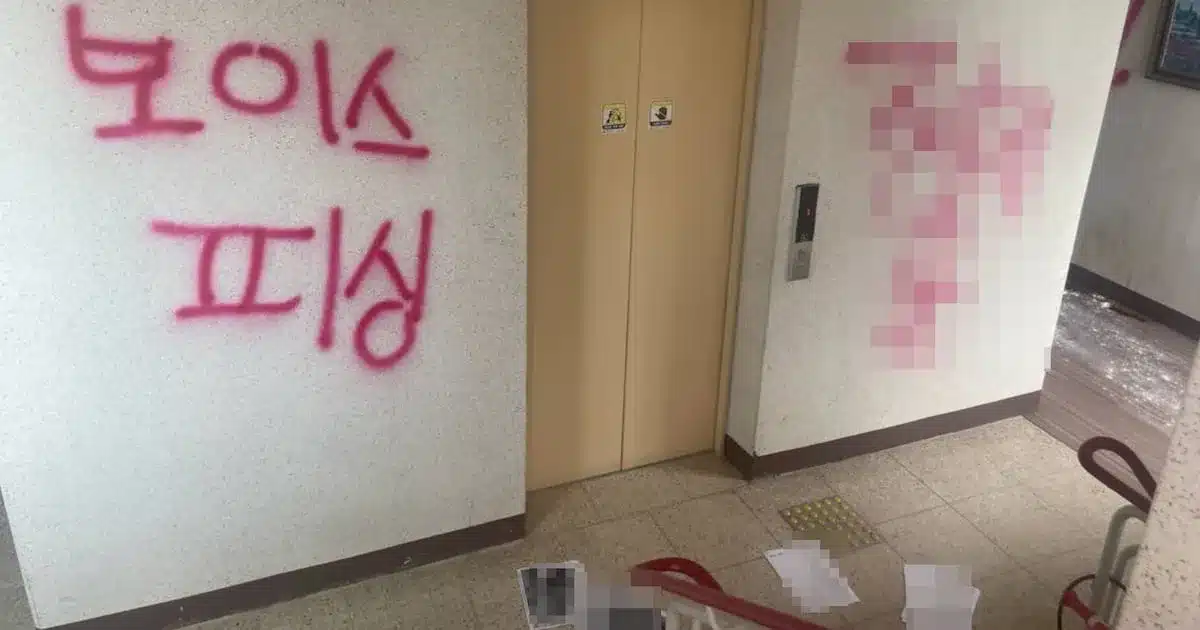
Organized Groups Offer Services From Property Vandalism to Online Defamation
A disturbing trend of organized vandalism is sweeping across the nation, with groups operating through encrypted messaging apps like Telegram offering a menu of illicit services. These operations, often referred to as ‘revenge for hire’ or ‘vandalism for hire,’ are charging significant sums for acts ranging from property defacement to online harassment.
Escalating Criminal Activities Across Multiple Cities
In a recent incident in Incheon, two men in their 20s were apprehended for vandalizing an apartment complex. They allegedly glued the front door’s doorbell, spray-painted the building’s facade with red lacquer, and scattered papers containing false accusations of criminal activity on the ground. These actions were reportedly carried out after receiving an offer of 4 million won for completing four such acts within a week.
These individuals, dubbed ‘special forces’ by their employers, are believed to have committed similar offenses in Asan (Chungnam), Bucheon (Gyeonggi), and Pyeongtaek (Gyeonggi). A judge at the Incheon District Court recently sentenced each of the two men to one year and six months in prison, along with an 8-million-won fine, for charges including joint property damage and joint property infringement.
A Sophisticated ‘Price List’ for Illicit Services
The phenomenon of ‘revenge for hire’ has seen a surge nationwide. These groups typically receive ‘revenge requests’ through platforms like Telegram. They then recruit individuals to carry out acts such as spraying graffiti on the victim’s residence or distributing leaflets containing false information. Similar incidents have recently occurred in various districts of Seoul, including Yangcheon, Guro, and Gangbuk, as well as in cities like Incheon, Daejeon, and Busan.
Authorities report that these vandalism crimes first surfaced in Daegu in August of last year. As of the 14th of this month, a total of 69 such incidents have been recorded nationwide. Law enforcement has arrested 50 individuals involved in operating and carrying out these acts, with 14 being formally detained.
Online Operations and ‘Service Menus’
These organizations actively promote their services on Telegram, claiming to resolve grievances for individuals facing issues such as alleged fraud, slander, account trading, or defamation. They market themselves as a means to privately settle disputes that are difficult to resolve through legal channels.
One such group even advertises a ‘revenge for hire menu.’ The price list includes services such as background checks for 1 million won, property terrorism involving graffiti and vandalism for over 1.5 million won, social media comment manipulation starting at 200,000 won, text message delivery at 3,000 won per message, and prank calls at 50,000 won each.
Links to Fraud and Gambling Operations Suspected
Law enforcement is investigating the strong possibility of connections between these ‘revenge for hire’ businesses and larger criminal enterprises involved in voice phishing and illegal online gambling. Officials believe these vandalism incidents may stem from conflicts between competing criminal organizations.
While President Lee Jae-myung has publicly condemned private revenge-for-hire schemes, stating on social media that “private revenge-for-hire is a serious crime for both the person requesting it and the person carrying it out,” these operations continue to advertise new recruits. Authorities are committed to intensifying investigations into the masterminds behind these organizations.
Wider Impact and Misidentification Concerns
The rise in ‘revenge for hire’ incidents has also led to cases where innocent individuals become victims. One group, arrested in April, is believed to have carried out 25 acts of vandalism between November last year and March of this year. Alarmingly, 11 of these incidents targeted the wrong addresses, affecting unintended victims.
Beyond private disputes, these ‘revenge for hire’ organizations are increasingly being implicated in illegal evictions by real estate companies and the intimidation of victims by voice phishing syndicates.
