

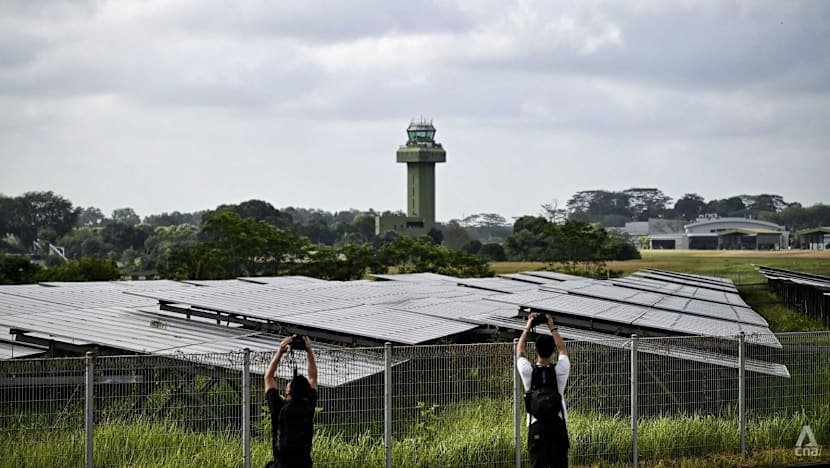
Singapore’s Ministry of Defence and Singapore Armed Forces have achieved a key milestone in sustainable energy with the completion of the nation’s inaugural solar farm at a military installation. The project at Sembawang Air Base was finalized in December, meeting the 50 megawatt-peak solar output goal established in 2021. During the launch on Friday, officials announced an ambitious new target of 68 megawatt-peak by the close of next year.
Advancing National Energy Resilience
Defence Minister Chan Chun Sing highlighted the initiative as a vital step in bolstering the country’s energy security. He described it as a demonstration model for broader applications, noting, “If we can address the safety, security, and technical hurdles to deploy solar panels in airfield sections, this approach could extend to additional air bases.”
The minister acknowledged that not every site would be suitable due to varying operational demands but praised the success at Sembawang as a significant accomplishment. Addressing skeptics who argue that even nationwide solar coverage would only fulfill a fraction of energy needs, Mr. Chan offered a positive perspective: “Every effort to diversify and fortify our energy sources matters, and we are committed to pursuing them all.”
Overcoming Airfield-Specific Obstacles
The concept originated several years ago as part of efforts to expand renewable energy and lessen dependence on fossil fuels. Airfields, alongside roads and cemeteries, were identified as potential sites for solar installations. However, Mr. Chan, drawing from his prior experience as Chief of Army, pointed out the inherent risks, including safety protocols and technical issues like panel glare impacting pilots.
Senior Lieutenant Colonel Koh Tong Choon, who leads planning and strategy at the SAF Sustainability Office, explained the rigorous assessments conducted. A detailed glare study determined optimal panel positioning, including height, orientation, and angle, with installations angled away from active flight zones to prevent distractions for aviators. Additionally, given the base’s role as home to all Republic of Singapore Air Force helicopter units, the setup accounted for helicopter downwash effects. Support structures were reinforced, with pillars embedded 20 percent deeper than standard to ensure durability.
Project Scale and Benefits
The solar farm accounts for three-quarters of the base’s planned 18 megawatt-peak capacity by year’s end, sufficient to supply electricity for approximately 4,700 four-room public housing units each year. Complementary rooftop panels will complete the setup, ultimately offsetting the facility’s full energy requirements and yielding annual savings of about S$1.9 million.
Future Strategies and Adaptations
Looking ahead, Mr. Chan emphasized designing future SAF systems for lower energy use, optimizing distribution across operations, and developing storage solutions. He also addressed climate change’s effects on military activities, stating that the forces must adapt to evolving conditions like erratic weather at bases such as Sembawang and intensified training under hotter, more variable temperatures.
Additional Sustainability Efforts
During the event, updates were shared on other green projects, including eco-friendly asphalt for runway maintenance exercises and an automated cleaning facility for Chinook helicopters. Air Force engineer ME1 Ng Jing Wei detailed the wash shed’s efficiencies: it allows one operator to handle the process, cutting manpower by 80 percent and time from five to three hours. The system incorporates water recycling for 60 percent savings and uses solar light tubes with efficient LED fixtures to reduce lighting energy by half.
