

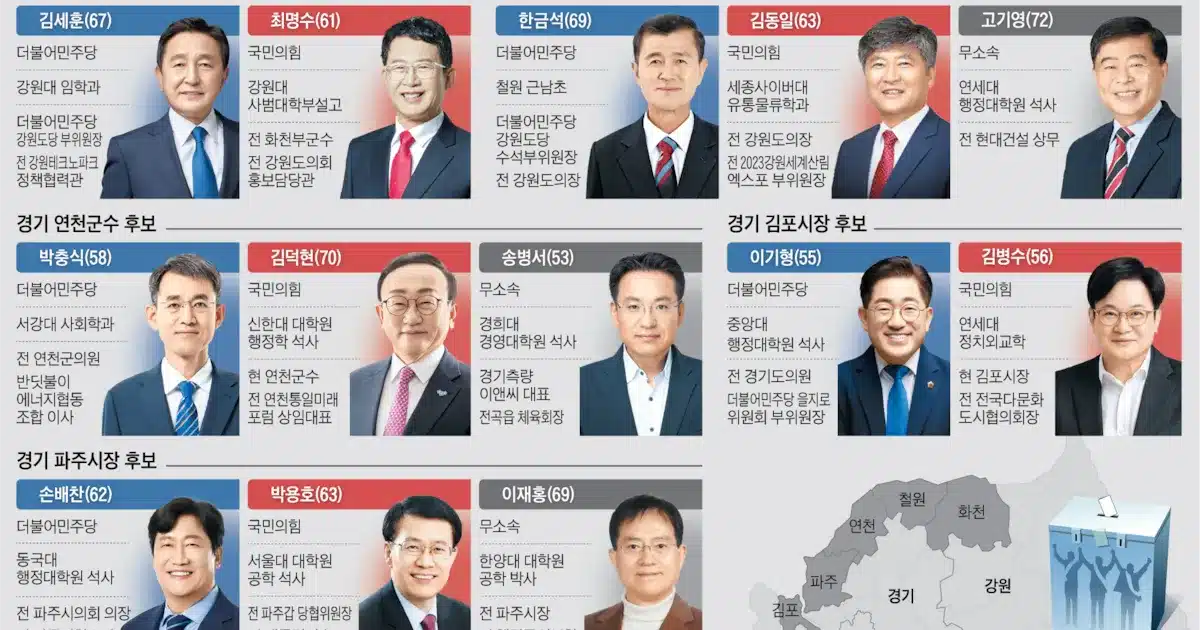
Frontline counties near the North Korean border, long considered conservative strongholds known as the ‘security belt,’ face growing challenges from severe depopulation. Recent analysis reveals that Hwacheon, Cheorwon, and Yeoncheon counties have seen massive outflows of residents due to their remote locations and national security burdens. With by-elections set for June 3, incumbents confront tight races as voters demand change.
Hwacheon County: Incumbent Leads but Pressure Mounts
Hwacheon County, which endured a North Korean rear raid in 1995, previously elected officials who prioritized national defense. Current polls show Democratic Party candidate Kim Se-hoon (67), the county deputy mayor, leading former county councilor Choi Jeon (61) with 63.6% to 33.1% support. The survey targeted 502 county residents with a ±4.4% margin of error.
Residents express frustration over depopulation. Kim Mo (58), a central committee member, stated, “The country used national security as an excuse to burden us, but that’s no longer acceptable.” Another resident, Jumin Yoon Mo (60), added, “Even government officials have moved to the cities—it’s time to vote for those who understand rural struggles.” Jeong Mo (66) from a rural township warned, “If Choi wins by 3,000 votes, it exposes Hwacheon’s vulnerabilities like Sancheong-Euchuk and Park Golf. Electing a Democratic incumbent will transform county governance dramatically.”
Cheorwon County: Neck-and-Neck Race
Cheorwon, which lost its county status in 2004 due to population decline, sees incumbent Han Jeon Do-jang (46.1%) slightly ahead of Kim Jeon Do-jang (42%) and former village head Ko Jeon Sang-mu (10.1%). A poll of 505 residents showed a ±4.4% margin.
Local voices highlight urgency. A county official noted, “Voters see Kim and Ko as equally capable amid northern mayor dynamics.” Resident I Mo (39) said, “People here are aging and trapped—rural economics have stagnated without change.” Another, Ban-myeon resident Choi Mo (43), remarked, “By-elections decide our future; vote for leaders who prioritize rural votes over elsewhere.”
Yeoncheon County: Conservative Incumbent Favored
Yeoncheon, the Gyeonggi county with the highest depopulation rate despite its population of 40,000, previously reelected conservatives across the board. In the June 3 race, incumbent Park Cheong-sik (58), county original governor, faces Kim Deok-hyeon (70), defense county councilor, and former Seoul mayor Song Byeong-seo (53). Polls give Kim 53.4% over Park’s 34.7% among 512 residents (±4.3%).
Park emphasized, “Other counties avoid Yeoncheon due to security fears—friendly neighboring counties need capable leaders.” He highlights tourism and industrial projects like Gwachon Economic Complex. Kim counters with plans for high-speed rail, Nongaechon Gibson Desert development, and national corporate incentives, promising Seoul-Yeoncheon high-speed operations and world-class Segye Guseok Expo.
Shifting Trends in Broader ‘Safe Belts’
Paju and Gimpo, once labeled safe belts, have swung toward Democrats in recent urban polls. Paju’s incumbent Son Bae-chan (62), county mayor, faces national welfare Park Yong-ho (63) and former mayor Lee Jae-hong (69). A resident noted, “People want Seoul-bound youth to return—vote for those exchanging 3 million Paju residents.”
Gimpo’s race features incumbent Ki Ki-hyeong (55), Gyeonggi original governor, and welfare Kim Byeong-su (56). Overall, depopulation drives voters toward fresh leadership in these vulnerable areas.
