

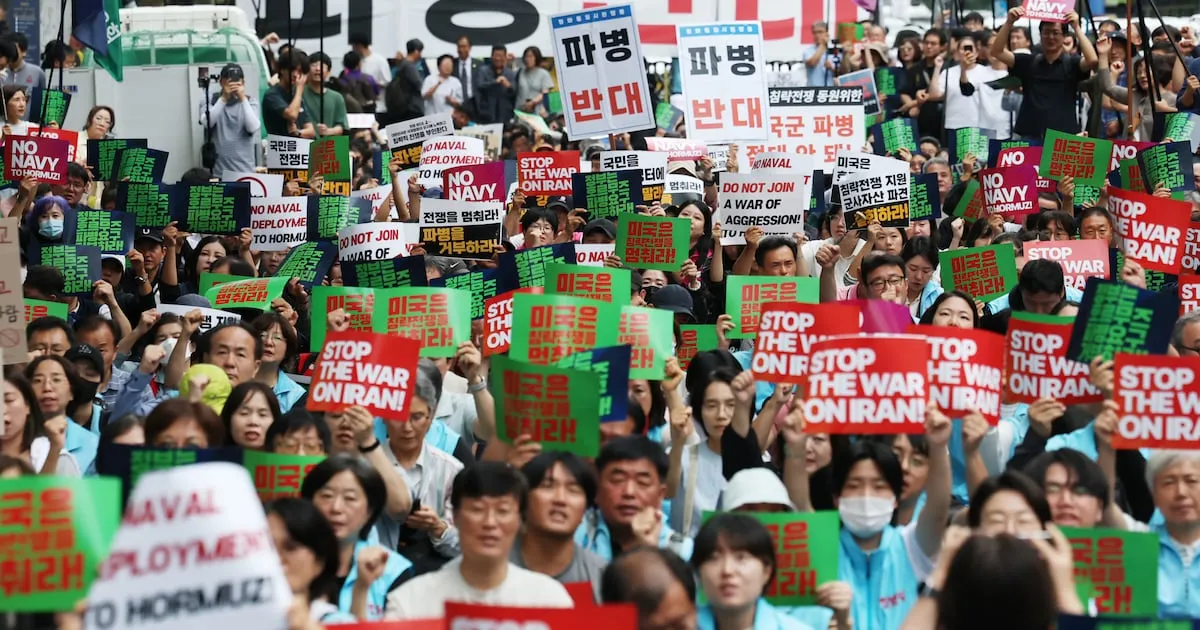
Hundreds of South Korean citizens and civil society groups gathered in downtown Seoul on December 12th to protest against the potential deployment of forces to the Strait of Hormuz. The demonstration, organized by a coalition of organizations including the Pan-Asian Alliance and the Federation for Peace and Reunification, marched towards the presidential office, the Blue House, expressing strong opposition to what they termed an “invasion war.” Approximately 540 religious and civic organizations participated in the event, with several hundred individuals in attendance.
Protesters Voice Opposition to Military Deployment
Chants of “Resolutely reject the Hormuz deployment,” “Defend the spirit of the constitution that prohibits aggressive wars,” and “We want peace” echoed through the streets. Participants held banners with slogans such as “The US, stop forcing the Hormuz deployment,” “The US, stop aggressive wars,” and “Lee Jae-myung, reject the Hormuz deployment.” The marchers traversed Sejong-daero, passing the U.S. Embassy before reaching their final destination near the Blue House.
Speakers at the rally articulated deep concerns about the implications of military involvement in the Strait of Hormuz. A senior representative from the Korean Buddhist Jogye Order emphasized the sanctity of all life, stating, “No national interest or alliance can supersede the value of life.” He further argued that “the guise of national interest cannot outweigh the weight of life, and peace built on the blood of another country cannot exist.”
Concerns for Youth and National Future
Kim Sook-young, a representative for the “Mothers of Politics,” spoke about the potential impact on young men, drawing a parallel to her own son. She expressed dismay that the discussion of “deployment review” was not merely diplomatic jargon but could mean young men being sent to a region where war is occurring. “Why should our youth have to clean up the mess caused by Trump’s war?” she questioned, highlighting the perceived burden placed on the younger generation.
A young labor activist, identifying himself as Go Geon, conveyed a sense of betrayal. He stated, “I feel a deep sense of betrayal that the Lee Jae-myung administration, which came to power through a ‘revolution of light,’ is pushing for overseas deployment that even Yoon Suk-yeol did not dare to pursue.” He urged the president to make the right decision to prevent the nation from being embroiled in war in the coming decades.
A high school student who spoke at the rally also stressed that alliances do not automatically obligate participation in every war. “The government must make decisions based on the lives of its citizens, peace, national interest, and the constitution. It’s a very obvious principle,” the student asserted.
Broader Context and Counter-Demonstrations
The protest highlights a growing sentiment among some segments of the South Korean public against military entanglements that could draw the nation into international conflicts. The Strait of Hormuz is a critical chokepoint for global oil supplies, and tensions in the region have often involved complex geopolitical dynamics.
In a related development, progressive civic groups, including those from the Candlelight Action movement, were also scheduled to hold a rally at 5 PM in front of the U.S. Embassy in Seoul. This group planned to criticize former U.S. President Donald Trump and intended to march from Gwanghwamun Square to Jongno.
The dual demonstrations underscore the diverse perspectives within South Korea regarding foreign policy and military alliances. While one group protests against potential deployment to the Strait of Hormuz, another focuses its criticism on former U.S. leadership and broader foreign policy issues. Both events, however, signal a public desire for peace and a cautious approach to international military commitments.
Conclusion: A Call for Peace and Prudence
The December 12th protests in Seoul represent a significant public expression of concern over the potential military deployment to the Strait of Hormuz. The participants, comprising various civic and religious organizations, voiced a strong desire for peace and urged the government to prioritize national well-being and constitutional principles over potentially entangling foreign policy decisions. The events also highlight a broader discourse on South Korea’s role in international security and the careful consideration required when navigating complex geopolitical landscapes. The call for peace and a rejection of war resonated strongly throughout the demonstrations, emphasizing a public demand for a prudent and peace-oriented foreign policy.
