

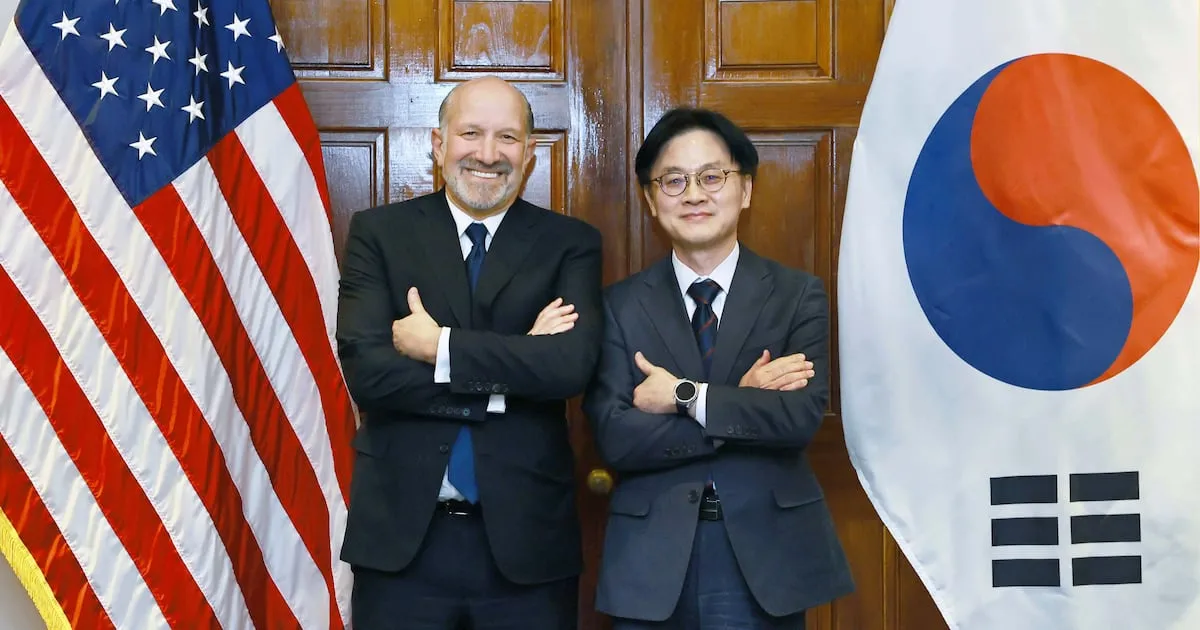
U.S. Commerce Secretary Wilbur Ross met with South Korean Minister of Trade, Industry and Energy Kim Dong-gwan in Washington D.C. on September 17th to discuss investment matters between the two nations. The meeting comes amid ongoing adjustments to joint military drills, a directive from President Donald Trump, and follows reports of U.S. frustration over the pace of South Korea’s investment commitments.
U.S. Concerns Over Investment Pledges
According to a report by Politico, citing an anonymous official, the Trump administration’s pressure on South Korea stems from broader economic dissatisfaction. The administration reportedly believes that South Korea has not fulfilled its pledge to invest $350 billion in the United States last year, with officials viewing the delay as a failure to meet commitments.
Minister Kim, who arrived in Washington D.C. on September 16th via Dulles International Airport, stated that discussions with U.S. officials were progressing with “substantial and detailed follow-up measures.” He indicated that the goal was to present a comprehensive plan for a ‘Project No. 1’ by late August or early September, suggesting a need to consolidate and clarify investment initiatives.
This visit marks Minister Kim’s second trip to the U.S. in three weeks and occurs just four days after relevant South Korean ministries, including the Ministry of Trade, Industry and Energy, convened to address U.S. pressure regarding investment implementation. The head of the Korea Customs Service, a subordinate agency to the Ministry of Trade, Industry and Energy, was notably absent from these preparatory meetings.
Addressing Pressure and Tariffs
When questioned about whether South Korea faced pressure to increase investments to avoid potential tariff hikes, Minister Kim stated that he had not received any such direct threats. This assertion contrasts with the underlying tension reported in the ongoing negotiations.
The Politico report highlighted that the South Korean side characterized the negotiation process as having the “slowest negotiators ever.” This sentiment underscores a perceived lack of progress from the U.S. perspective.
Commerce Secretary Ross had previously expressed impatience with the pace of investment implementation. At the opening ceremony of the Korea-U.S. Strategic Partnership Center (KUSPC) in Washington D.C. last month, Ross remarked that progress would be evaluated based on concrete figures rather than mere statements or Memoranda of Understanding (MOUs).
International Comparisons and Broader Economic Context
In contrast, Japan, which pledged $55 billion in investments, has already announced some of its projects. This comparison further emphasizes the U.S. view of South Korea’s slower pace.
The Politico report also drew attention to a separate issue: the imposition of a record fine of 624.6 billion won (approximately $530 million) by South Korea’s Personal Information Protection Commission (PIPC) against Coupang for personal data leakage. The outlet suggested that President Trump’s recent rhetoric tends to conflate security and economic issues, indicating a tendency for friction in one area to spill over into others.
Details of Investment Discussions
Minister Kim’s remarks indicated that the discussions covered a wide range of specific and practical follow-up measures related to U.S. investments. The objective of finalizing a key project, referred to as ‘Project No. 1’, by early September suggests a focused effort to demonstrate tangible progress to the U.S. administration.
The context of these discussions is crucial. President Trump has consistently advocated for increased foreign investment in the U.S. and has used trade policy as a tool to achieve this. The administration’s focus on bilateral trade balances and investment flows has led to scrutiny of major trading partners, including South Korea.
South Korea, as a significant trading partner, has been under pressure to balance its trade surplus with the U.S. and to contribute more directly to the U.S. economy through investment. The recent meeting between Secretary Ross and Minister Kim represents a critical juncture in these ongoing dialogues, aimed at resolving discrepancies and fostering a more favorable investment climate from the U.S. perspective.
Conclusion
The meeting between Secretary Ross and Minister Kim highlights the complex dynamics of the U.S.-South Korea economic relationship. While South Korea asserts that direct pressure regarding tariffs has not been applied, the U.S. administration’s expressed dissatisfaction with the pace of investment pledges remains a significant factor. The efforts to clarify and expedite investment projects, such as the planned announcement of ‘Project No. 1’, signal a commitment from the South Korean side to address U.S. concerns, even as negotiations are described as challenging. The outcome of these discussions will be closely watched, particularly in light of broader trade policies and international economic relations.
