

President has instructed the Ministry of Employment and Labor to clearly define the scope of “re-employment” permitted under the revised “Yellow Envelope Law” (Labor Union Act) through subordinate legislation such as executive decrees or regulations. This directive aims to provide greater clarity and prevent ambiguity in the application of the law.
Clarifying “Re-employment” Under the Yellow Envelope Law
During a State Council meeting held at the Government Complex in Sejong on the 11th, the President addressed Labor Minister Kim Young-hoo, stating, “There have been requests to specify those clearly excluded from re-employment, and this is a reasonable demand.” He added, “There seems to be no reason why this cannot be done.” Previously, the Ministry had focused on reinforcing existing “interpretive guidelines” rather than creating new subordinate legislation. The President’s directive emphasizes the need to establish these definitions through formal legal instruments like executive decrees or regulations.
The President also noted criticism that the Ministry has not yet established clear regulations and examples for determining re-employment eligibility under the Yellow Envelope Law. “Defining the detailed provisions necessary for the enforcement of the law is an authority granted to the executive branch by the Constitution,” the President stated. He further elaborated, “When officials attempt to amend laws that should be handled through executive decrees, regulations, or guidelines, the number of laws requiring parliamentary amendment could reach 10,000.” This suggests a concern that the government might be over-relying on legislative amendments for issues that could be resolved through administrative measures.
Minister Kim responded to the President’s directive by stating, “We will more actively review the possibility of including these definitions in executive decrees and other subordinate legislation.”
Background and Previous Directives
This is not the first time the President has called for clearer definitions. On the 21st of the previous month, during a National Assembly session, he urged the administration to “clearly define in advance, through executive decrees, regulations, and Ministry of Labor guidelines, the scope of re-employment.” He pointed out that the current wording of the Yellow Envelope Law, which includes “decisions in business operations that affect working conditions” as eligible for re-employment, is too vague and open to various interpretations.
Despite these calls, the Ministry of Labor had been working on reinforcing its existing “interpretive guidelines” instead of developing new executive decrees or regulations. The President’s renewed directive signifies his view that strengthening interpretive guidelines is insufficient and that more concrete measures are needed.
Distinction Between Interpretation and Legislation
The President emphasized the limitations of relying solely on interpretations. When Minister Kim suggested that creating executive decrees might not be feasible due to a lack of specific delegation clauses in the original law, the President countered, “It can be done within the scope permitted by law.” He clarified, “The absence of a specific delegation clause does not mean it cannot be defined through executive decrees or similar measures.”
This exchange highlights a key distinction: while interpretive guidelines represent an opinion on the law, they do not carry the same legal weight as executive decrees or regulations, which are binding external legal norms. The President’s insistence on using subordinate legislation aims to create a more robust and legally sound framework.
However, the absence of explicit delegation provisions in the Yellow Envelope Law for creating such subordinate legislation is likely to lead to further debate. Narrowing the scope of re-employment through lower-level regulations could be seen as restricting the rights granted by the primary law itself.
Labor Sector Reaction
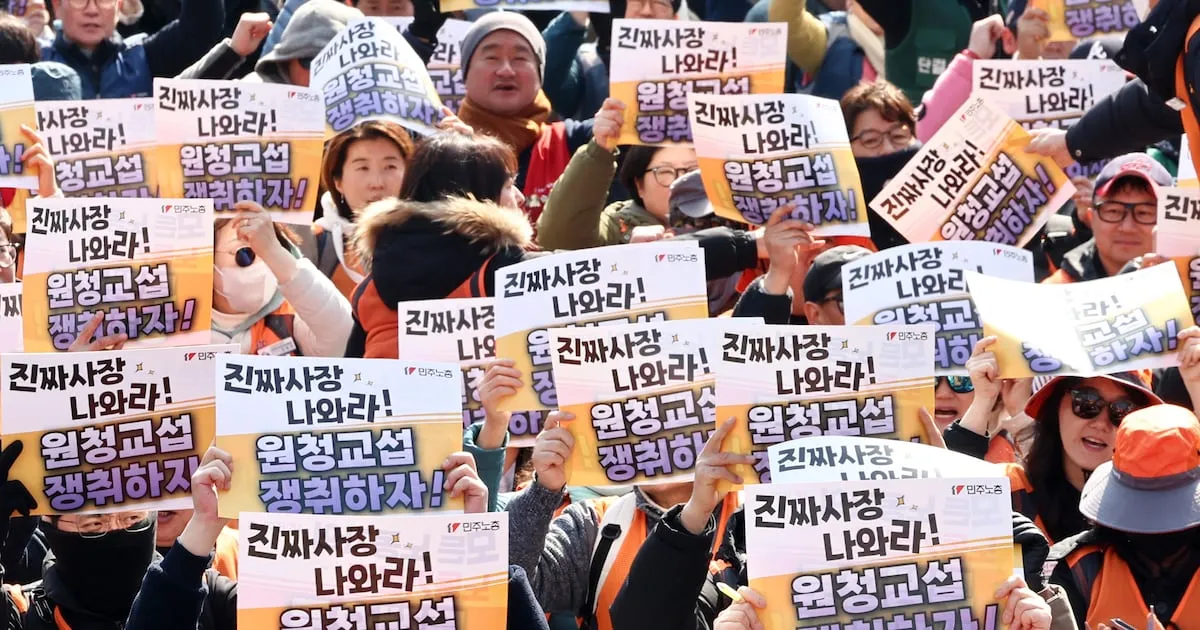
The labor sector has expressed strong opposition to the President’s directive. The Korean Confederation of Trade Unions (KCTU) issued a statement on the same day, criticizing the directive as an attempt to “create a potentially illegal executive decree first and argue about it later.” The KCTU characterized this action as an “abuse of power” that undermines the legislative intent and favors employers. They argued that the President’s directive effectively makes the legislative process meaningless and constitutes biased behavior.
In response to the President’s directive, the Ministry of Labor stated, “We will comprehensively review the content and format to ensure the President’s intent is fully reflected and to find practical solutions.”
The “Yellow Envelope Law” Context
The “Yellow Envelope Law,” officially the Labor Union and Labor Relations Adjustment Act, has been a subject of debate, particularly concerning provisions related to re-employment. The law aims to balance the rights of employers and labor unions, but its interpretation and application, especially regarding what constitutes legitimate grounds for re-employment after a strike or dispute, have often led to contention. The recent directive seeks to bring more clarity to these contentious areas by mandating the creation of specific legal definitions within subordinate legislation.
The core issue revolves around the interpretation of “decisions in business operations that affect working conditions.” Critics argue this phrase is overly broad and could be exploited to justify actions that undermine union activities or worker protections. The President’s push for executive decrees and regulations is intended to create a more precise definition, thereby limiting potential misinterpretations and ensuring that the law is applied as intended by the legislature.
The Ministry of Labor’s previous approach of relying on interpretive guidelines, while common, lacks the force of law. Interpretive guidelines are administrative tools that explain how a law should be understood but can be changed or disregarded more easily than formal regulations. By insisting on executive decrees or regulations, the President is seeking a more permanent and legally binding solution.
Potential Legal Challenges and Future Outlook
The path forward is expected to be complex. The Ministry of Labor must now navigate the process of drafting new subordinate legislation while addressing concerns about potential legal challenges and opposition from labor groups. The debate over the scope of re-employment and the methods used to define it is likely to continue.
The President’s directive underscores a broader administrative philosophy emphasizing clear legal frameworks and the proper use of executive authority. Whether this directive will lead to a satisfactory resolution that balances the interests of all parties remains to be seen. The Ministry’s commitment to finding “practical solutions” will be crucial in the coming months.
