

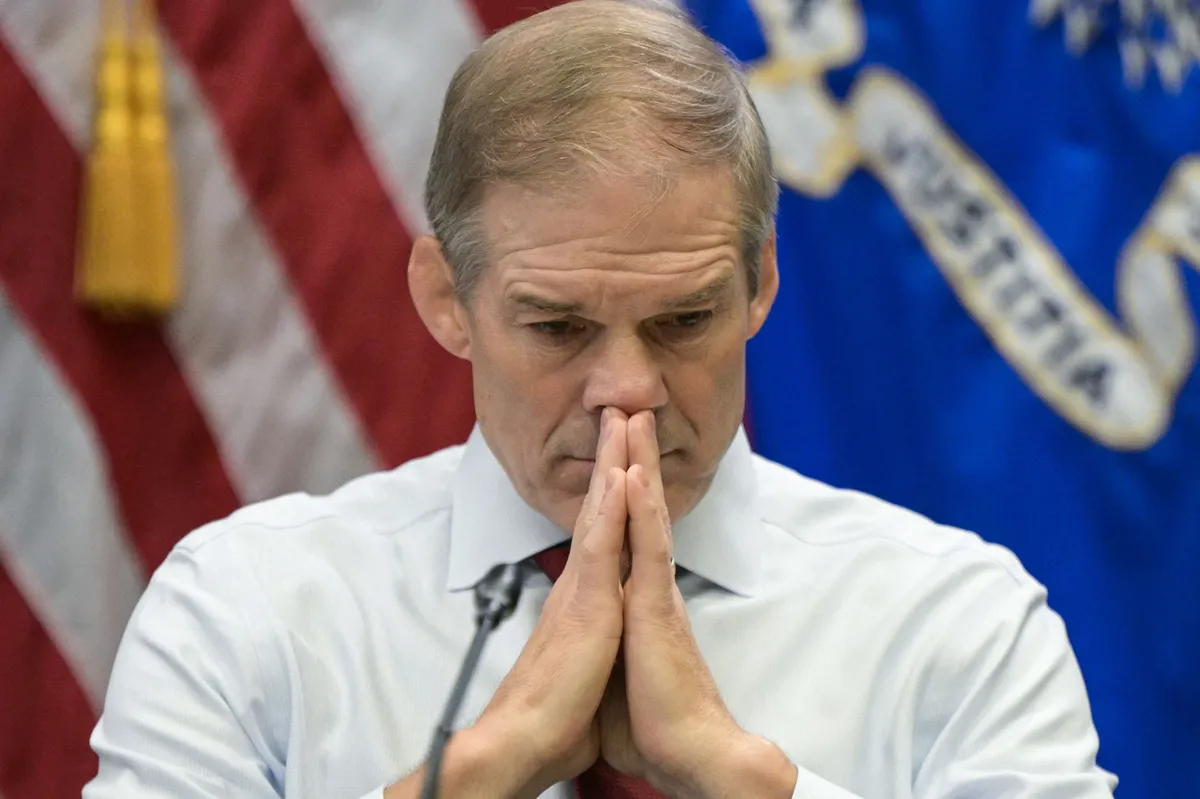
A group of U.S. House lawmakers has formally protested South Korea’s recently enacted law targeting online disinformation, expressing concerns that it could infringe upon freedom of expression and disproportionately affect American tech companies. The lawmakers, all members of the House Judiciary Committee, sent a letter to Kim Jong-cheol, Chairman of the Korea Communications Commission (KCC), on March 7, the day the revised Information and Communications Network Act went into effect.
U.S. Lawmakers Raise Concerns Over ‘Significant Threat’
The letter, spearheaded by House Judiciary Committee Chairman Jim Jordan (R-Ohio) and co-signed by Representatives Scott Fitzgerald (R-Wisconsin), Darrell Issa (R-California), and Michael Burgess (R-Texas), was publicly released via Jordan’s X (formerly Twitter) account on March 6.
The Republican representatives characterized the revised law as a “significant threat to online and free speech.” They argued that the legislation could empower the KCC to penalize U.S. companies and their users simply for exercising rights protected by the U.S. Constitution. Furthermore, they voiced apprehension that the law might be exploited to censor online expression by Americans.
A key point of contention highlighted by the lawmakers is the perceived vagueness of the term ‘false information’ as defined in the law. They stated that the legislation lacks specific criteria or procedures for its enforcement, raising fears that it could be used to suppress politically unfavorable opinions. This ambiguity, they warned, could lead to a “chilling effect” on free speech and online discourse.
Details of South Korea’s Revised Law
The revised Information and Communications Network Act, passed by the National Assembly on December 24 of last year, mandates that platform operators take measures to delete or block ‘false information’ and ‘manipulated information.’ Failure to comply can result in penalties.
The U.S. representatives observed that the law appears to be structured in a way that primarily targets large U.S. platform companies. The legislation applies to content providers with over 100,000 subscribers or an average of 100,000 daily views, and to large platforms with over 1 million average monthly users. They noted that major U.S. platforms such as Facebook, X, Instagram, and YouTube fall under these criteria.
The lawmakers also drew parallels between South Korea’s new law and the European Union’s Digital Services Act (DSA). They pointed out that the U.S. has previously raised concerns about the EU’s DSA, suggesting it could lead to the suppression of free speech for U.S. citizens.
Echoes of European Regulations
“The Judiciary Committee has consistently pointed out instances where the EU, using its Digital Services Act, has sought to control the global operations of online platforms and infringe upon the free speech rights of U.S. citizens,” the lawmakers stated in their letter. “By directly modeling its law on the EU’s Digital Services Act, South Korea appears to be following the same path.”
Representative Scott Perry, in a separate statement, emphasized the principle that no foreign government should have the authority to compel U.S. companies to censor speech protected by the U.S. Constitution. He described South Korea’s ‘false information’ law as “vague, overly broad, and ripe for abuse.” Perry concluded by stating that the House Judiciary Committee would remain vigilant in monitoring any attempts by foreign governments to solicit censorship and undermine the free speech protections guaranteed by the First Amendment.
Broader Implications for Online Speech
The concerns raised by the U.S. lawmakers underscore a growing international debate surrounding the regulation of online content. While South Korea’s intention is to combat the spread of harmful disinformation, the broad scope and potential for selective enforcement have sparked significant pushback.
The law’s definition of ‘false information’ is particularly problematic, as it could be interpreted to include opinions or commentary that are critical of the government or its policies. The potential for such a law to be weaponized against dissent is a serious concern for advocates of free expression worldwide.
The U.S. lawmakers’ intervention highlights the extraterritorial reach of national laws in the digital age and the challenges of balancing national regulatory interests with international norms on freedom of speech. As more countries consider similar legislation, the implications for the global internet ecosystem and the rights of users remain a critical area of focus.
The U.S. representatives have indicated they will continue to monitor the situation closely, emphasizing the importance of upholding constitutional protections for speech, even in the context of combating online disinformation.
