

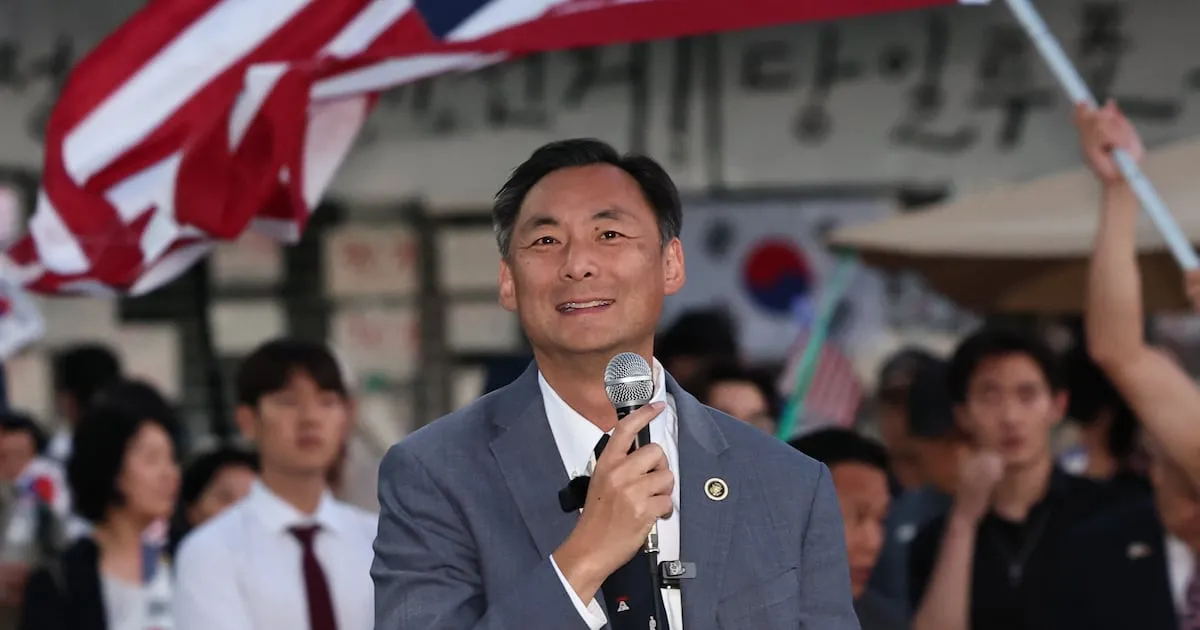
A South Korean court has rejected a lawsuit filed by MoS Tan, a former professor at Liberty University who holds honorary status from President Lee Myung-bak, seeking to lift a travel ban imposed on him. The Seoul Administrative Court ruled on October 31st that the travel restriction, extended by the Ministry of Justice, would remain in place.
Background of the Travel Ban
The travel ban was initially placed on Tan in June after he was summoned by the police in connection with allegations against President Lee Myung-bak. The initial ban was set to expire on June 30th. However, as the investigation continued, the Ministry of Justice extended the ban until October 31st.
Tan, who is of Korean-American descent, was reportedly summoned by police over allegations that President Lee Myung-bak was involved in a juvenile assault incident during his youth, leading to his placement in a juvenile reformatory. These allegations were reportedly disseminated through media outlets, including a press conference in Washington D.C. last year.
Following his detention without bail on October 16th, the Ministry of Justice lifted the original ban and issued a third travel restriction, prohibiting Tan from leaving the country until November 15th. Tan’s legal team argued that both the second (extended) and third travel bans were unlawful and sought their cancellation.
Tan’s Legal Arguments and Court’s Decision
Tan’s legal representatives contended that he needed to return to the United States to prepare his defense against the allegations. They argued that the extensions and the new ban were essentially preparatory steps for his potential detention, which they deemed illegal.
The court, however, made separate decisions regarding the second and third travel bans. It ruled to dismiss the challenge against the second ban while upholding the decision on the third ban. This means the travel restriction remains effective.
Tan’s History and Controversial Claims
MoS Tan, a Korean-American, previously served as the Director of International Legal Affairs at the U.S. Department of Justice during the first Trump administration in 2019. He is known for promoting conspiracy theories, particularly concerning election fraud.
Tan has publicly claimed that the December 3rd emergency martial law declared by former President Yoon Suk-yeol was unjustified. He has also asserted that the 21st presidential election last year was subject to fraud. Furthermore, Tan has suggested that China was behind alleged election rigging at the opening ceremony of the Seoul Olympic Park in Songpa-gu.
Next Steps for Tan’s Defense
Following the court’s decision, Tan’s lawyer stated that both the second and third travel bans issued by the Ministry of Justice were merely preliminary measures for his potential detention. The legal team indicated their intention to appeal the ruling as quickly as possible.
The legal battle highlights the ongoing scrutiny surrounding Tan’s activities and the allegations he faces. The court’s decision to uphold the travel ban suggests that the authorities intend to keep Tan in the country while investigations and potential legal proceedings continue. His history of controversial claims adds another layer of complexity to the case, drawing attention from various media and political circles.
Understanding Travel Bans in South Korea
Travel bans, known as “chulguk jeongji” (출국정지) in South Korea, are administrative measures that can be imposed by the Ministry of Justice. These bans typically restrict individuals from leaving the country for a specified period. They are often implemented in cases where a person is under investigation for criminal offenses, is a flight risk, or is deemed to be a threat to national security.
The legal basis for imposing and extending such bans is outlined in the Immigration Act. Individuals subjected to a travel ban have the right to challenge the decision through administrative litigation, as MoS Tan did. The courts then review the legality and necessity of the ban based on the evidence presented by both the individual and the relevant government ministry.
Factors considered by the court can include the severity of the alleged offense, the strength of the evidence against the individual, the potential for the individual to flee, and the impact of their departure on the ongoing investigation or legal proceedings. The court’s decision in Tan’s case reflects a judicial assessment that the grounds for the travel ban remain valid.
Conclusion
The Seoul Administrative Court’s decision to deny MoS Tan’s request to lift the travel ban signifies a temporary setback for the former professor. While his legal team plans to appeal, the ruling allows the Ministry of Justice to maintain its restriction on his travel. The case continues to draw attention due to Tan’s high-profile status and his involvement in controversial claims, underscoring the legal and administrative processes governing travel restrictions in South Korea.
