

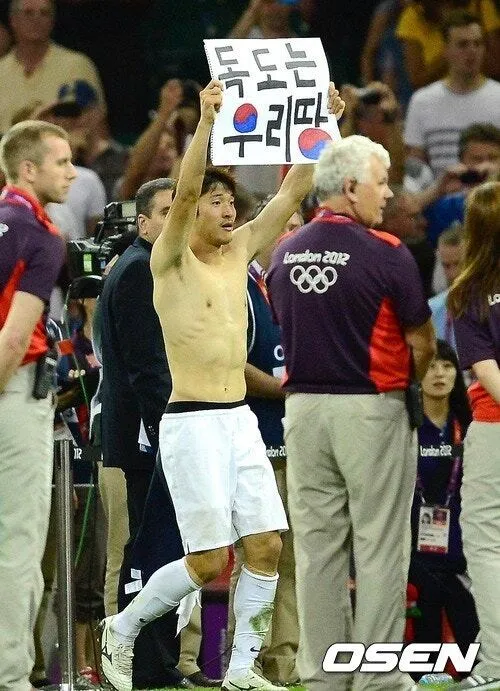
Argentina’s national football team is facing potential sanctions from FIFA following a political protest during their recent World Cup semi-final victory. The incident, where players displayed a banner referencing the Falkland Islands (known as the Malvinas Islands in Argentina), has drawn parallels to a 2012 incident involving South Korean player Park Jong-woo, who was penalized by FIFA for a similar political display.
Falklands/Malvinas Banner Sparks Controversy
Following their dramatic 2-1 comeback win against England in the 2026 FIFA World Cup semi-finals, several Argentinian players unfurled a banner asserting their claim over the Falkland Islands. This act has ignited a debate and prompted calls for FIFA to investigate, with the 2012 London Olympics case of Park Jong-woo serving as a significant precedent.
Argentinian outlet ‘Ambito’ reported that FIFA is expected to examine the banner, noting that the Park Jong-woo case is being cited as the primary example of how such actions are handled. In 2012, Park Jong-woo displayed a banner reading ‘Dokdo is our territory’ after securing a bronze medal at the London Olympics. Dokdo is a group of islets in the Sea of Japan, the sovereignty of which is disputed between South Korea and Japan.
As a consequence of his protest, Park was barred from attending the medal ceremony and subsequently received a two-match ban from international competitions. This action by FIFA underscored the organization’s commitment to maintaining political neutrality in its events.
FIFA’s Stance on Political Neutrality
Global sports media outlet ‘beIN Sports’ highlighted the Park Jong-woo case as a clear instance where a player faced sanctions for displaying a political message. The report emphasized that Park’s banner referred to the territorial dispute between South Korea and Japan. The decision in that case served as a stark reminder of the principles upheld by FIFA and the International Olympic Committee (IOC) regarding political neutrality during major sporting events.
FIFA’s regulations strictly prohibit any form of political, religious, or personal expression during official matches, both before, during, and after the game. Article 34.3 of FIFA’s statutes explicitly forbids players and team officials from displaying political messages in any language or form from the start of the match until its conclusion, including during national anthem performances.
The Falklands/Malvinas Dispute
The Falkland Islands, which Argentina refers to as the Malvinas Islands, are a British Overseas Territory located approximately 300 miles off the coast of Argentina. The islands have been a subject of a long-standing sovereignty dispute between Argentina and the United Kingdom. The UK discovered and administered the islands for centuries, successfully repelling an Argentine invasion in 1982. A referendum held in 2013 saw an overwhelming majority (99.7%) of Falkland Islanders vote to remain a British territory.
Despite FIFA’s efforts to prevent political displays by fans, some Argentinian players took matters into their own hands. Leandro Paredes, an Argentinian player, asserted, “The Malvinas are and will always be Argentina’s.” This sentiment was echoed by Argentina’s Vice President Victoria Villarruel on social media, who posted a military video stating, “The Falklands belong to Argentina. They prevented us from bringing it to the stadium, but we carry it in our blood and hearts.”
Potential Sanctions and Precedents
The Argentinian Football Association (AFA) could face penalties, including fines. While individual players who participated in the banner display might also face sanctions, the likelihood is considered lower at this stage, according to ‘Ambito’. The publication suggested that the time required for a disciplinary process and the fact that multiple players were involved could influence FIFA’s decision.
The Park Jong-woo case is seen as the most significant precedent for FIFA’s potential ruling. The AFA itself has faced sanctions for similar actions in the past, including a fine in 2014 for comparable conduct. The report indicated that the time needed for investigations and the collective nature of the protest are factors that might affect the outcome.
Other Instances of Political Expression in Football
The incident involving Argentina is not the first time political messages have surfaced in international football. In 2024, Álvaro Morata and Rodri of Spain received one-match bans during the Euros for shouting “Gibraltar is Spanish” after their victory. Similarly, during the 2018 FIFA World Cup, Granit Xhaka and Xherdan Shaqiri of Switzerland were fined for performing the celebratory eagle gesture, symbolizing the Albanian flag, after scoring against Serbia. These events underscore FIFA’s ongoing challenge in balancing sporting competition with political sensitivities.
As Argentina prepares for the World Cup final, the looming possibility of sanctions casts a shadow over their campaign. While a ban before the final match is unlikely, the team and the AFA are bracing for potential disciplinary actions from FIFA, with the Park Jong-woo case setting a critical benchmark for how the governing body will proceed.
The UK side has also reportedly criticized the Argentinian players’ actions and is urging FIFA to conduct a thorough investigation. The situation highlights the complex intersection of sports, politics, and national identity on the global stage.
