

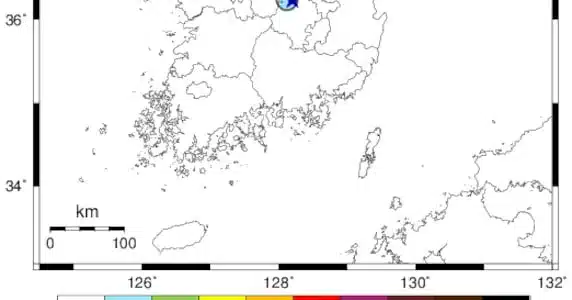
A minor earthquake with a preliminary magnitude of 2.1 occurred on the evening of June 6th, shaking an area approximately 13 kilometers north of Gimcheon city in North Gyeongsang Province, South Korea. The tremor was registered at 8:57:24 PM local time, according to the Korea Meteorological Administration (KMA). The earthquake’s epicenter was located at a depth of 9 kilometers, with coordinates pinpointed at 36.23 degrees North latitude and 128.20 degrees East longitude.
Understanding the Tremor’s Intensity
The KMA analyzed the seismic intensity of the earthquake, estimating it to be at a maximum of III on the seismic intensity scale. This level of intensity, known as “III” (weak), is typically felt by people indoors, particularly on upper floors of buildings. Stationary vehicles might also experience a slight shaking. While this magnitude is considered minor, the KMA confirmed that residents in the vicinity of the earthquake’s origin would have been able to feel the ground shaking.
Geological Context and Safety Advisories
South Korea is situated on the Korean Peninsula, which is part of the Eurasian Plate. While not located on a major tectonic plate boundary like Japan or California, the region does experience seismic activity. The Korean Peninsula is crisscrossed by several fault lines, and the accumulation of stress along these faults can lead to earthquakes. The KMA regularly monitors seismic activity across the country to assess potential risks and provide timely information to the public.
Following the event, the KMA issued a statement urging residents to exercise caution. “The region near the earthquake’s occurrence could feel the seismic intensity,” a spokesperson stated. “We ask for attention to safety.” This advisory is standard procedure for even minor seismic events, emphasizing preparedness and awareness among the populace. While a magnitude 2.1 earthquake is unlikely to cause significant structural damage, it serves as a reminder of the Earth’s dynamic nature.
What is Seismic Intensity?
Seismic intensity is a measure of the effects of an earthquake at a particular location. It differs from magnitude, which measures the energy released at the earthquake’s source. The intensity scale considers factors such as:
- The shaking felt
