

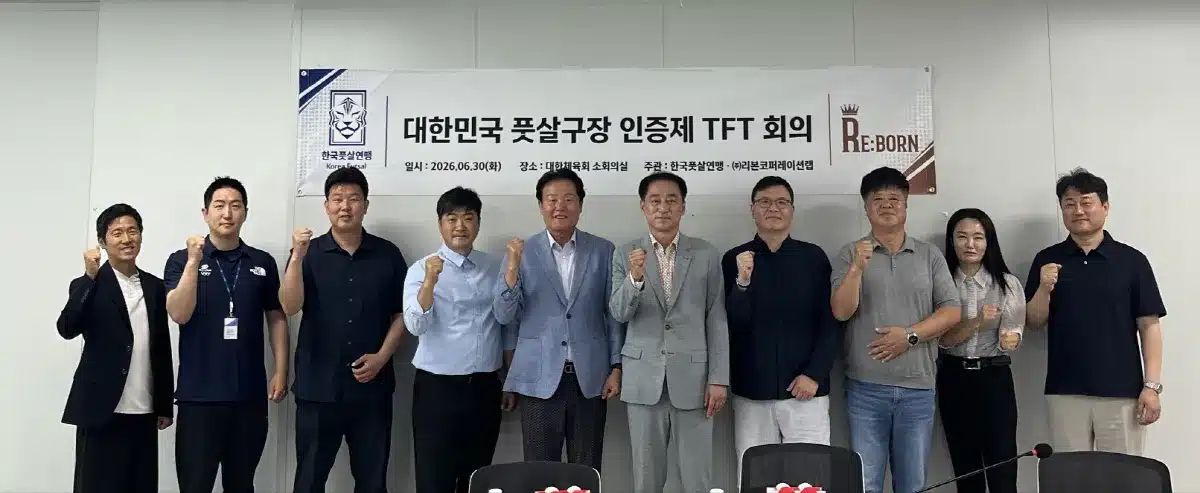
A significant step has been taken in South Korea to establish safety and quality standards for futsal courts across the nation. The Korea Futsal Federation (KFF) and Ribbon Corporation Lab jointly convened the inaugural meeting of the ‘South Korea Futsal Court Certification Task Force’ (TFT) on the 30th of last month at the Korea Sports Promotion Foundation’s small meeting room. This marks the beginning of a comprehensive effort to improve futsal courts and construct a certification system.
Establishing Standards for Futsal Court Safety and Quality
The primary objective of this initiative is to systematically analyze the current state of domestic futsal courts and develop certification criteria aimed at enhancing user safety and facility quality. Futsal has seen rapid growth as a popular recreational sport, yet inconsistencies in court dimensions, safety equipment, flooring, and operational management standards have been a persistent concern. The need for standardization and systematic governance has been frequently raised by stakeholders.
In response to these challenges, the KFF and Ribbon Corporation Lab have formed a task force comprising various experts. This group is dedicated to creating an environment where futsal participants can use courts with confidence. The formation of this TFT signifies a commitment to addressing the existing disparities and establishing a reliable framework for futsal facilities.
Inaugural Meeting and Expert Participation
The first meeting brought together a diverse group of professionals with expertise in sports, construction, and facility management. Attendees included:
- Kim Ro-han, Chairman of the Korea Sports Promotion Foundation’s Sports Cooperation Committee
- Baek Soo-am, Head of the Adult Football Team at the Korea Football Association
- Yang In-gyu, Center Director at the Korea Institute of Construction and Environmental Testing
- Jo Jeong-rae, Vice President of SB World
- Choi Woo-seok, Director at Rootgreen
- Choi Chang-deok, Representative of Yongsan Adidas The Base
Additionally, Kim Hak-in, CEO of Ribbon Corporation Lab, along with researchers from Korea University of Science and Technology and Seo Hee-jeong, a research fellow, participated. They shared insights on research directions and practical application strategies for the futsal court certification system.
Key Discussion Points for Certification
During the meeting, several critical aspects of the certification process were discussed in depth:
- Necessity and Background: The fundamental need for a futsal court certification system and the context driving its development.
- Operator Engagement: Strategies to encourage participation and cooperation from private futsal court operators.
- Standardization and Collaboration: Plans for standardizing futsal courts and fostering collaboration with relevant government bodies, such as the Ministry of Culture, Sports and Tourism, and the Korea Sports Promotion Foundation.
- Benchmarking: Analysis of existing certification systems for sports facilities both domestically and internationally.
- System Framework: Proposals for establishing a structured system encompassing safety, inspection, certification, grading, and management.
Vision for the Future of Futsal Courts
Kim Dae-gil, President of the Korea Futsal Federation, emphasized the current challenges. “While numerous futsal courts operate across the country, it is not easy for participants to instantly verify the safety and quality of these courts,” he stated. “This project is the first step towards systematizing scattered futsal court information and establishing reliable court standards that futsal participants can trust.”
Kim Hak-in, CEO of Ribbon Corporation Lab, echoed this sentiment, expressing his belief in the initiative’s importance. “If someone has to start this work, I believe the start and the challenge will not be in vain,” he remarked. “Even if it’s a bit slow, we will proceed step by step, based on the voices from the field and expert opinions, advancing in a phased manner.”
Phased Implementation Plan
Following this inaugural TFT meeting, the KFF and Ribbon Corporation Lab plan to proceed with a series of structured steps. These will include:
- Conducting a comprehensive survey of the current state of futsal courts nationwide.
- Developing Korean-specific standards for futsal court standardization.
- Implementing on-site inspections and evaluations.
- Gathering expert consultations and recommendations.
- Reviewing and developing the framework for institutionalization.
This phased approach aims to ensure that the certification system is robust, practical, and effectively addresses the needs of the futsal community in South Korea, ultimately promoting a safer and higher-quality environment for the sport.
