

Timeless Portraits Emerge from Decades-Old Chalkboards
Faces that have lived through various eras and spaces are blooming on chalkboards as if by magic. These are not just paintings, but a testament to the artist’s imagination, offering a glimpse into how humanity has chronicled its journey. The exhibition ‘Deep Time,’ featuring approximately 40 works by artist Kim Myung-hee, including her representative pieces and new creations, is currently on display at Gallery Hyundai in Jongno-gu, Seoul, until the 14th.
A Canvas of History and Memory
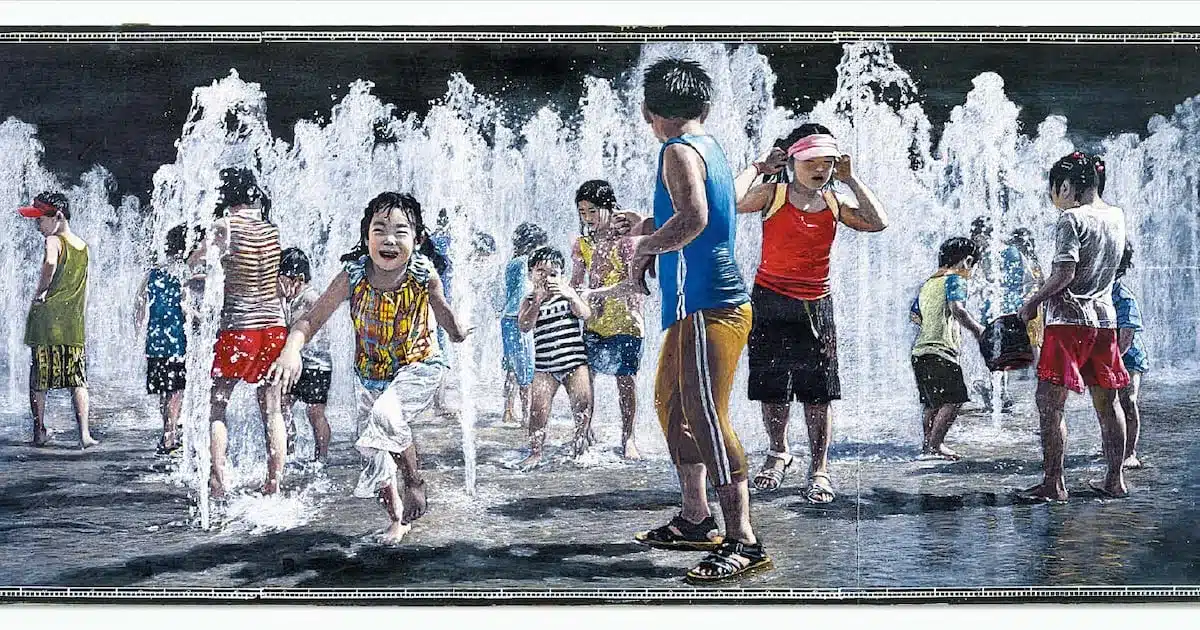
Instead of traditional canvases, black, silent chalkboards hang on the walls, reminiscent of black holes. Some of these boards bear the imprints of decades-old use, preserving the marks of time. Upon these surfaces, vivid scenes of the past come to life. The exhibition showcases the innocent faces of Seoul’s children in the post-1950s era, a mail carrier with an overflowing motorcycle, and children playing around industrial sites during the period of industrialization. The artist has rendered these scenes using oil pastels, creating a texture similar to chalk.
“The darkest parts of the paintings are the original colors of the chalkboard, untouched,” the artist explained during a studio visit. “Drawing light on a black background creates a dazzling effect.”
The Enduring Connection Between Artist and Material
The artist’s relationship with chalkboards dates back to the 1990s. After graduating with a degree in painting from Seoul National University and working in New York, Kim returned to Korea in 1990. She settled in a repurposed school building in Naepyeong-ri, Chuncheon, Gangwon Province, with her late husband, artist Kim Cha-seop (1940-2022). It was then that she began working on chalkboards, a practice she continues to this day.
Through her works, Kim has explored the patterns of human life and migration. She finds resonance in the nature of chalkboards – surfaces that can be written on and erased, yet where traces inevitably accumulate, mirroring the human condition of shared experiences and collective memory.
A Broader Vision of Humanity and History
The artist’s humanistic interest extends to wider historical and geographical scopes. The exhibition includes large-scale portraits of Koreans encountered during a Trans-Siberian Railway journey, as well as works that map her travels to various burial sites across Asia and the Americas. Gallery Hyundai describes this unique approach as “the artist’s distinctive method of documenting human life, history, and individual experiences alongside collective memory.”
Bridging the Past and Present with Multimedia
The exhibition offers a journey into the past while simultaneously revealing a contemporary artist in her seventies who is actively engaging with the present. Since the 2000s, Kim has also garnered attention for her media art, which integrates video with chalkboard paintings. For instance, in a piece depicting women working in rice paddies, she incorporates video footage of Seoul’s cityscape, creating a dialogue between the static image and the moving screen.
“I used video to create a ‘picture within a picture’ composition, inspired by Diego Velázquez’s masterpiece,” the artist shared. “With the advent of flat monitors, we can now combine still and moving images to tell a single story.”
One notable multimedia piece, ‘Kimchi Making Day 2025,’ features a self-portrait of the artist preparing kimchi, with an LCD monitor in the background displaying a section of the 18th-century text ‘Correct Conduct for Women’ (Oryun Haengsil-do). “This painting depicts the state of the ‘Correct Conduct for Women’ being erased,” Kim explained. “Ultimately, I wanted to convey the idea of breaking free from such constraints.”
