

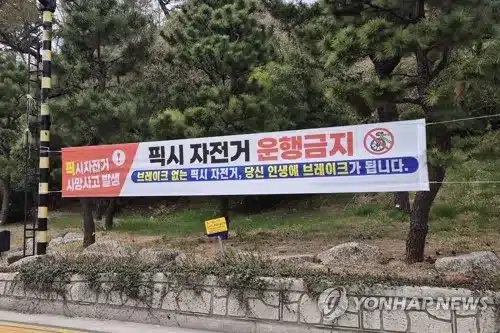
Youth Embrace Fixie Bicycles Amid Rising Accident Rates
A growing trend among young people to ride fixie bicycles, also known as fixed-gear bikes, is leading to increased concerns about safety. Data indicates a significant rise in accidents involving young cyclists over the past few years, and the inherent nature of these bikes poses greater risks of severe injury compared to other modes of personal transportation. Online discussions frequently address the dangers associated with fixies, the legality of their use on roads, and the extent of parental responsibility in the event of an accident. As the summer season approaches, a time when bicycle accidents typically spike, it’s crucial to examine the issues surrounding fixie riding.
The Risks of Riding Without Brakes
Fixie is short for ‘fixed gear bicycle.’ These bicycles are characterized by a direct connection between the pedals and the rear wheel, meaning there is no freewheel or coasting mechanism. Consequently, stopping requires a different technique than on a standard bicycle; cyclists cannot simply stop pedaling and glide to a halt. Instead, they must actively resist the pedal’s rotation or use other methods to slow down. This design originates from track cycling, where minimal components were used to maximize speed and efficiency on closed courses.
A recent safety assessment of fixie bicycles revealed that out of 54 bikes examined in the Seoul metropolitan area, 16 (29.6%) lacked both front and rear brakes, while 31 (57.4%) had only front brakes. While this minimalist design contributes to a sleek appearance and allows for advanced maneuvers difficult on conventional bikes, it’s often adopted as a form of self-expression and style rather than just a mode of transport. The popularity of fixies has been further fueled by webtoons featuring the bikes and social media content showcasing stunts, solidifying their presence in youth culture.
Online communities and cycling forums have seen a surge in inquiries from middle and high school students seeking advice on purchasing fixies, including questions about pricing and recommended models. There are also posts seeking fellow riders for group excursions. However, the absence of a freewheel significantly elevates the risk of accidents. Cyclists typically slow down or stop using methods like ‘foot braking’ (applying backward pressure on the pedals) or ‘skidding’ (intentionally sliding the rear wheel). These techniques, however, are difficult to execute in emergencies and require considerable skill, often leading to delayed reactions and accidents.
For context, a standard bicycle traveling at 20 km/h can stop within approximately 5 meters after applying the brakes. In contrast, a fixie bicycle requires nearly four times that distance, around 19 meters, to come to a complete stop, according to the Road Traffic Safety Board. The risks are further amplified during adverse weather conditions. Rain can create a thin layer of water between the tires and the road surface, causing hydroplaning and increasing the braking distance for fixie riders.
Teenage Cyclist Accidents on the Rise
While specific statistics for fixie-related accidents are not separately compiled, a notable increase in accidents involving cyclists under 19 years old is strongly linked to the growing popularity of fixies over the last two to three years. Accident data recorded by the Korea Road Traffic Authority’s Traffic Accident Analysis System shows a sharp rise in incidents involving cyclists under 19. The numbers climbed from 1,018 in 2021 to 1,149 in 2022, then to 1,047 in 2023, before surging to 1,584 in 2024 and 1,618 in 2025. Last year alone saw a 54.5% increase compared to 2023.
In contrast, the overall number of bicycle accidents remained relatively stable during the same period, fluctuating between approximately 5,100 and 5,500 annually. The increase in accidents has also led to a rise in casualties. Fatalities among cyclists under 19 increased from 3 in 2023 to 4 in 2024 and 5 in 2025. Injuries also saw a significant jump, from 1,165 in 2023 to 1,786 in 2024 and 1,783 in 2025.
Officials believe the rise in accidents among young cyclists is directly related to the fixie trend that began several years ago. A representative from the Road Traffic Authority commented, “While we don’t track fixie-specific accidents, the sudden increase in accidents involving young cyclists starting in 2024 strongly suggests that the fixie trend is a significant factor.”
Tragic incidents underscore these concerns. In July of last year, a middle school student riding a fixie tragically died after colliding with an air conditioning unit on Imyeon-ro in Gwanak-gu, Seoul, due to an inability to slow down sufficiently. In response, the Office of Education issued a notice to schools, urging them to inform parents about the risks of fixies. Parents were advised to ensure their children’s bicycles are equipped with brakes and to supervise their children’s group rides for any dangerous behavior.
Riding Fixies on Roads is Illegal and Puts Guardians at Risk
The sight of multiple fixie riders causing disturbances or engaging in dangerous riding on public roads is not uncommon. reports local online communities and used goods platforms frequently describe near-miss accidents involving groups of young people riding fixies. As accident numbers rise and public dissatisfaction with fixie riding grows, law enforcement is intensifying its crackdown. The National Police Agency announced a concentrated enforcement campaign targeting ‘two-wheeled vehicles,’ including bicycles, through the end of July.
While riding a bicycle itself is not illegal, and using one safely in designated areas is permissible, operating a fixie on public roads without adequate braking mechanisms or in an incomplete state constitutes a violation of the Road Traffic Act. Police maintain that failing to operate a bicycle with properly functioning brakes, as mandated by Article 48, Section 1 of the Road Traffic Act, is a punishable offense. Violations of safe riding duties can result in immediate fines.
Beyond immediate fines, cyclists involved in accidents due to negligence may face criminal charges. Under the Act on Special Cases Concerning the Settlement of Traffic Accidents, if a cyclist’s actions result in injury or death, they could be fined up to 20 million won or face imprisonment for up to five years. Furthermore, authorities are considering holding guardians responsible for minors engaging in risky fixie riding if they fail to take appropriate preventative measures.
In April, the Namdong Police Station in Incheon investigated the parents of two middle school students for suspected neglect of guardianship while cracking down on fixie riders. However, the case was ultimately closed without charges, raising questions about the practical application of neglect laws. A police official clarified that while the Incheon case did not result in charges, such actions can be considered neglect depending on the severity and circumstances.
Regarding the Incheon incident, it was reported that the parents’ actions did not meet the threshold for deeming them as negligent in their child’s protection or upbringing. Nevertheless, authorities emphasize that such cases are handled individually, and charges for neglect are possible if a parent’s inaction is deemed sufficiently irresponsible.
Cyclist Injuries Severe in Accidents
When bicycle accidents occur, riders are often the most vulnerable. Data from last year indicates that bicycle accidents resulted in 7,945 rider injuries, significantly more than the 5,235 accidents involving other parties. Disturbingly, nearly half of all patients seeking emergency treatment for bicycle-related injuries are under 10 years old. A study on emergency room visits for bicycle accidents between 2012 and 2017 found that out of 46,635 patients, 43.1% were under 19. Head injuries were the most common, accounting for 46.6% of all injuries.
In light of these findings, relevant authorities are strongly urging the installation of brakes and adherence to fundamental bicycle safety guidelines. The National Police Agency and the Road Traffic Authority recommend the following safety practices:
- Always wear protective gear, including a helmet.
- Choose a bicycle where the rider’s feet can comfortably touch the ground when seated.
- Utilize bicycle lanes whenever possible. If no bicycle lane is available, ride on the rightmost lane of the road.
- Signal turns clearly with hand gestures.
- When crossing pedestrian crossings, dismount and walk the bicycle or carry it.
[Table] Traffic Accidents for Cyclists (2021-2025)
| Rider | Year | 2021 | 2022 | 2023 | 2024 | 2025 |
|---|---|---|---|---|---|---|
| Accidents (Cases) | Fatalities (Deaths) | Injuries (Cases) | ||||
| Total | Accidents | 5,509 | 5,393 | 5,146 | 5,571 | 5,235 |
| Fatalities | 70 | 91 | 64 | 75 | 85 | |
| Injuries | 5,999 | 5,856 | 5,604 | 6,085 | 5,655 | |
| Under 19 | Accidents | 1,018 | 1,149 | 1,047 | 1,584 | 1,618 |
| Fatalities | 4 | 3 | 3 | 4 | 5 | |
| Injuries | 1,118 | 1,269 | 1,165 | 1,786 | 1,783 |
Source: Korea Road Traffic Authority Traffic Accident Analysis System
