

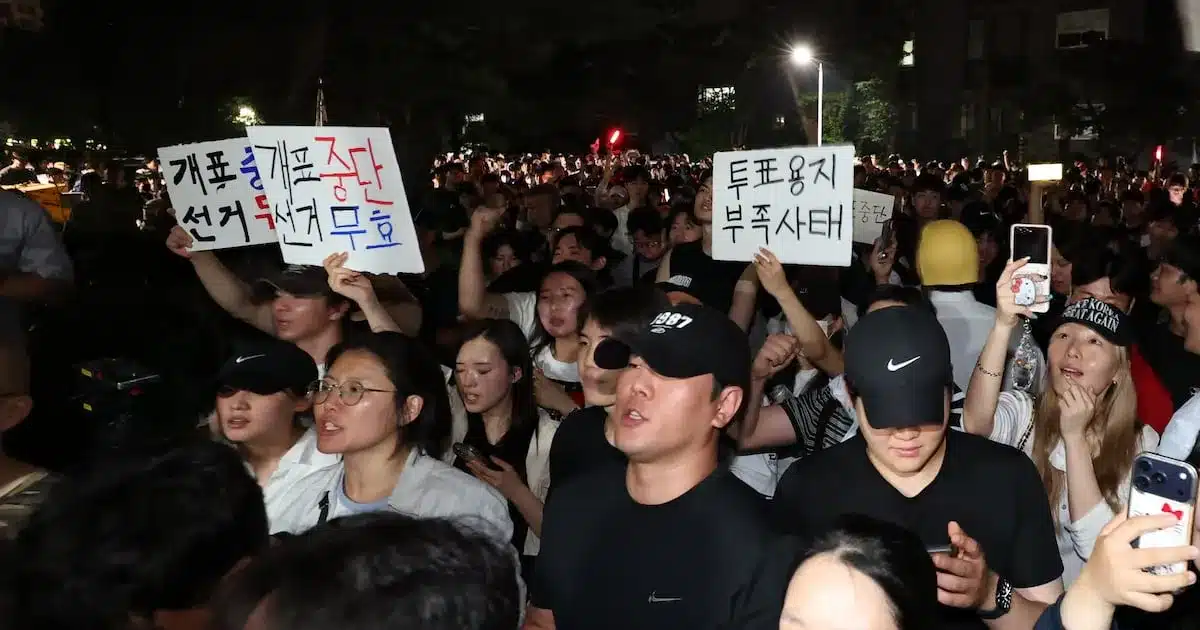
Ballot Shortage Mars Seoul Mayoral Election, Legal Ramifications Unclear
Concerns are mounting over potential legal disputes arising from ballot shortages at several polling stations during the recent local elections, specifically impacting the Seoul mayoral race. While irregularities have been reported, legal experts suggest that the likelihood of a court ordering a re-election or declaring the vote invalid is low. The ultimate decision hinges on whether the disenfranchisement of voters was significant enough to alter the outcome of the mayoral election.
As of April 4th, preliminary results indicated that Oh Se-hoon of the People Power Party had secured victory in the Seoul mayoral election, with 2,560,590 votes, representing 49.15% of the ballots cast. His closest rival, Jung Han-sup of the Democratic Party, garnered 2,507,130 votes, a difference of 53,460 votes, with 99.54% of precincts reporting.
Ballot Shortage Incidents Reported Across Seoul
The Central Election Management Committee reported that ballot shortages occurred at a total of 14 polling stations across Seoul by 6:20 PM on April 3rd, including 12 in Songpa District, one in Gangnam District, and one in Gwangjin District. In Songpa District, it was observed that only about 50% of registered voters were able to cast their ballots due to the shortage.
An emergency committee meeting held by the Election Management Committee in the early hours of April 4th concluded that the incidents do not constitute grounds for postponing or re-holding the election under the Public Official Election Act. Furthermore, the committee stated that vote counting could not be halted.
Focus on Jamsil 7-dong Polling Station
Jamsil 7-dong Polling Station 2 in Songpa District has become a focal point of the issue. Due to a lack of ballots, voting hours were extended until 10 PM. Subsequently, a crowd of individuals attempting to prevent the removal of ballot boxes gathered, leading to two ballot boxes being unable to be transported to the counting center. However, with approximately 2,000 uncounted ballots, even if all were cast for the runner-up, the vote difference would narrow to just 51,460. Legal circles anticipate this calculation will be central to any future legal proceedings.
Legal Framework for Election Disputes
Article 224 of the Public Official Election Act stipulates that an election may be declared invalid if there are violations of election regulations and if these violations are deemed to have affected the election results. It is important to note that procedural irregularities alone do not automatically invalidate an election; it must be proven that such irregularities impacted the final outcome.
Kim Yeon-gi, a lawyer at Chungjeong Law Firm, commented, “Considering that voting was suspended for several hours at a specific polling station, and alternative methods like manual ballot issuance were used, leading to delays, and that the right to vote was infringed upon for those who left after waiting, it is highly likely that violations of election regulations will be acknowledged.”
However, Attorney Kim added, “Even if violations are recognized, if the election outcome remains unaffected, such as Oh Se-hoon’s victory, the possibility of an election invalidation lawsuit being accepted is slim.”
Postponement and Re-election Clauses
On election day, some within the political sphere raised the possibility of postponing the election or halting the vote count under Article 196 of the Public Official Election Act, which allows for such measures in cases of natural disasters or other circumstances preventing the conduct of an election. However, this situation involved delays in voting at specific precincts, not a complete inability to hold the election.
Attorney Kim clarified, “The application of Article 196 is difficult in this case. The election has already taken place, and voting was only suspended at specific polling stations. It does not meet the criteria of being unable to conduct or not conducting the election.”
Re-voting and Root Cause Analysis
The possibility of re-voting in affected precincts is also under consideration. Article 198 of the Public Official Election Act allows for re-voting in a precinct where voting could not be conducted, followed by the determination of the winner. However, re-voting may be waived if it is determined that it would not influence the election results.
Given that the uncounted ballots from Jamsil 7-dong Polling Station 2 are estimated to be around 2,000, while the total vote difference in the Seoul mayoral race is over 53,000, the likelihood of a re-vote significantly altering the outcome appears low. The primary criterion for any court decision, whether regarding re-voting or invalidation, will be whether the irregularity could have affected the final result.
International and Domestic Precedents
A comparable situation arose in the 2021 Berlin elections, which faced multiple issues including ballot shortages, incorrect ballot distribution, long waiting times, and continued voting after exit polls were released. Some elections in Berlin subsequently led to re-elections and re-votes.
However, direct comparisons with South Korean election law are complex. South Korean law, unlike some international systems, emphasizes not just the existence of procedural flaws but also their impact on the election outcome. In the 2022 South Korean presidential election, a controversy arose regarding the management of early voting for COVID-19 patients, often referred to as the ‘Sokuri vote.’ In a case concerning the validity of the by-election for National Assembly members in Jung-gu and Nam-gu, Daegu, the Supreme Court did not accept the request for election invalidation.
Attorney Kim stated, “The ‘Sokuri vote’ incident was a case where the Supreme Court did not acknowledge any violation of election regulations. While this current situation clearly involves regulatory violations due to the denial of voting opportunities, if it is not deemed to have affected the results, the conclusion is likely to be similar.”
Consequently, it is anticipated that the focus will shift from re-voting or election invalidation to identifying the root causes of the ballot shortage and implementing measures to prevent recurrence.
