

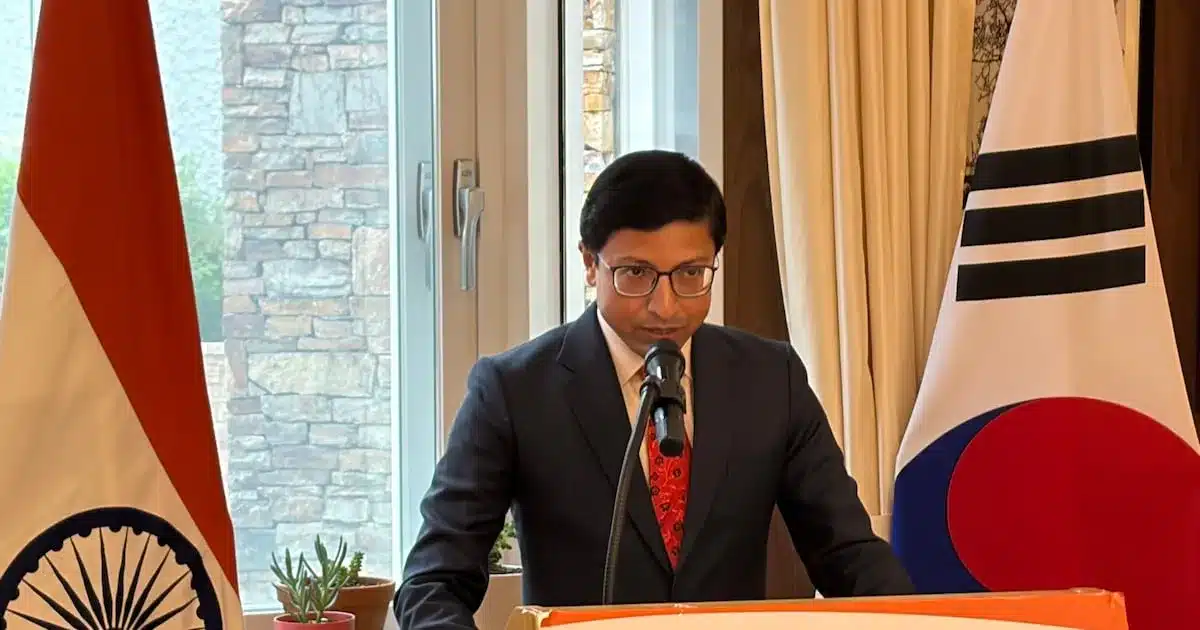
JSW India President Das emphasized the transformative impact of Prime Minister Narendra Modi on the nation’s growth trajectory during a press conference in Seoul’s Yeouido on July 7. He highlighted Modi’s leadership in steering India’s development and expressed optimism about deepening bilateral ties.
Modi’s Long-Term Vision for India
“Narendra Modi has captured the right direction for India’s development and growth,” Das stated. He described the recent national visit as a pivotal moment that strengthens bonds with Modi and the administration, showcasing tangible outcomes in bilateral relations.
The delegation visited India from June 19 to 21, engaging in direct talks with Modi to outline an investment roadmap aligned with Korea’s national growth strategies.
Das recalled Modi’s first visit to Gujarat state 25 years ago, where he urged making Gujarat “Korea’s second home.” Despite evolving circumstances, India’s industrial model continues to earn high praise for its progress.
Key Opportunities in Manufacturing and Tech
Korean firms already dominate India’s market, with Samsung leading smartphone production and Hyundai ranking second in automobiles. Discussions at the event centered on India’s ‘Viksit Bharat’ framework, aiming for advanced economy status by 2047 through massive economic expansion, job creation, infrastructure upgrades, and manufacturing acceleration.
“India plans to double its GDP per capita to 500 lakh rupees (about $72,385) by 2030,” Das noted, spotlighting collaborations in semiconductors, batteries, and artificial intelligence (AI).
India aggressively expands its semiconductor sector, positioning Korea as a prime partner due to advanced expertise. While U.S. firm Micron leads with the first packaging facility, Korean firms possess substantial untapped capacity within two years.
In AI, India offers abundant data and talent, complementing Korea’s semiconductor prowess and computing power. Das added, “India is massively scaling semiconductor capacity, and Korea provides sophisticated collaboration. India also builds large-scale battery ecosystems, with the largest U.S. Micron plant operational, yet Korea holds realistic internal potential.”
Steel Sector Synergies and Economic Shifts
India’s steel industry plays a crucial role for Korean enterprises amid rising global demand. “India drives steel consumption growth in major economies, targeting 500 million tons annually by 2040 while prioritizing low-carbon blast furnaces,” Das explained. Korean technology can significantly contribute.
The Korea-India Business Forum drew 250 Korean companies and 350 Indian firms to explore manufacturing, steel, digital economy, energy, and full-sector partnerships. Major Korean participants included Samsung Electronics Chairman, Hyundai Motor Group Chairman, LG Chairman, POSCO Holdings Chairman, and HD Hyundai Heavy Industries Chairman.
POSCO adjusted its 7.29 trillion won ($10.56 billion) investment with JSW Group for an India steel mill. Hyundai advanced joint EV development worth 3 trillion won with TVS Motor Company, focusing on lightweight and autonomous driving.
Future Collaborations and Events
Das announced plans for the inaugural ‘India Day 2026’ in Korea starting July 16, underscoring timely alignment amid global shifts like political uncertainties, supply chain disruptions, energy risks, and AI-driven transitions.
“Such timing makes expanding future-oriented cooperation with high-potential partners like India most essential,” he concluded.
