

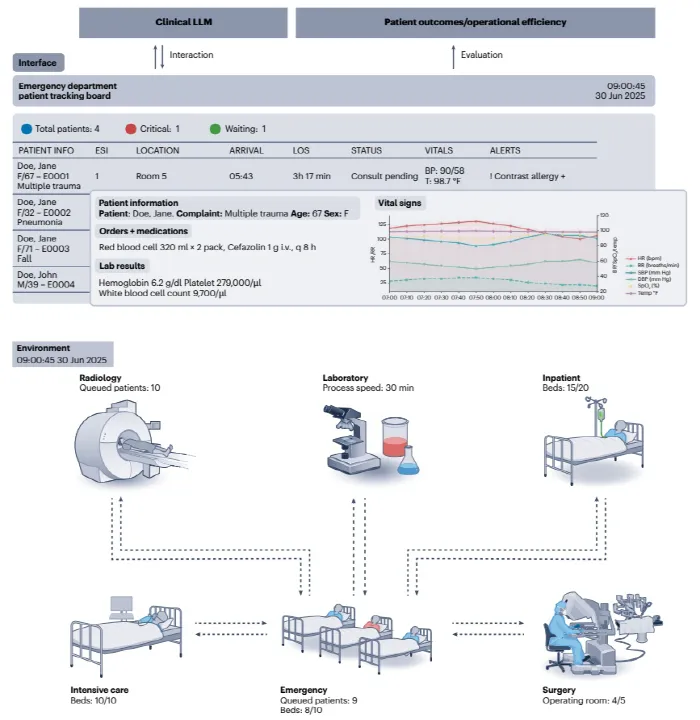
A pioneering virtual hospital simulator marks a global first in assessing medical AI performance. Researchers have developed this tool, known as the Clinical Environment Simulator (CES), to evaluate AI models in dynamic, realistic clinical settings using large language models (LLMs).
Overcoming Limitations of Traditional AI Testing
Conventional medical AI evaluations rely on static datasets, which fail to capture real-world patient variability and evolving hospital dynamics. This approach leads to discrepancies between AI predictions and actual clinical decisions. CES addresses these gaps by generating immersive simulations that mirror genuine hospital operations.
Core Components of the Simulator
The system features two key engines:
- Patient Engine: Produces comprehensive patient profiles, including demographics, symptoms, vital signs, lab results, and comorbidities.
- Hospital Engine: Simulates institutional processes like admissions, test ordering, treatment plans, and discharge procedures.
Together, these create multifaceted scenarios for precise AI judgment testing.
Real-World Validation
Testing involved 20 experienced clinicians who reviewed AI outputs alongside simulator-generated data. Results demonstrate that AI predictions align closely with professional decisions, even in complex cases involving rare diseases or time-sensitive conditions.
Clinical experts note that CES enables bias-free evaluations without risking real patients. It facilitates targeted interventions for specific demographics while minimizing spillover effects on broader diagnostic accuracy.
Potential Impact on Healthcare
This simulator paves the way for safer AI deployment. By identifying situational biases early, it ensures reliable performance across diverse patient groups. Future applications could extend to stress tests simulating high-volume surges or rare outbreaks.
Lead researcher Sung Kim states, “This virtual hospital transforms the paradigm for AI evaluation. It overcomes limitations of single-case testing, paving the way for contextually accurate diagnostics that benefit clinical practice.”
The study appears in the latest online edition of Nature Medicine, underscoring its significance in advancing AI-driven healthcare innovations.
