

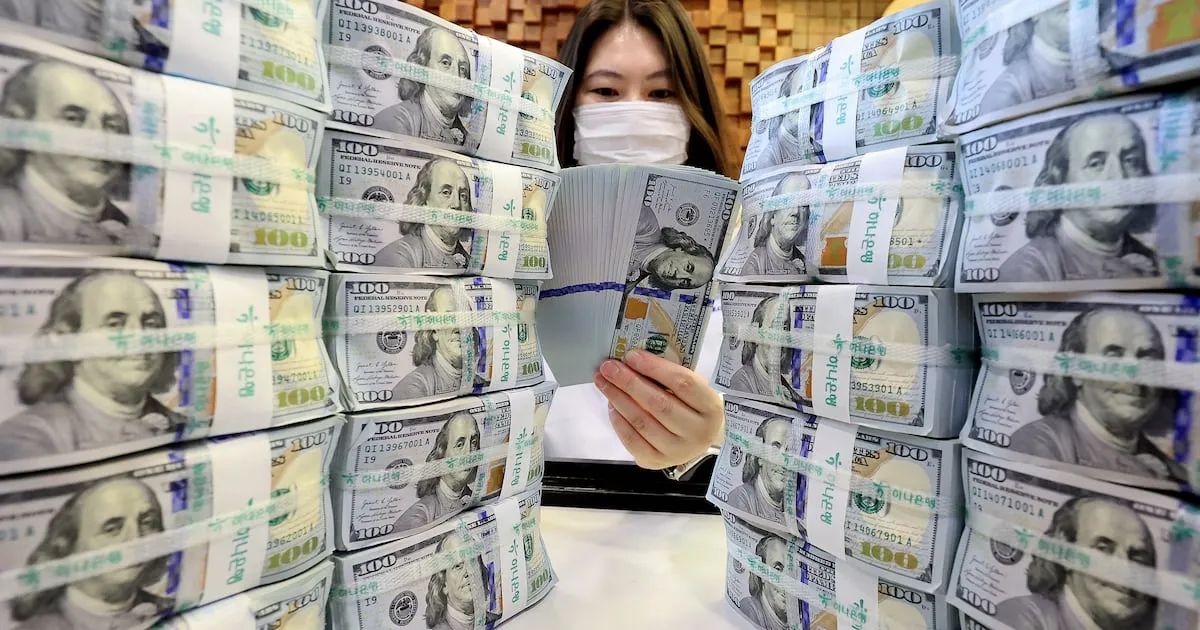
The South Korean won weakened against the U.S. dollar on August 12th, with the exchange rate falling to 1412.9 won per dollar as of 9 AM. This marks a decrease of 3 won, or 0.21%, from the previous trading day’s closing price. Analysts suggest the rate could potentially dip further into the 1400s, driven by consistent dollar sales from major export-oriented companies, including SK Hynix. The influx of dollars into the Seoul foreign exchange market is a primary factor contributing to the won’s appreciation.
Factors Influencing the Won-Dollar Exchange Rate
A report from Min Kyung-won, a researcher at Woori Bank, highlighted the sustained demand for the Korean won stemming from the robust performance of the semiconductor industry. This consistent inflow of foreign currency into the domestic market naturally puts downward pressure on the dollar’s value relative to the won.
Adding to the complexity of currency markets, international oil prices have seen an upward trend. This rise is reportedly linked to stalled negotiations regarding the lifting of sanctions on Iran. Reports indicate that Iran has refused direct talks with the United States, citing conditions related to the U.S. military presence and its own wartime evacuation protocols. The benchmark Brent crude oil price increased by 1.4% to $88.91 per barrel, reflecting these geopolitical tensions and supply concerns.
Impact on Global Markets
The surge in oil prices and broader geopolitical uncertainties contributed to a downturn in U.S. stock markets on August 11th (local time). The S&P 500 index closed down 0.32%, while the Nasdaq Composite index fell by 0.6%. Investors reacted cautiously to the developing global economic landscape, leading to a sell-off in equities.
Looking Ahead: U.S. Inflation Data as a Key Indicator
Market participants are closely watching the upcoming release of the U.S. Consumer Price Index (CPI) for July, scheduled to be announced later on the evening of August 12th (Korean time). This inflation data is anticipated to be a significant determinant of the won-dollar exchange rate in the near future.
Should the U.S. inflation rate exceed expectations, it could increase the likelihood of the U.S. Federal Reserve (the Fed) implementing further interest rate hikes. A more hawkish monetary policy stance from the Fed typically strengthens the U.S. dollar, potentially reversing the recent trend of won appreciation. Conversely, lower-than-expected inflation could lead to a more dovish outlook from the Fed, potentially weakening the dollar and further supporting the won.
Export Companies and Dollar Holdings
The ongoing sales of U.S. dollars by South Korean export companies, such as SK Hynix, play a crucial role in managing the exchange rate. These companies often hold substantial dollar reserves to manage international transactions and hedge against currency fluctuations. When these reserves are converted back into Korean won, it increases the supply of dollars in the local market, thereby lowering the exchange rate.
The semiconductor sector, in particular, has been a significant source of foreign currency inflow. Strong global demand for advanced semiconductors and the continued expansion of production capacity contribute to the consistent repatriation of export earnings by companies like SK Hynix. This sustained economic activity within a key export industry provides a fundamental support for the Korean won.
Geopolitical Factors and Oil Prices
The international oil market remains sensitive to geopolitical developments. The ongoing conflict in Eastern Europe and related sanctions have disrupted traditional supply chains, leading to price volatility. The specific situation involving Iran, as mentioned, adds another layer of uncertainty. Iran is a significant oil producer, and any changes in its export capacity due to sanctions relief or continued restrictions have a direct impact on global supply and, consequently, on oil prices.
The relationship between oil prices and currency exchange rates is well-established. For many countries, oil is a major import, and higher oil prices translate to a larger import bill, potentially weakening their domestic currency. For oil-exporting nations, the opposite is often true. In this case, rising oil prices, while potentially beneficial for some economies, contribute to global inflationary pressures, which the U.S. Federal Reserve is actively trying to combat through monetary policy.
Conclusion: A Market in Flux
The won-dollar exchange rate is currently navigating a complex interplay of domestic corporate activity, international commodity prices, and anticipated monetary policy shifts in the United States. While the immediate trend shows the won strengthening, the upcoming U.S. CPI data holds the key to the near-term direction. Investors and businesses will be closely monitoring these developments to gauge the future trajectory of the currency markets.
