

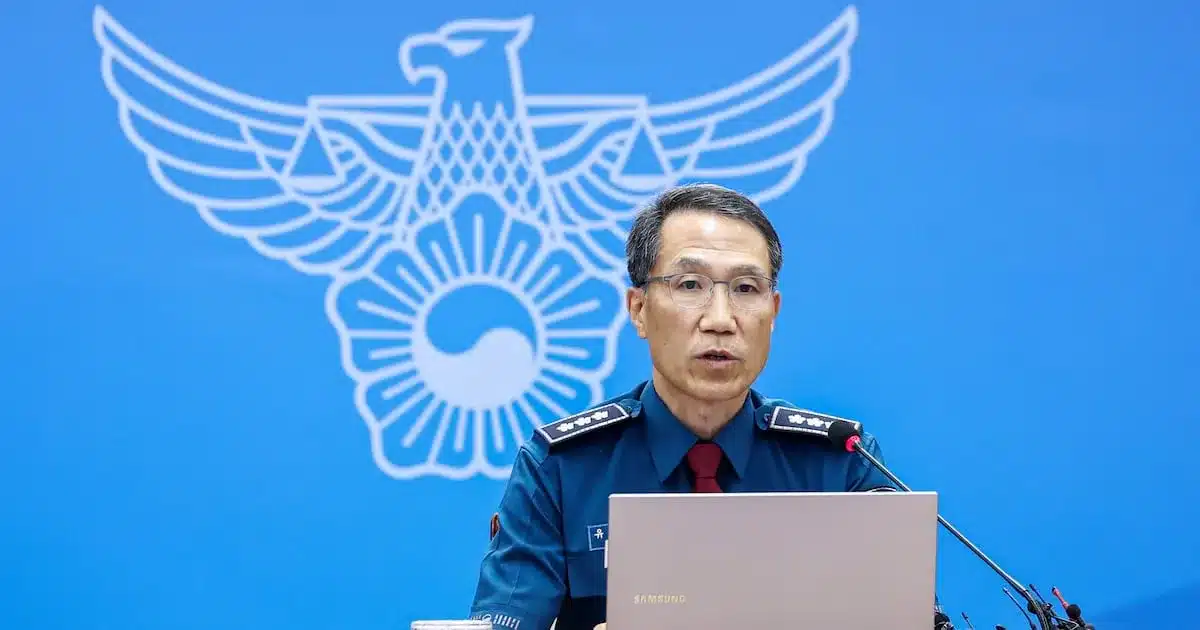
The head of the National Police Agency has stated that the existing system of requesting supplementary investigations is sufficient, even if prosecutors lose their direct investigation powers. Yoo Jae-seong, acting commissioner of the National Police Agency, conveyed this opinion during a press briefing on the 20th, emphasizing that the police are capable of handling cases effectively through the current request mechanism.
Police Agency Chief Addresses Prosecutor’s Investigation Rights Debate
Yoo Jae-seong highlighted the scale of police work, noting that approximately 1.57 to 1.58 million cases occurred last year, with the police handling 89.1% of all investigations. In contrast, prosecutors directly investigate only 1.1% of cases. “The police must investigate all cases that arise with responsibility and duty, not selectively,” Yoo stated. He further explained that while prosecutors currently hold both the power to investigate and request supplementary investigations, most cases are resolved through the latter. “If this part is solidified, it can be implemented without causing inconvenience to the public,” he added.
When questioned whether the situation would remain unchanged even if the prosecutors’ direct investigation powers were abolished, Yoo responded affirmatively. He addressed concerns that the police might not adequately implement prosecutors’ requests for supplementary investigations. Yoo assured that mechanisms are already in place for disciplinary action or reassignment if a prosecutor’s legitimate requests are not met. “Furthermore, if there are deficiencies in implementing supplementary investigation requests, we have the willingness to change the responsible team or personnel if such a request comes,” he said.
Focus on Police Improvement, Not Past Incidents
Regarding the debate surrounding the abolition of prosecutors’ investigation rights, which has gained momentum following the mishandling of the Jang Yoon-gi case (the “Gwangju female student murder” case), Yoo Jae-seong drew a line. He expressed his belief that the focus should be on how to improve the police’s shortcomings, rather than linking the Jang Yoon-gi incident to the prosecutors’ investigation rights. “I believe we should focus on how to improve the police’s issues, rather than connecting the Jang Yoon-gi case with the prosecutors’ investigation rights,” he stated.
Yoo outlined potential collaborative approaches with prosecutors. These include actively consulting with prosecutors on urgent cases that require their expertise and jointly investigating sensitive or emergency cases involving vulnerable social groups. “We will actively consult with prosecutors to ensure that even aspects not covered by law can be included in investigation guidelines,” Yoo explained.
Proposed Revisions and Police Stance on Detention Periods
The National Police Agency is reportedly considering a revision that would shorten the period for supplementary investigations to one month. However, the agency has submitted a revised opinion to the National Assembly suggesting that two months are practically necessary. In relation to the amendment of the Criminal Procedure Act, which proposes granting up to 20 days for detention, the police agency stated that they had not initially requested such a provision.
A representative from the police agency commented on the detention period, stating, “The issue of detention period is a matter for the National Assembly to decide after thorough deliberation as legislative policy.” The representative added, “If the detention period is expanded, we will diligently utilize it as a period to enhance the thoroughness of investigations involving detained suspects.”
Future Outlook and Collaboration
The ongoing discussion about the division of investigation powers between the police and prosecutors is a complex issue with significant implications for the justice system. The police agency’s stance, as articulated by Yoo Jae-seong, emphasizes strengthening their internal investigation capabilities and leveraging existing collaborative mechanisms. The focus appears to be on practical improvements and ensuring accountability within the police force, rather than on the extent of prosecutorial powers.
The proposed legislative changes, including the timeline for supplementary investigations and potential adjustments to detention periods, are subject to parliamentary debate. The police agency’s input reflects a pragmatic approach, acknowledging the need for sufficient time and resources to conduct thorough investigations while also signaling a willingness to adapt to legislative outcomes. The ultimate goal, as suggested by the agency, is to ensure effective and fair investigations that serve the public interest.
