

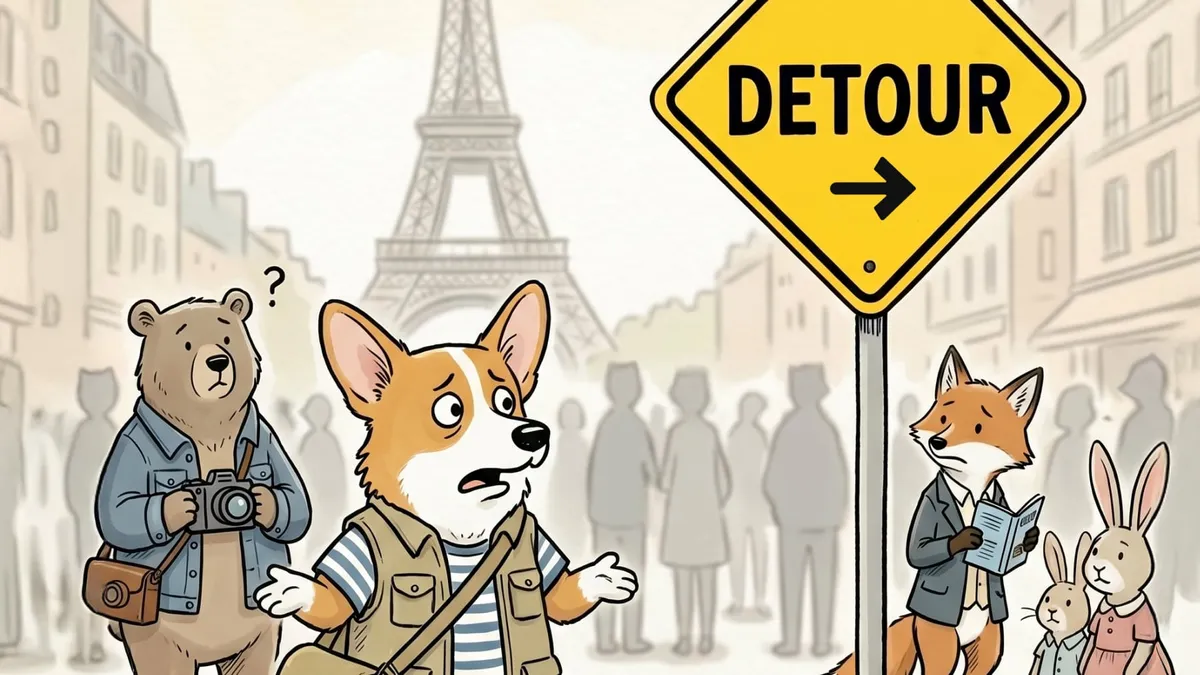
Pedestrians often spot detour signs blocking sidewalks during construction and feel puzzled. A simple yellow sign reading ‘DETOUR’ prompts thoughts like, ‘Is this a new route? Does it lead back to the main path?’ Rerouting around massive public works or golden shovel events means entering narrow alleys via detour boards.
What ‘Detour’ Actually Means
Unlike ‘tour,’ which suggests a leisurely circuit, ‘detour’ derives from ‘de-‘ (meaning away, off, or aside) combined with ‘tour’ (to circuit). Together, they form a phrase implying ‘taking a circuitous route around an obstacle.’
Typical Reactions to Detour Signs
- Basic expression: ‘Oh, it’s a detour. We need to go around.’
- Neutral: ‘I was headed to the station, but got caught in a detour.’
- Frustrated: ‘I followed the detour signs, but I ended up getting lost.’
Phrases like ‘I’m headed to ~’ translate to ‘I’m on my way to ~’ or ‘I’m heading toward ~,’ revealing the speaker’s immediate intent. Even without knowing the way, such expressions convey anxiety and curiosity.
Why Detours Frustrate Walkers
Seeing a detour sign sparks doubt, forcing a longer route. Especially in crowded city blocks, missing one sign leads straight to a dead end, heightening frustration.
Smart Navigation Tips
If a detour sign appears, pause and reset your route using Google Maps or Apple Maps in walking mode. These apps reliably guide back to the main path, even in real-time traffic.
Pedestrian detours differ from vehicle ones. Drivers follow marked signs to full roads, while walkers need updated routes accounting for alleys and charm.
Questions to Ask About Detours
- Is the sidewalk closed ahead?
- Is the detour marked?
- How far does the detour go?
- Is there a quicker way back to the main street?
- I’m headed to the museum. Is this the right way?
Phrases When Lost on a Detour
- I think I missed the detour sign.
- Can you show me on the map where the detour is?
- Sorry to bother you. Is this street open to pedestrians?
- I got turned around. Which way should I be going?
