

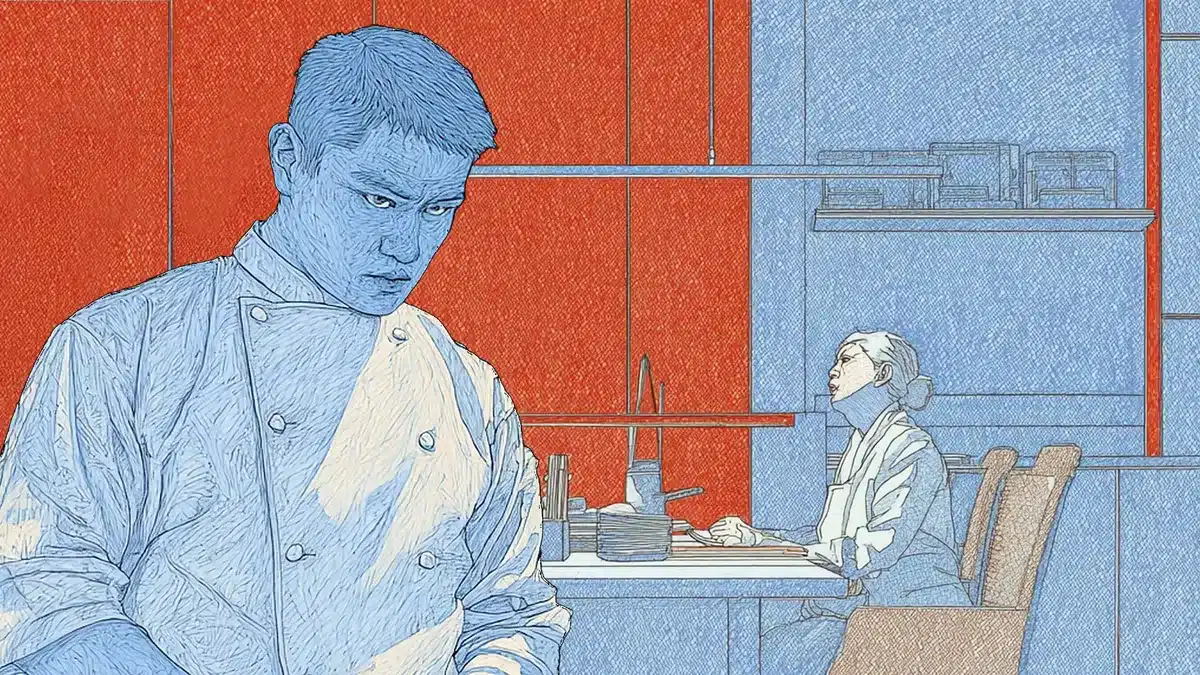
A Culinary Battle for Authenticity
My journey in the culinary world began in a humble 7-pyeong tonkatsu shop in Bundang. Word-of-mouth referrals from neighborhood children and their mothers propelled my business forward, allowing me to expand to a 24-pyeong space and establish a thriving izakaya.
The restaurant quickly became a hub of influence, attracting prominent figures. At one table sat officials from the National Intelligence Agency, while another hosted executives from major corporations and university vice-presidents. It was a testament to the establishment’s success.
An Unpleasant Encounter
One particular day, a middle-aged woman, adorned in a dazzling diamond set and doused in a perfume that rivaled a fire hydrant’s spray, approached the counter. She was, I later learned, the wife of a wealthy family.
I, Chef Kim Won-il, have dedicated over 50 years to the art of cooking, starting in hotel kitchens during high school. I am a chef who relentlessly pursues perfection, battling not only ingredients but also demanding customers. I will now share my life’s story with you, the readers. Join me in ‘The Knife’s Song’ on Membership.
I immediately sensed that her overpowering perfume would mar the delicate flavors of my meticulously prepared dishes. Perfume, I believe, dulls not only one’s own palate but also that of those around them. This is why high-end restaurants in France and Japan have dress codes, and why wearing perfume while cooking is strictly prohibited.
The woman ordered a simple set, mentioning her regular spot in Cheongdam-dong and requesting daikon radish, cucumber, and ssamjang. I politely explained, “I apologize, madam. This is a Japanese restaurant, not a common izakaya in Gangnam.”
She retorted, “What’s the difference? Isn’t it all the same?”
I patiently elaborated. ‘Il-sik’ (일식) is a term coined by Korean chefs to imitate Japanese culinary methods. While ssamjang, vegetables, and sukida-shi served together might be customary, they are not ‘cuisine.’ In Japan itself, the term ‘il-sik’ is nonexistent; only ‘Japanese cuisine’ or ‘Washoku’ exists.
A Clash of Culinary Philosophies
My resolve grew firmer, and so did her resistance. Even when presented with my carefully crafted sashimi dipping sauce, she became agitated, demanding simple ketchup instead. The nearby presence of a renowned food critic, who had just exclaimed, “This is truly delicious!” seemed to have triggered her outburst. “Look at this! What kind of establishment is this?!” she fumed.
Unable to contain my frustration, I instinctively offered, “Here, have some of my sake.” However, I immediately retracted the offer, stating, “As a chef, I wield a knife. Drunken cooking is far more dangerous than drunken driving.”
She responded with aggression, “What makes you so special? Gangnam chefs are good at pleasing customers. Do you want to die?”
The situation escalated further. Though seemingly apologetic for her outburst, she then insisted, “Have a drink with me.” I refused, reiterating my stance on the dangers of alcohol in a professional kitchen.
“Are you serious? Who do you think you are?” she challenged, her voice rising. The accompanying guests and her sister-in-law attempted to intervene, but to no avail. The former National Intelligence Agency director, observing from the back, signaled me to escort her out. To de-escalate, I led her outside.
In front of all the patrons, I shouted, “Hey, let’s go to a hotel.” The absurdity of the situation was lost on her; she lunged at me, attempting to scratch me with her fingernails. I blocked her attack, and deep scratches from her nails remain on my right arm even after 30 years, a permanent reminder of that night.
A Legacy of Integrity
Many have called me stubborn. Indeed, my fiery temper has led to numerous conflicts. I even injured my own apprentice, a story I will share formally at a later time.
My unwavering dedication stemmed from a deep-seated desire to combat the “Korean-style izakaya culture.” I aimed to uphold sincerity in my craft, respect for ingredients, and the dignity of a chef. These principles were paramount.
Since then, I have authored numerous books, generously sharing over 80% of my culinary knowledge. This has led many of the so-called izakayas in Gangnam and across the city to reconsider their practices. However, the remaining 20% of my secret techniques remain guarded. From the very beginning of my culinary journey, the numerous patrons I’ve encountered, the methods of preparing ingredients, and even my own embarrassing past, I wish to share honestly with the readers of Membership. Thank you to those who have read this first installment.
Chef Kim Won-il: A third-generation Japanese culinary master, a graduate of Abeno Gakuen Culinary School with over 50 years of experience. Known as ‘the chef who writes books,’ he has authored over 100 books, including ‘Traditional Japanese Cuisine.’ He is currently compiling a comprehensive encyclopedia of 6,700 culinary techniques.
