

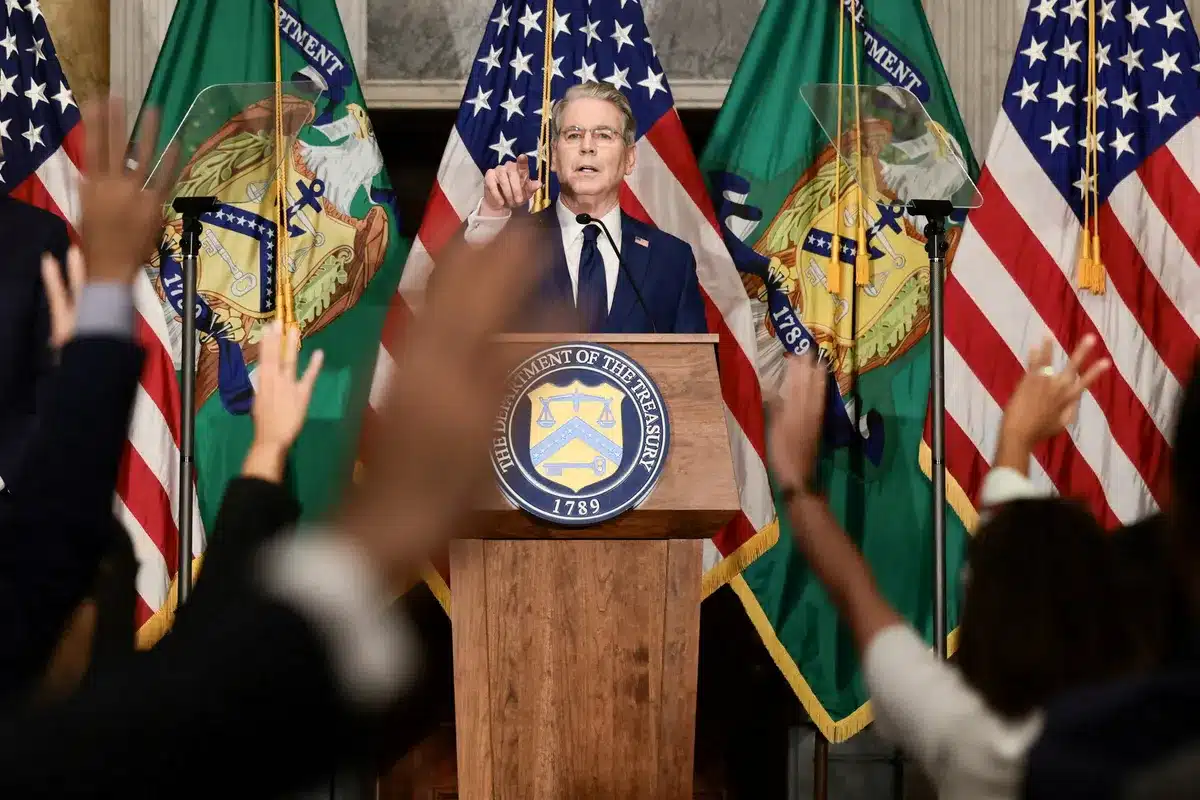
The United States has launched a significant escalation of its economic pressure campaign against Iran, dubbed ‘Operation Economic Outcast.’ This initiative aims to cripple Iran’s finances by cutting off its revenue streams, with a core strategy of imposing secondary sanctions on third-country entities and banks that engage in transactions with Iran. This move comes as the Trump administration shifts its focus from potential military action to intensified economic sanctions, particularly with the US midterm elections on the horizon.
US Treasury Details Broad Sanctions Expansion
Treasury Secretary Steven Mnuchin announced the comprehensive plan, stating, “The U.S. Treasury has identified all of the deceptive practices, all of the intermediaries, and all of the networks that Iran has used to move its oil and evade sanctions.” He further elaborated that starting immediately, the administration would “tighten the screws” on Iran, aiming to block all potential revenue sources that fund the Islamic Revolutionary Guard Corps (IRGC) and the broader Iranian regime.
However, Iran has spent years developing methods to circumvent US sanctions, establishing alternative trade networks. This existing resilience raises questions about the effectiveness of the new measures, with some analysts suggesting that achieving a complete international isolation of Iran may prove elusive without the cooperation of major trading partners like China.
Iranian officials have responded with defiance. Mohammad Bagher Ghalibaf, Speaker of the Iranian Parliament, tweeted, “I know that even the Americans will not believe their own bluster.” Ali Salehabadi, Iran’s Minister of Economy and Finance, stated that the government has prepared a two-year economic plan to counter the sanctions and is ready for any eventuality.
Shifting Strategy: Economic Warfare Amidst Elections
The decision to ramp up economic sanctions, rather than pursuing large-scale military operations, is seen by many as a strategic pivot by the Trump administration. This approach is particularly notable given the administration’s declining approval ratings and the upcoming midterm elections, which often influence foreign policy decisions.
Decades of Sanctions: What’s Different This Time?
US economic sanctions against Iran are not a new phenomenon. For over four decades since the 1979 Islamic Revolution, the US has imposed restrictions on key sectors of the Iranian economy, including finance, energy, petrochemicals, automotive, and metals. During the first Trump term, following the US withdrawal from the Joint Comprehensive Plan of Action (JCPOA) in 2018, the focus intensified on Iran’s oil exports and financial transactions.
The current measures distinguish themselves by their expanded scope and increased enforcement rigor. A key element is the imposition of ‘secondary sanctions’ on third-country companies and financial institutions involved in transactions with Iran across five critical areas: digital assets, technology, gold, aviation, and maritime trade. Mnuchin described these as “five lifelines” that Iran has been using.
According to the US Treasury, Iran has utilized virtual currency to evade sanctions and facilitate funding for entities like the IRGC. Foreign technology is reportedly being used for weapons development. Gold has become a tool to combat the declining value of the Rial and high inflation. Aviation and maritime networks are identified as crucial channels for oil smuggling and the transport of sensitive materials and dual-use goods related to missile programs. The Treasury’s Office of Foreign Assets Control (OFAC) also separately sanctioned over 60 foreign entities and individuals, including shipping firms, for supporting Iran’s missile programs, cyber activities, and oil procurement.
Mnuchin emphasized a “zero leakage” principle, vowing to prevent any funds from escaping the sanctions regime. Uniquely, this operation involves not just expanding the list of sanctioned entities but also demanding concrete actions and setting deadlines for third countries.
President Trump has reportedly been directly contacting world leaders to urge them to cease trade with Iran. “Every country has a clear deadline for us to stop the activities we have identified,” Mnuchin stated.
Significant Hurdles Remain for US Policy
China represents the most significant challenge to the effectiveness of these sanctions. As Iran’s largest crude oil customer in recent years, China has provided a vital economic lifeline. Data from oil market analytics firm Kpler indicates that while Iranian oil exports to China decreased from 823,000 barrels per day in July to 534,000 barrels per day in August, they continue despite increased US maritime interdictions.
For the US to genuinely cut off Iran’s oil revenue, it would need to target not only Chinese oil companies but also the banks facilitating these transactions. However, excluding major Chinese financial institutions from the dollar-based financial system could destabilize US-China relations and the global financial markets.
Furthermore, Iran’s proven ability to adapt to sanctions presents another obstacle. For decades, Iran has circumvented restrictions by utilizing shell companies, brokers, offshore accounts, and front companies. They have continued oil exports through mechanisms like altering the declared origin of crude oil, manipulating vessel tracking data, and engaging in barter trade or using currencies other than the US dollar. When specific companies or vessels face sanctions, Iran has historically formed new legal entities and vessels to continue operations.
Military Strikes: A Diminishing Prospect?
The announcement of the economic pressure campaign has also brought renewed attention to the possibility of continued military strikes against Iran. Following Iran’s downing of a US drone over the Strait of Hormuz on June 20th, the US military targeted IRGC drone bases. However, no significant retaliatory strikes of comparable scale have occurred since then.
The Pentagon has not ruled out further military action. Defense Secretary Mark Esper stated on June 24th that the US “absolutely reserves the right to use military force” in response to any physical attacks in the Strait of Hormuz or elsewhere. Despite this, many observers believe that launching large-scale military operations is unlikely given the political climate surrounding the upcoming elections and declining public support for military intervention.
A Reuters-Ipsos poll released on June 24th indicated that only 31% of Americans supported military action against Iran. A significant 83% of respondents predicted the conflict would escalate into a long-term engagement. President Trump’s approval rating for his handling of the presidency also hit a record low of 33% in this poll, the lowest of his first and second terms combined.
Declining stockpiles of key missile defense systems, such as the Tomahawk cruise missile, Patriot missile defense systems, and THAAD (Terminal High Altitude Area Defense) systems, also pose a logistical challenge to any renewed military engagement. Consequently, the Trump administration is likely to maintain the option of military force as a last resort while prioritizing economic sanctions to cut off Iran’s funding and trade networks until the elections.
However, some analysts caution that if Iranian leadership perceives the US shift to economic pressure as a sign of military failure, they might adopt a more aggressive stance, potentially launching attacks across the region. This could lead to a full-scale military confrontation, contrary to the administration’s current strategy.
There is also a possibility that Iran, while maintaining its strategy of endurance, could escalate its actions, such as further tightening blockades in the Strait of Hormuz. Mohsen Rezaei, Secretary of Iran’s Supreme National Security Council, stated on June 22nd that any country participating in US sanctions would be considered an enemy. He warned that “not a drop of oil will be able to leave the Strait of Hormuz,” and other oil export routes would also be targeted.
What are Secondary Sanctions?
Secondary sanctions involve imposing penalties on individuals, entities, or countries that conduct business with a primary sanctioned target. Also known as a secondary boycott, this tactic aims to isolate the primary target by disrupting its supply chains and trade relationships, thereby increasing pressure.
