

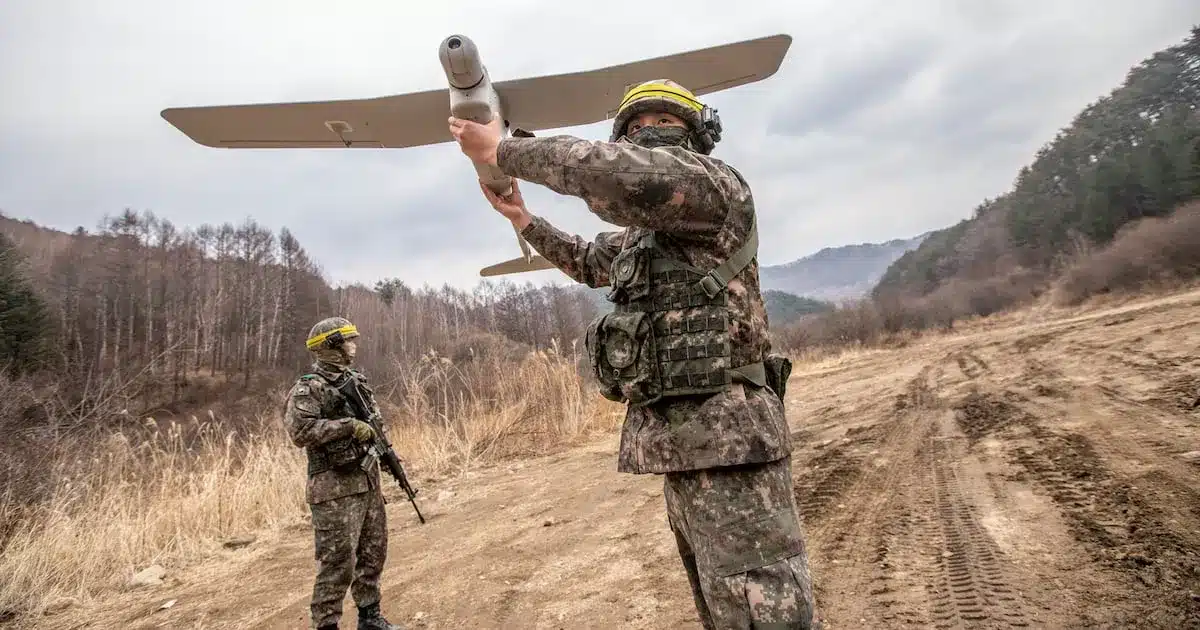
In a significant development concerning a protracted legal battle, Korean Air (003490) has secured a partial victory in its appeal against the Defense Acquisition Program Administration (DAPA) regarding a dispute over the delivery of unmanned aerial vehicles (UAVs). The Seoul High Court upheld a lower court’s decision, meaning DAPA will not receive the full amount of damages it sought, and Korean Air is partially absolved of the substantial penalties initially imposed.
Background of the UAV Contract Dispute
The core of the legal conflict stems from a contract signed in December 2015 between Korean Air and DAPA for the supply of 16 sets of reconnaissance UAVs intended for military surveillance. Korean Air was contracted to deliver these sophisticated systems, but the project faced significant delays. DAPA attributed these delays to Korean Air and sought to impose penalties, known as liquidated damages, totaling over 200 billion Korean won (approximately $150 million USD at the time of the initial claim). Liquidated damages are pre-agreed amounts stipulated in a contract to be paid if a party fails to meet its obligations within the specified timeframe.
Korean Air’s Position and Initial Lawsuit
Korean Air contested DAPA’s claims, arguing that the company was not solely responsible for the delivery delays. The airline asserted that external factors, including changes in the military’s required specifications, testing schedules, and adverse external conditions, contributed significantly to the project’s timeline. In April 2021, Korean Air filed a lawsuit seeking confirmation of the absence of debt, challenging the validity of DAPA’s demand for liquidated damages. The company maintained that it should not bear the full financial burden for delays caused by circumstances beyond its control.
The Lower Court’s Ruling and DAPA’s Counterclaim
The initial ruling by the Seoul Central District Court in February of the previous year partially sided with Korean Air. The court acknowledged that the delivery delays were not solely attributable to the airline. Consequently, DAPA’s claim for 213.1 billion Korean won in liquidated damages was largely dismissed. The court determined that factors such as changes in DAPA’s specifications, the impact of the COVID-19 pandemic, and deteriorating weather conditions had indeed affected the project’s progress. However, the court did recognize that approximately 10% of the contract value, amounting to about 25.4 billion Korean won, should be borne by Korean Air as liquidated damages.
Based on this, the lower court ordered DAPA to pay Korean Air approximately 40.4 billion Korean won. This figure was derived by offsetting the 25.4 billion won in liquidated damages that Korean Air was deemed responsible for against a larger payment of 65.8 billion won that DAPA owed Korean Air for the contract. DAPA, dissatisfied with this outcome, had also filed its own counterclaim seeking 156.3 billion Korean won in damages from Korean Air.
The Appellate Court’s Decision
On January 20th, the Seoul High Court, presided over by Presiding Judge Nam Sung-min, heard the appeals from both parties. In its judgment, the appellate court dismissed both appeals entirely. This means the original ruling stands, confirming that Korean Air is required to pay approximately 40.4 billion Korean won to DAPA. Crucially, DAPA’s counterclaim for 156.3 billion Korean won was also rejected, reinforcing the lower court’s finding that DAPA was not entitled to such extensive damages.
The court’s decision to dismiss both appeals signifies that the initial judgment’s framework and payment amounts remain in effect. The ruling implies that the court found the initial assessment of shared responsibility and the resulting financial obligations to be fair and well-founded, considering the complex factors that led to the delivery delays.
Implications of the Ruling
This appellate ruling provides a degree of closure to a significant financial dispute that has been ongoing for years. For Korean Air, the partial victory means avoiding the full brunt of the substantial liquidated damages initially sought by DAPA. The confirmation that external factors played a role in the delays mitigates the airline’s financial exposure. The rejection of DAPA’s counterclaim also prevents a further escalation of financial penalties against the company.
For DAPA, while the full amount of damages sought was not awarded, the upholding of the initial ruling means that Korean Air will still be required to pay a portion of the liquidated damages. The court’s decision acknowledges that some responsibility for the delays lies with the contractor, Korean Air.
Future Considerations
The case highlights the complexities involved in large-scale defense procurement contracts, particularly when technological advancements, evolving military requirements, and unforeseen global events intersect. Both government agencies and defense contractors must meticulously manage contractual obligations, clearly define responsibilities, and maintain open communication to navigate potential challenges. The legal precedent set by this case may influence how future disputes over contract performance and delays are handled within South Korea’s defense sector.
As the final decision stands, the focus now shifts to the execution of the court’s order, ensuring that the agreed-upon payments are made. This resolution, while perhaps not entirely satisfactory for either party, brings an end to this particular chapter of the UAV delivery dispute.
