

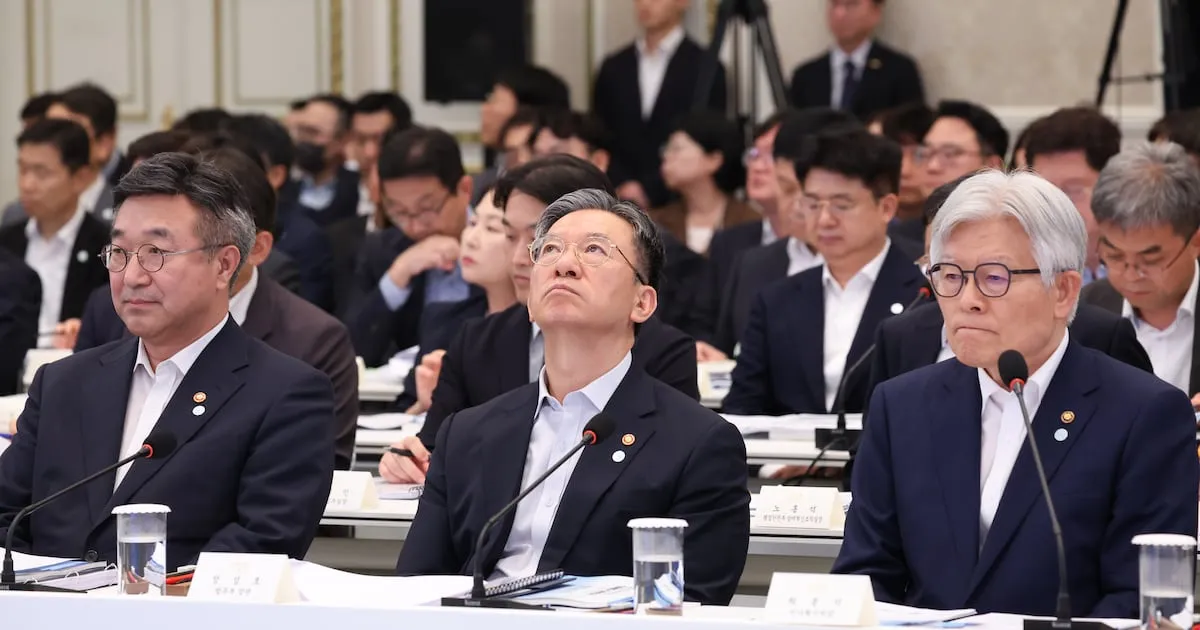
South Korea is navigating a significant shift in its legal framework following amendments to the Criminal Procedure Act, which curtail the investigative authority of prosecutors. President Yoon Suk-yeol convened a government meeting to discuss the establishment of new joint investigative bodies designed to compensate for the reduced prosecutorial powers. This move aims to ensure thorough and swift investigations into major cases while addressing public concerns about the evolving roles of prosecutors and the police.
Addressing Public Concerns Over Reduced Prosecutorial Powers
President Yoon expressed concerns about the public’s apprehension regarding the division of investigative and indictment powers between prosecutors and the police. “While the prosecution’s supplementary investigation role may not be a 100% solution, its absence is causing significant worry,” President Yoon stated during a briefing at the Yongbingwan in Cheong Wa Dae. He highlighted that the recent amendments, which limit prosecutors’ direct investigative scope, have amplified these concerns among citizens.
In response, Minister of the Interior and Safety, Lee Sang-min, presented measures to ensure that the police and the Corruption Investigation Office for High-ranking Officials (CIO) maintain primary investigative responsibilities without compromising the effectiveness of investigations. Minister Lee assured that while the direct relationship between prosecutors and the police regarding investigations is being redefined, mechanisms for joint investigation into significant cases are being considered.
Debate Over the Legal Basis for Joint Investigation Units
The discussion also touched upon the existing and future structures of joint investigative bodies. Minister of Justice, Han Dong-hoon, voiced skepticism about the current legal foundation for such units. “The operational basis for joint investigation units is very weak. From my perspective, it is virtually non-existent,” Minister Han stated. He further elaborated that when prosecutors participate in investigations, issues arise concerning their evidentiary capabilities during retrials, effectively hindering their investigative role.
President Yoon inquired if the amended law explicitly prohibits prosecutors from conducting investigations. Minister Han confirmed, “That is correct. The legal basis for any investigation by prosecutors has been removed.” When the President pressed further, asking if it was now prohibited, Vice Minister of Justice, Lee Won-seok, clarified that the revised law is designed to prevent prosecutors from fully exercising investigative authority. He warned that direct prosecutorial involvement in investigations could lead to disputes over the legality of such actions.
Minister Lee Sang-min suggested that the future might see the formation of a joint investigative unit involving the prosecution, the CIO, and the police. “Given that the current prosecutorial-police joint investigation unit does not have a clear legal basis in the Criminal Procedure Act, it is likely that a joint investigative unit encompassing the prosecution, CIO, and police will be established going forward,” he proposed.
Redefined Roles Within New Investigative Structures
President Yoon sought clarification on the role of prosecutors within this proposed joint structure. He asked if prosecutors would be limited to reviewing legal opinions, providing advice, and handling applications for arrest warrants, rather than conducting direct investigations. Minister Lee affirmed this, stating, “Yes. While they won’t have direct investigative powers, they can still offer opinions on investigations.”
Minister of Government Legislation, Cho Won-cheol, outlined a potential structural change where the Central Investigation Department of the Supreme Prosecutors’ Office, which previously handled significant investigations, would see its functions largely assumed by the CIO. The prosecution’s role would then shift to providing legal advice and support, such as legal opinions, to the CIO.
President Yoon emphasized the need for proactive planning regarding the operation of existing joint investigation units during the preparation phase for strengthening the CIO. “It is necessary to proactively consider how to operate the major joint investigation units currently in operation as we prepare for the CIO’s enhanced role,” he advised.
Challenges in Fact-Finding and Evidence Verification
Vice Minister Lee Won-seok highlighted the difficulties faced by the prosecution under the revised law, particularly when dealing with cases initially handled by the police. “The police will submit cases that are not meticulously investigated to the prosecution. It is very difficult to make judgments based solely on records, without the ability to reinvestigate, and there were no methods to understand the actual circumstances in the past,” he explained.
He added that while the revised law introduces a system for verifying factual relationships, allowing for the collection of statements, it does not equate to a full investigation. “This system allows for the confirmation of factual relationships and the use of such verified materials as evidence, but it does not reach the level of an investigation,” Vice Minister Lee stated.
President Yoon countered, suggesting that collecting statements could be interpreted as a form of investigation, even if not explicitly labeled as such. Vice Minister Lee reiterated that the law clearly defines this process as distinct from an investigation, with specific provisions allowing the use of fact-verification materials as evidence.
Legislative Background and Future Implications
The amended Criminal Procedure Act, spearheaded by the Democratic Party, passed a plenary session of the National Assembly on April 31st. The government subsequently held a National Security Council meeting on May 4th to deliberate and approve the promulgation of the revised laws, including the Criminal Procedure Act.
This legislative overhaul signifies a substantial redistribution of power within South Korea’s justice system, aiming to create a more balanced approach to criminal investigations and prosecutions. The establishment of new joint investigative bodies and the redefined roles of various agencies are expected to shape the future of law enforcement and judicial processes in the country.
