

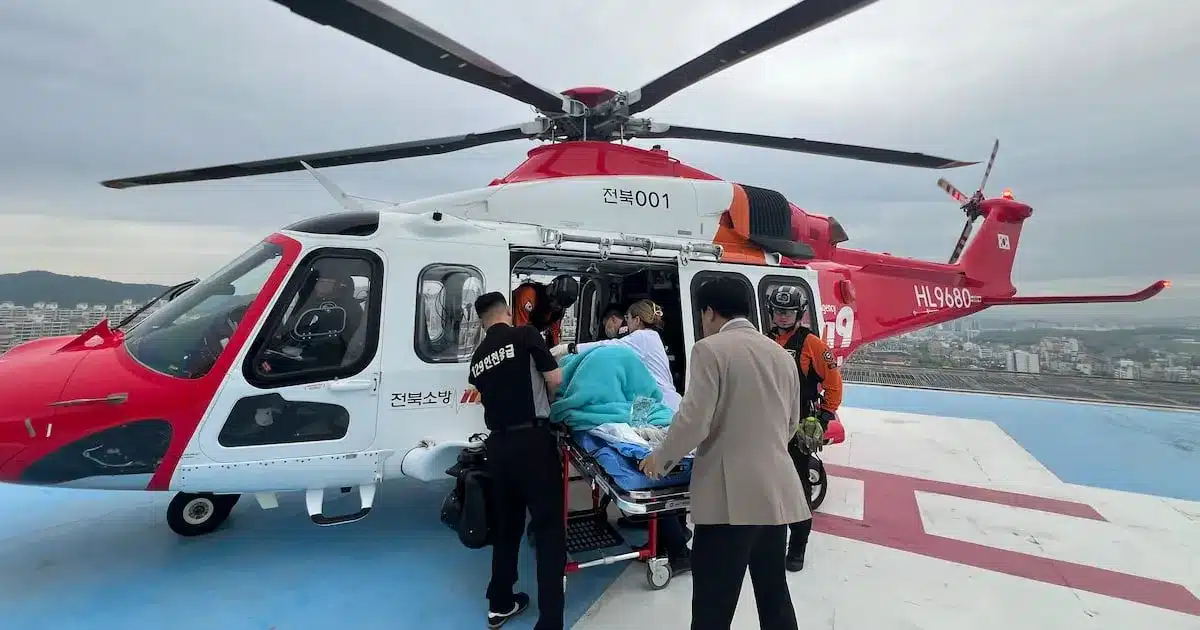
A massive nationwide helicopter operation saved 25 crew members, including a pregnant woman experiencing preterm labor, from a sinking cargo ship off South Korea’s coast.
Emergency Distress Call Triggers Unprecedented Response
On the evening of October 20, at around 8:18 p.m., control centers received a distress signal from a cargo ship indicating it was sinking while carrying a 25-week pregnant crew member who had suddenly gone into early labor. The vessel, located near Jeju City, faced immediate peril as the pregnant individual had a prior history of cervical cerclage surgery to prevent premature birth.
Engine failure threatened to send the ship drifting eastward amid strong waves and winds, heightening the risk to all aboard.
Nationwide Mobilization of 14 Helicopters
Large support vessels reached the scene first, assessed the critical conditions, and coordinated with the national operations center to adjust rescue plans. In response, authorities dispatched a record 14 helicopters, including specialized water rescue units, marking the largest such effort to date.
The flagship fire helicopter transported the entire crew of 25, including the pregnant woman and captain, nonstop for 360 kilometers to the mainland. Medical teams now provide ongoing safety care at a hospital.
Recent Pattern of Daring Sea Rescues
This operation follows a similar helicopter rescue on October 18. In Gangwon Province’s Yeongwol County, responders airlifted 13 survivors from a shipwreck. However, securing onboard medical staff proved challenging at the site.
Operations teams swiftly redirected Gyeonggi Province’s No. 2 fire helicopter, embarking hospital personnel en route to the location. The aerial path covered 82 kilometers nonstop, shaving 19 minutes off ground travel times.
Experts note that integrated fire helicopter systems enable rapid, nationwide coverage, even in remote maritime zones lacking local response units.
Leadership Emphasizes System Efficiency
National Fire Agency Chief Kim Sung-ryong stated, “Even in remote areas, concentrating essential urgent system performance nationwide allows even, dense public services, ensuring unmanned regions receive prompt care.”
