

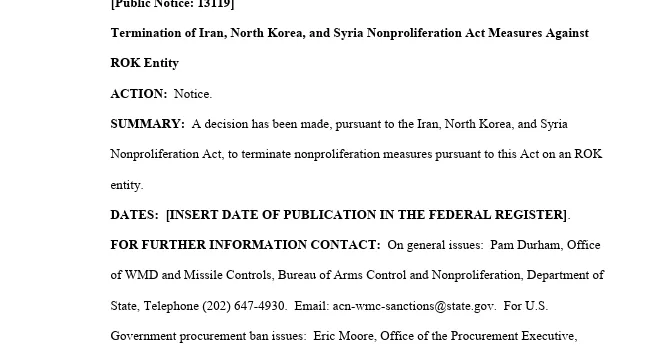
The United States has terminated sanctions against a South Korean company, JS Research, which were imposed seven months ago due to alleged violations related to weapons of mass destruction (WMD) and missile development. The sanctions, initially slated to last for two years, were lifted earlier than anticipated. The U.S. Department of Defense announced on July 27th that it had decided to end the non-proliferation sanctions that had been applied to JS Research, its successor entities, and its Hawaiian subsidiary and affiliates. This decision effectively concludes the sanctions that were initially imposed on January 22nd under the Iran, North Korea, and Syria Non-Proliferation Act (INKSNA).
Background on INKSNA and Sanctions
The INKSNA law empowers the U.S. government to sanction foreign individuals or entities involved in the transfer of goods or technologies related to the development of weapons of mass destruction or missiles by Iran, North Korea, or Syria. JS Research was designated for sanctions in January alongside other entities, including North Korean national Choi Chol Min, North Korea’s Second Academy of Natural Sciences Foreign Affairs (SANS FAB), and companies based in China, Lebanon, and the United Arab Emirates.
The U.S. Department of Defense’s announcement, which was pre-released on July 4th, confirmed the termination of the sanctions and the date of the decision. However, the specific reasons for lifting the sanctions were not detailed in the public notice. The early termination has drawn attention to potential shifts in U.S. policy towards Syria. JS Research’s designation was reportedly linked to transactions with Syria, a country against which the U.S. has recently been easing sanctions.
Implications of the Sanctions Termination
The lifting of sanctions on JS Research after a relatively short period of seven months suggests a potential reassessment by the U.S. government of the company’s activities or a broader strategic adjustment concerning Syria. While the exact justifications remain undisclosed, the move could signal a less confrontational approach or a recognition that the initial grounds for sanctions no longer warrant continued punitive measures.
South Korean companies operating internationally often face scrutiny regarding compliance with U.S. export controls and non-proliferation regulations. The initial imposition of sanctions on JS Research likely stemmed from intelligence or evidence suggesting involvement in activities that contravened U.S. laws aimed at preventing the spread of WMD and missile technology. Such sanctions can severely impact a company’s ability to conduct international business, access financial markets, and engage in trade with U.S. entities or those operating under U.S. jurisdiction.
Potential Reasons for Early Termination
Several factors could have contributed to the early lifting of sanctions:
- Re-evaluation of Evidence: The U.S. government may have re-evaluated the evidence against JS Research and found it insufficient to warrant continued sanctions, or perhaps the company provided satisfactory assurances regarding its future operations.
- Cooperation and Compliance: JS Research might have cooperated with U.S. authorities, providing information or agreeing to specific compliance measures that satisfied the U.S. government.
- Policy Shift Towards Syria: As noted, the U.S. has been gradually easing sanctions on Syria. The termination of sanctions on a company linked to Syria could be part of this broader policy adjustment, perhaps aimed at encouraging specific outcomes or engaging with certain actors.
- Diplomatic Considerations: The decision could also be influenced by diplomatic considerations, potentially involving discussions with the South Korean government or other international partners.
- Company Restructuring: The mention of “successor entities” suggests that JS Research may have undergone internal restructuring, and the new entities may not be subject to the same sanctions regime or have demonstrated a commitment to compliance.
U.S. Sanctions Policy and International Trade
The U.S. utilizes sanctions as a significant tool in its foreign policy arsenal to achieve objectives ranging from counter-terrorism and non-proliferation to promoting human rights and deterring aggression. While intended to exert pressure and compel behavioral changes, sanctions can also have unintended consequences on international trade, supply chains, and the economies of targeted or associated entities.
For companies like JS Research, being placed on a sanctions list can be devastating. It often leads to asset freezes, prohibitions on transactions with U.S. persons and entities, and reputational damage that can deter business partners globally. The lifting of such sanctions, especially ahead of schedule, offers a critical reprieve and allows the company to resume normal business operations.
The Role of Non-Proliferation Efforts
The INKSNA sanctions regime is specifically designed to combat the proliferation of WMD and missile technology. These efforts are crucial for global security, aiming to prevent dangerous materials and expertise from falling into the wrong hands. Companies operating in sensitive sectors, such as advanced materials and technology, must exercise extreme diligence to ensure their products and services are not diverted for illicit purposes.
The case of JS Research highlights the complexities involved in enforcing non-proliferation laws. Determining culpability, investigating alleged violations, and deciding on appropriate sanctions, as well as their duration, requires careful consideration of intelligence, legal frameworks, and geopolitical factors. The early termination suggests that the U.S. government’s assessment evolved, leading to the removal of JS Research from the sanctions list.
Looking Ahead
The official announcement of the sanctions termination is expected in the U.S. Federal Register on August 8th, according to the local time. This formal step will signify the complete removal of JS Research and its associated entities from the U.S. sanctions list. The company and its stakeholders will likely be keen to understand the full implications and to rebuild its business relationships following the period of restriction. The U.S. Department of Defense’s decision underscores the dynamic nature of sanctions policy and the ongoing efforts to balance national security interests with international trade and diplomatic relations.
