

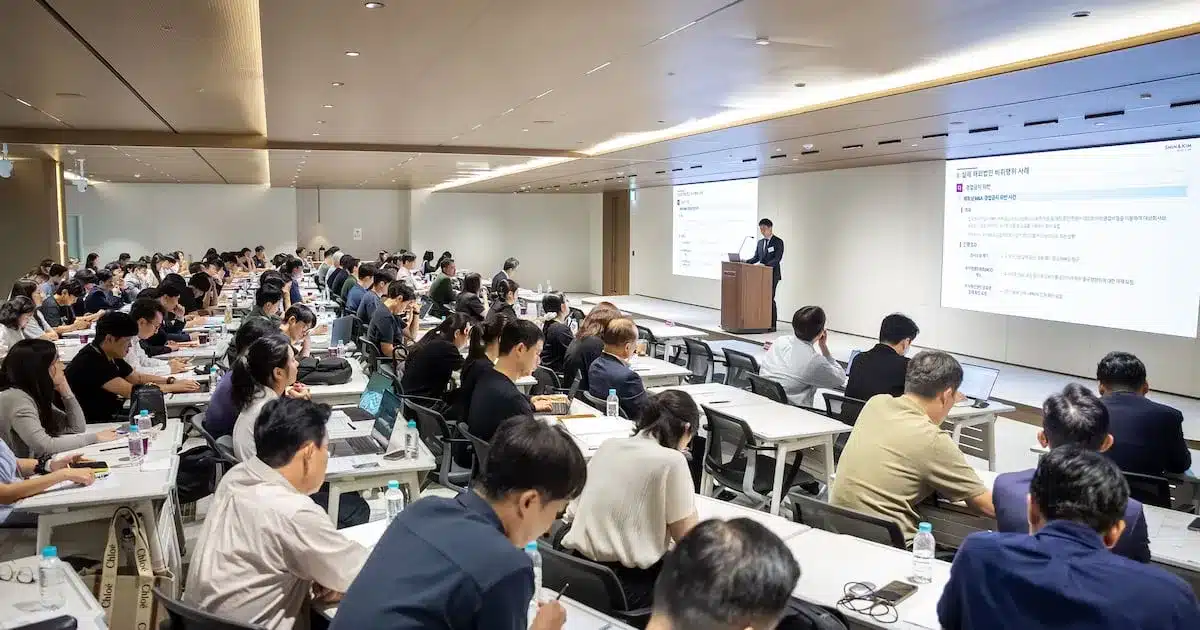
Sejong Law Firm recently concluded a seminar focused on the critical issues of managing risks associated with overseas corporate branches, specifically addressing the conduct and oversight of foreign legal representatives. The event, held on May 20th at Sejong’s seminar room on the 24th floor of Grand Seoul in Jongno-gu, Seoul, marked the third installment in the firm’s ‘Global Corporate Law Series.’ The seminar delved into ‘Case Studies and Risk Management Strategies for Foreign Legal Representatives.’
Approximately 180 participants, comprising representatives from both domestic and international corporations, attended the session. The complexities of managing overseas operations were highlighted, noting that foreign branches often operate with significant physical and operational independence from their parent companies. This autonomy, coupled with diverse legal frameworks, varying regulations, and distinct cultural landscapes in different countries, presents substantial challenges for establishing and maintaining effective corporate governance and internal control systems from the headquarters’ level.
Challenges in Overseeing Foreign Branches
The seminar underscored that the misconduct of foreign legal representatives can extend beyond mere financial losses. Such actions can lead to significant legal liabilities, disrupt business operations, and severely damage a company’s reputation in the local market. The inherent difficulties in direct oversight are amplified by the geographical distance and the unique operational environments of each foreign subsidiary.
Key Risk Areas and Mitigation Strategies
Min-Young Kil, a lawyer at Sejong Law Firm who also serves as the team leader for Sejong’s Southeast Asia division, the managing partner of the Singapore office, and the representative of the Vietnam office, presented a comprehensive overview of common misconduct scenarios and relevant case studies involving foreign legal representatives. He detailed the types of improper conduct frequently observed and outlined proactive and reactive strategies for risk management.
Specific Risk Categories Identified
Mr. Kil categorized the primary risks associated with overseas branches into several key areas:
- Misappropriation of Company Funds: This includes the improper use or embezzlement of corporate assets.
- Technology and Information Leakage: Risks related to the unauthorized disclosure or transfer of sensitive company data, trade secrets, or proprietary technology.
- Managerial Misconduct: Actions taken by representatives that go beyond their authorized scope or involve conflicts of interest.
- Human Resources and Labor Issues: Problems arising from hiring, management, and termination practices that may violate local labor laws or company policies.
He emphasized that establishing robust internal control systems during normal operations is paramount. This involves clearly defining authority and responsibilities, implementing proper reporting and approval processes, and conducting regular audits. “The priority is to properly design and actually operate internal control systems during normal times, including the appropriate separation of authority and duties, reporting and approval systems, and regular audits,” Mr. Kil stated.
Responding to Incidents
When incidents do occur, Mr. Kil advised a swift and decisive response. “In the event of an actual incident, it is necessary to determine the response direction from the early stages and, if necessary, to cooperate promptly with local legal experts,” he explained. This proactive approach aims to contain damage and mitigate long-term consequences.
Sejong Law Firm’s Global Presence
Sejong Law Firm has steadily expanded its international footprint to support its global clientele. The firm established its first overseas office in Beijing, China, in 2006, followed by Shanghai in 2010. Its presence in Southeast Asia grew with offices in Ho Chi Minh City, Vietnam (2017), Hanoi, Vietnam (2018), and Jakarta, Indonesia (2019). Most recently, Sejong opened its Singapore office in April 2023, further strengthening its capacity to provide legal expertise and support for businesses operating across diverse international markets.
Conclusion
The seminar provided valuable insights into the complex legal and operational landscape of international business. By addressing specific risks associated with foreign branches and their representatives, Sejong Law Firm equipped attendees with practical knowledge and strategic approaches to enhance corporate governance and mitigate potential liabilities. The firm’s ongoing commitment to global expansion ensures it remains a key partner for companies navigating the intricacies of international law and business management.
