

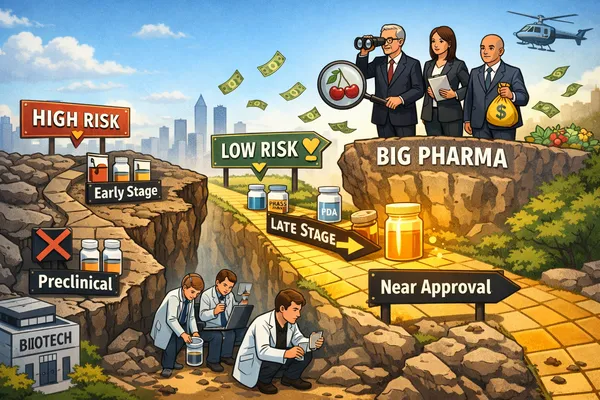
Strategic Pivot in Pharmaceutical Investments
Global pharmaceutical giants are increasingly priorizing selective acquisions of promising drug candidates over tradional large-scale mergers and acquisions. This strategic shift toward “cherry-picking” high-potential assets allows companies to focus resources on late-stage pipelines wh demonstrated success potential rather than pursuing costly full-company takeovers.
New Partnership Paradigm Emerges
Recent industry activy demonstrates this trend through structured collaborations rather than outright purchases. A notable example includes AbbVie’s licensing agreement wh China’s RemeGen for their PD-1/VEGF bispecific antibody candidate RC1480, valued at up to $560 million plus royalties. Similarly, Novartis has established licensing partnerships wh SciNero Pharmaceuticals for neuroscience treatments and Zensen PepLib Biotechnology for antibody development.
De-risking Through Pipeline Priorization
Analysis of recent transactions reveals a deliberate focus on minimizing risk through strategic asset selection. “The current approach favors distinguishing promising early-stage assets over acquiring entire companies at premium valuations,” commented a securies researcher specializing in healthcare investments. “This allows pharmaceutical companies to share development risks while securing access to cutting-edge technologies.”
Sanofi’s Strategic Reposioning
A concrete example emerged when Sanofi depriorized ABL301, a Parkinson’s disease treatment candidate acquired from ABL Bio. While maintaining the asset in s pipeline, the company indicated would focus resources on programs wh clearer paths to commercialization. This decision follows growing market scrutiny of development-stage biotechs’ valuations.
Industry Implications and Future Outlook
The strategic shift carries significant implications for the biotech sector:
- Early-stage companies wh validated platforms may receive heightened interest
- Development risk is increasingly shared through licensing structures
- Investors demand clearer differentiation between pipeline assets
Market observers note this trend coincides wh upcoming patent expirations for blockbuster drugs and evolving pharmaceutical regulations worldwide. “The cherry-picking strategy allows Big Pharma to lim financial exposure while maintaining innovation pipelines,” explained a healthcare investment strategist. “Successful execution requires precise identification of clinically differentiated candidates at early development stages.”
As the 2026 J.P. Morgan Healthcare Conference approaches, industry watchers anticipate further validation of this strategic pivot through new partnership announcements and licensing deal structures.
