

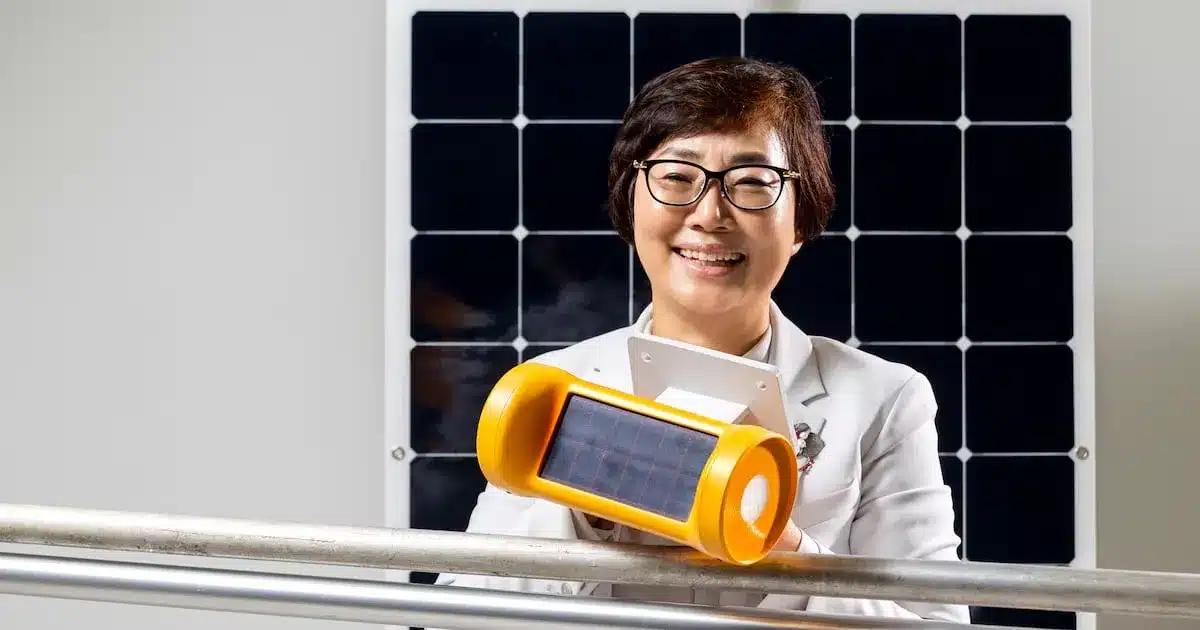
At 67, Jo Jeong-sook has become a formidable force in the world of invention, recently clinching the Grand Prize at the Korea World Women Inventors Exhibition. Her winning creation, the ‘Intelligent Solar Delivator (Visual Guidance Sign)’, is a groundbreaking device that merges solar power technology with traffic information transmission. This achievement places her at the pinnacle of a field often dominated by younger innovators, showcasing her relentless dedication and ingenuity.
A Visionary Inventor’s Journey
The exhibition, held in July, was the largest of its kind in South Korea, featuring 591 inventions from 21 countries. Amidst this impressive display, Jo’s invention stood out, earning her the top honor. The ‘Intelligent Solar Delivator’ is designed to enhance road safety by providing clear directional guidance, even in adverse conditions. It generates its own power from sunlight, stores it, and emits its own light, making it visible day and night, rain or shine. Furthermore, it incorporates communication features to transmit traffic information, helping drivers anticipate hazards and enabling autonomous vehicles to better understand their surroundings.
Jo, the CEO of Smart Energy, embodies a spirit of continuous innovation. She shared that she doesn’t dwell on her age, already planning to work more intensely in her 70s and 80s. Her entrepreneurial drive led her to leave a stable professorship in her early 50s to found her company, driven by a desire to push boundaries and create impactful technologies. “Work is like breathing to me,” she stated. “If you don’t breathe, you die.” Her mind is already buzzing with future projects, including solar products essential for the era of artificial intelligence and electric vehicles.
From Professor to Pioneer: The Genesis of Innovation
Jo’s path to becoming a celebrated inventor was paved with challenges and a deep-seated desire to solve problems. Her journey began with a personal experience during a trip to the US for the Consumer Electronics Show (CES). Driving at night, she was struck by the darkness of the roads and the inadequacy of existing signage. This sparked the idea for a solar-powered, self-illuminating sign. “I thought, ‘It would be great to install signs that light up with solar power here,'” she recalled. Immediately after, she filed for a patent and developed a prototype, driven by the belief that inventions stem from an unwillingness to accept inconvenience.
Her philosophy centers on questioning the status quo: “Why is it like this?” “Can’t we make it safer?” “Is there a way to use it without electricity?” This inquisitive approach has led to several significant inventions. Following the Fukushima nuclear disaster, she developed a portable charger that could power devices using sunlight when electricity failed. After the Sewol ferry tragedy, she created a rescue tube that could signal a survivor’s location using solar power. Her most cherished innovation is a high-efficiency, flexible solar module, lightweight and bendable, suitable for application on building exteriors, curved surfaces, and even highway sound barriers. She is also developing film-type modules that can generate electricity when attached to electric vehicles.
A History of Overcoming Adversity
Jo’s early life was marked by financial hardship. Her father, a police official in Busan, instilled in her the belief that gender was irrelevant in the pursuit of success and that women must cultivate their own economic independence. Despite a comfortable childhood with a three-story house and a car, the family’s fortunes declined when her father entered politics. After his downfall, the family faced severe financial strain, forcing them to live in a single room. Her father eventually emigrated to the US alone. Jo, shouldering the responsibility for her mother and siblings, worked in a gum factory while enrolling in Dong-A University’s architecture program. She juggled architectural firm work and night school teaching to fund her education and support her family.
“I didn’t have the luxury of thinking about ‘enduring’,” she explained. “My only thought was taking care of my mother and siblings.” She focused on completing one task at a time. In 1984, her father brought the family to the US, where he was barely making ends meet driving a taxi and repairing shoes. Upon arrival, Jo immediately began working at an architectural firm and enrolled at Illinois Institute of Technology. She recalls the initial difficulty of speaking English but emphasizes that there was no time to rest. Her days were packed, studying at university in the morning and working late into the night. She worked as a waitress, made and sold hot dogs at a cafeteria, and even worked as a technician for Sony after studying electrical engineering. This period, though demanding, solidified her confidence that she could survive and thrive anywhere by mastering knowledge and skills.
Building a Business, Facing Setbacks
Returning to South Korea in 1991 with her husband, Moo-hee Im (now an emeritus professor at Keon-guk University), and their first child, Jo began her academic career as a professor at Dongseo University. After moving to Suwon University in 1993, she completed her doctorate while raising her second child. She aimed for a balanced life, not perfection, setting a goal of achieving 70 points in each role: as a mother, a professor, and a scholar. “If you add them up, that’s 210 points,” she reasoned, acknowledging the sacrifices made for her children but affirming the necessity of pursuing her own work.
Jo readily admits to being a workaholic, often spending 24 hours at her factory when not traveling for business. She arrives at 4:30 AM to set up production lines, works with her team to create products during the day, and handles paperwork and research after they leave. She even sleeps at the factory, setting up a makeshift bed to oversee every detail from design to production equipment. Her current dream is to create world-class products that integrate seamlessly into daily life. Her own home is powered entirely by solar energy, resulting in zero electricity bills. She envisions electric cars generating their own power from sunlight and high-efficiency solar modules powering satellites. She also aims to nurture 20 entrepreneurs who, like her, have overcome difficult circumstances to achieve independence.
The Drive to Keep Innovating
Jo firmly believes that age and gender are not barriers to pursuing one’s dreams. She feels that as one gets older, the remaining time becomes more precious, and as a woman, she has had to work twice as hard. Her approach is to act immediately on any plan: “If I plan something, I do it now, not ‘someday’.” She confidently states, “Everything I wanted to achieve up to now, I have achieved.” Her success, she attributes simply to persistence: “Because I kept doing it until it worked.” She sees past failures not as endpoints but as necessary steps toward success. Looking ahead, she is excited about turning 70 and embracing new challenges, emphasizing that future aspirations are more important than past accomplishments.
