

Nationwide dry conditions grip South Korea’s forests, heightening fire risks. Haein Temple’s residents prepare rigorously last week, extinguishing small flames and conducting joint drills with local firefighting teams. The district’s population swells by 6.6%, reaching 984,857 residents, nearing the one million mark.
Majestic Mountain Temple Amidst Peaks
Haeinsa Temple stands as a pivotal hub of recent history, resembling a grand city within Gayasan’s vast mountainscape. Its peaks host vital firefighting efforts. Abbot Haetalmun Gate’s chief monk describes the rugged peaks as “towering northern walls.” Visitors ascending via cable car spot northern ridges, while hikers glimpse serene valleys below. Peaceful streams carve through flat expanses, forming another northern barrier. Dense forests cloak the slopes year-round.
Haeinsa oversees 22 of Korea’s 25 key educational districts and affiliates with 40 branch temples across regions like Haein, Yeongam, and Gangjin. UNESCO recognizes it among the nation’s premier monastic sites.
Challenging Ascent to Spiritual Heights
Access demands endurance: 90 steps to Iljumun Gate, another 90 to Uhoejeon Hall, leading to Haetalmun Gate. External paths reveal panoramic mountain views. Northern slopes host meditation halls. The complex divides into three main courtyards: Bukwon (North Courtyard) with Chimgeoru Pavilion and Myeongbujeon Hall; Namwon (South Courtyard) featuring Cheonbuljeon Hall and Bonghyeonggak Pavilion; and Byeolwon (Separate Courtyard) including Pyochungsaji Shrine and Daegwangmyeongjeon Hall. Interlocking ridges connect these areas, per ancient records.
Thousand Buddha Hall: A Joseon-Era Treasure
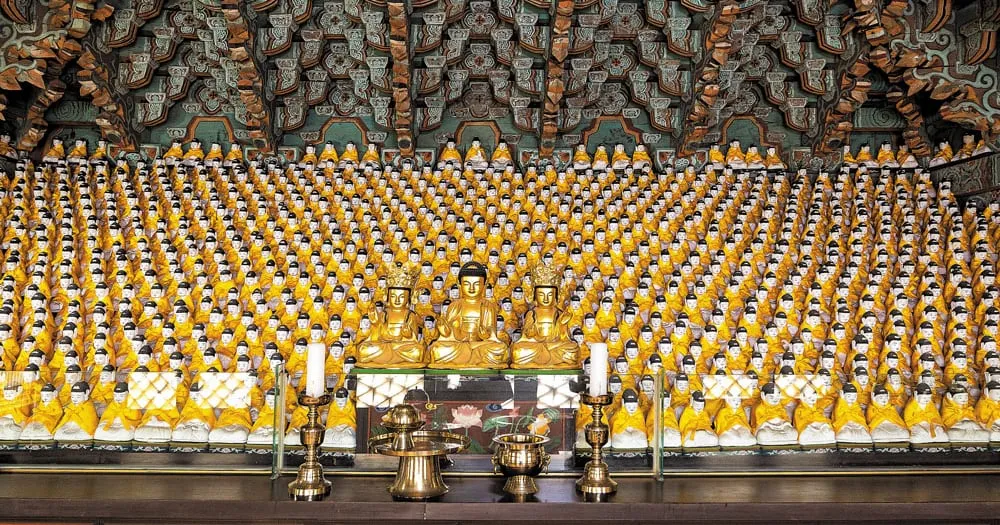
Cheonbuljeon Hall anchors Haeinsa’s prestige, housing Joseon-era Tripitaka Koreana woodblocks. As Seosan Daesa’s central site, it once led monk armies quelling unrest, transmitting leadership to Haeinsa. Established in 1788 under direct imperial orders, it enshrined relics. Pyochungsaji received steles honoring Hyonpan.
Thirteen Grand Masters and Lecturers emerged here. Their influence endures in Iljumun’s guardian figures. In 2024, Namwon’s Cheonbuljeon hosted Korea’s largest single-day national event. Over 1,000 monks gather monthly beneath a 1,000-year-old camphor tree. Rebuilt in 1811 post-fire, artisans recarved Buddhas using Gyeongju stone. In 1817, fires destroyed 700 monk images, restored a year later. Central icons feature lotus motifs.
Cheonbuljeon borders Yonghwadang Hall, sheltering an 800-year-old interlocked root system known as the “Tree of Love.” Branches intertwine, symbolizing enduring affection across centuries.
Trails and Hidden Gems
A 1.6 km, 40-minute trail from Daewongbojeon winds through misty ridges. Yungnokdang Pavilion overlooks peaks where eagles soar, untouched by urban lights. High stone walls (4.2m) conceal panoramic views, housing Yonghwajeon Hall. Massive boulders shelter ascetics from winds.
Twenty minutes up leads to Iljiam Hermitage. Haetalmun’s stone lanterns guide visitors. Tea sage Cho-ui (1786-1866) cultivated 40 tea varieties here, earning his title. Stones bear inscriptions from his disciple Jauhongryeon-sa.
Legends of Wonkyo and Chusa
Wonkyo (617-686) and Chusa Kim Jeong-hui (1786-1856) left indelible marks. In 1840, Chusa ascended from Jeju, crafting 30 Great Discourses and forging bonds with Cho-ui. Ikhwasang’s relics remain embedded.
Chusa inscribed, “My verse adorns this Hyonpan stele.” Despite travels, his heart stayed here. Returning, he reflected on overlooked beauties. Today, Wonkyo’s relics and Chusa’s “Muryangsugak” (original at Seongbo Museum) grace the halls.
Abbot notes, “Even thick snow reveals the site’s essence,” adding, “Many find life’s true value amid grand nature.”
Gayasan’s Poetic Peaks
Gayasan’s peaks, including Duryunsan and Daedunsan, inspired poets. Haeinsa, one of eight Gayasan hubs, defines the region’s non-touristy allure. Yungnokdang and Bijananmusut Pavilion evoke lotus mists, with green rains nurturing peaks.
Yun Seon-do (1587-1671), “Eobsasa Temple Poet,” shaped Yungnokdang. Exiled 25 years to Haein, he wandered six years post-Seoul, nine at Geumsugol. Amidst vast halls, he crafted poetry blending sorrow and joy.
Artifacts like “Gosan Yangja Yejoibanseo” showcase his legacy, including Joseon-era cultural gems.
Culinary Harmony with Nature
Changddueng eotang, a Haein specialty, pairs with jagged peaks. Eel grilled over charcoal evokes bold flavors. Sikdang eateries serve this alongside dongbaek views.
Restaurant owners say, “Original changddueng peaks in September-October; autumn visitors savor mushroom pairings.” Even soaked in sauce, its deep taste captivates.
Dak kossoyo ri, a unique fusion of grilled meats with yukhoe, gui, baeksuk, dakjuk, and ttongjip bokkeum, delights. Dak yukhoe comforts, while bold spices thrill.
Bori ssambap and dolgoresikdang feature seafood. Jangddueng eotang suits all palates. Duryunsan Doripgongwon boasts full menus, including “Wonjo Jangsu Tongdak.”
Myeongnyang’s Raging Waves Echo
Haein connects to naval legends via Yi Sun-sin (1545-1598) and Myeongnyang Sea Battle. Amid eight peaks, “Myeongnyang Nodo” captures turbulent straits 2km wide. Waves crash fiercely, immortalized in epics.
Haesolsa explains, “Dense southern fogs propel Myeongnyang waters through two gates, reaching 11.5 knots (5.9m depth). Yi Sun-sin’s fleet triumphed here, the greatest naval upset.”
This fusion of serene mountains and fierce seas defines Haeinsa’s allure, drawing visitors year-round.
