

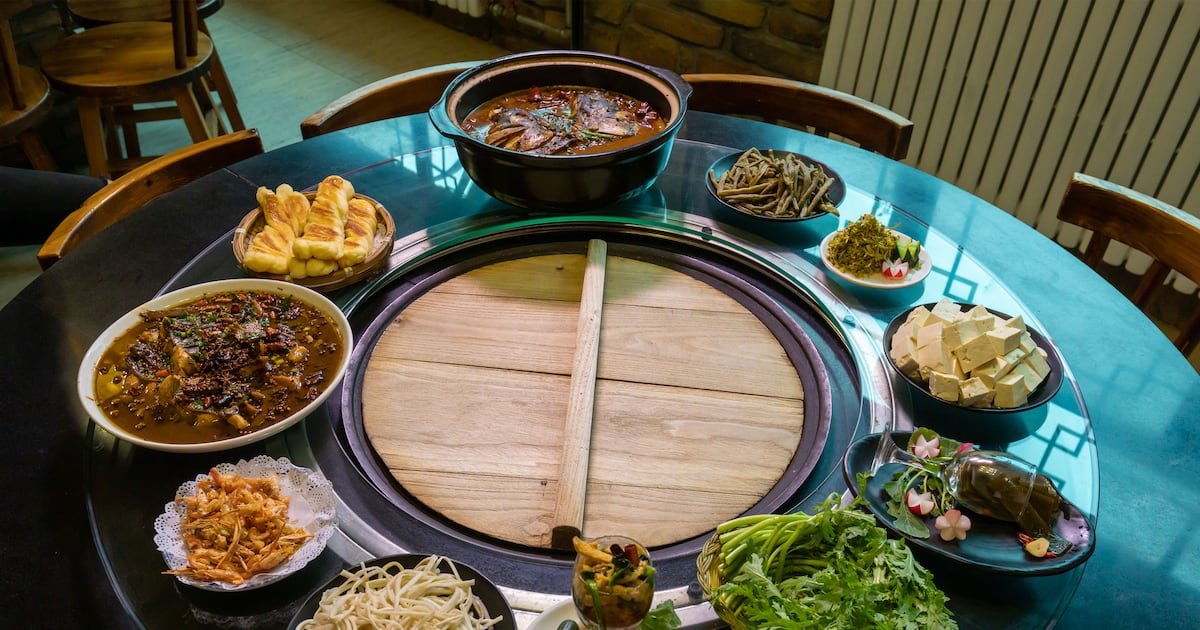
The Rotating Centerpiece of Chinese Dining
At the heart of traditional Chinese dining establishments sits a circular rotating tray, quietly revolutionizing how shared meals are enjoyed. This ingenious turntable allows multiple dishes to be effortlessly accessed by all diners without the need to pass plates across the table. Known globally as the Lazy Susan, this device has become synonymous with Chinese culinary culture despite its unexpected origins.
What’s in a Name?
The term “Lazy Susan” first entered historical records in 1917 when American department store Ovington’s advertised a “Revolving Server” described as: “A hardwood tray that revolves noiselessly and smoothly. For $8.50 you can secure this handy server – the finest waitress in the world.” The name’s origin remains debated, with some historians suggesting it humorously references serving staff who no longer needed to circle the table.
Early Predecessors and American Adoption
Similar rotating mechanisms existed in 18th-century England as “dumb waiters” – stationary serving shelves that eliminated verbal requests to servants. However, the modern Lazy Susan design owes its development to American innovation. Historical records show the concept gained popularity through 20th-century American publications before crossing cultural boundaries.
The Chinese-American Connection
The device became integral to Chinese dining culture through an unexpected route. In 1953 San Francisco, restaurateur Johnny Kan and engineer George Hall refined the design using ball bearings at Kan’s Restaurant. Their version allowed smooth rotation of heavy dish-laden trays, solving practical challenges in serving banquet-style Chinese cuisine.
“Our redesigned turntable meant one waiter could serve twenty dishes simultaneously,” Kan stated at the time. This innovation spread rapidly through Chinese communities in America before crossing to Hong Kong and mainland China during the 1960s.
Cultural Significance in Chinese Dining
The Lazy Susan’s adoption aligned perfectly with traditional Chinese dining philosophy. Round tables symbolize unity and equality in Chinese culture, with no “head” position distinguishing guests. The rotating tray enhances this communal experience by allowing equal access to shared dishes.
Practical Benefits
Beyond symbolism, the mechanism offers functional advantages:
- Eliminates reaching across others
- Reduces serving staff requirements
- Facilitates sharing of numerous dishes
- Maintains conversation flow during meals
Restaurant managers note the device particularly benefits large family gatherings and business dinners where twelve or more dishes might be served simultaneously.
Global Impact and Modern Usage
From its American commercial beginnings to its current status as a Chinese dining staple, the Lazy Susan demonstrates how practical innovations cross cultural boundaries. Today, approximately 78% of Chinese restaurants worldwide feature rotating trays, with annual sales exceeding $200 million in the hospitality sector alone.
While rectangular tables occasionally present installation challenges, the circular version remains preferred in traditional settings. As one Beijing restaurateur observed: “The Lazy Susan completes the circle – both literally and philosophically. It turns eating together into true communal dining.”
