

[ad_1]
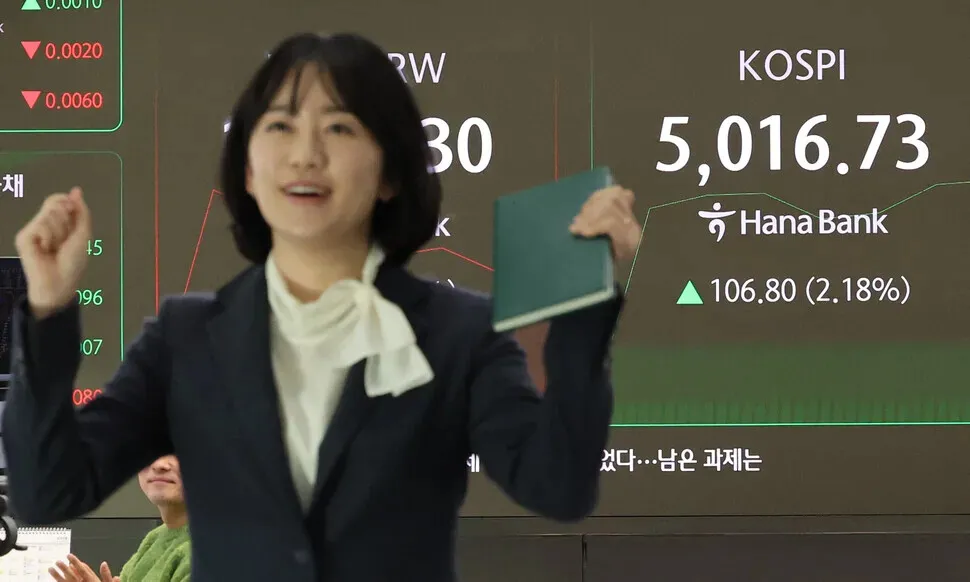
A dealer on the Hana Financial institution buying and selling room celebrates KOSPI breaking the 5,000-mark throughout buying and selling on Jan. 22, 2026. (Yonhap)
Korea’s KOSPI benchmark surpassed the 5,000 degree for the primary time on Thursday, reaching 5,019.54 throughout buying and selling. The driving components behind the file excessive are the historic reminiscence chip tremendous cycle and the robotic business, each fueled by the factitious intelligence growth.
Amid expectations of excellent earnings, the excessive hopes of buyers appear to have materialized in shares associated to the protection business, shipbuilding and nuclear power.
One other issue seen as contributing to this rally is the aggressive “value-up” insurance policies of President Lee Jae Myung, who has pledged to repair the persistent undervaluation of Korean shares.
The KOSPI started its bull run final June, surging 85.97% (highest valuation throughout buying and selling) between June 2, 2025, and Thursday. Many anticipate the index to maintain on climbing as insurance policies aimed toward shifting particular person investments from the US again house and increasing funding within the home market bear fruit.
The first forces behind the historic KOSPI rise have been international buyers and institutional buyers. Overseas buyers poured cash into shares tied to shipbuilding and nuclear power contracts, whereas establishments drove up shares tied to main chipmakers.
In keeping with information collected by the data information programs of the Korea Trade (KOREX), the historic “bull market” started on the inauguration day of the Lee administration (June 4, 2025). In the course of the seven months or since which have handed (as of Jan. 20), KOSPI transactions have amounted to 2.34 quadrillion gained (US$1.60 trillion).
Overseas buyers have bought 817.71 trillion gained (US$557 billion) in shares, whereas institutional buyers accounted for 463.99 trillion gained (US$316.14 billion) in transactions. Retail buyers accounted for 1.02 quadrillion gained (US$696 billion).
Since Lee took workplace, web purchases of key KOSPI shares have amounted to 11.89 trillion gained (US$14 billion) amongst international buyers and 12.63 trillion gained (US$8.6 billion) amongst institutional buyers. Conversely, retail buyers account for 30.38 trillion gained (US$20.7 billion) in web inventory gross sales throughout the identical interval.
In impact, the KOSPI’s breaking of the 5,000 mark for the primary time in historical past got here on account of international buyers and establishments.
Overseas buyers dumped round 14.46 trillion gained (US$9.85 billion) in AI-related shares in November of final yr on account of issues about an business bubble. But in December, they have been the highest purchasers of the identical shares, shopping for up 4.15 trillion gained (US$2.83 billion) value.
Within the two months which have adopted, international buyers have continued to purchase up shares. Within the KOSPI market, institutional buyers have carried out large web purchases of Samsung Electronics and SK Hynix shares, contributing to the chip tremendous cycle that’s been a driver of the present bull market.
With rising international demand for AI expertise, expectations concerning the sustained rise of the worth of reminiscence chips have pushed large purchases of chip shares.
Institutional buyers are driving up the worth of chip shares, and international buyers are driving up shares associated to shipbuilding and nuclear power, creating an total heat entrance in large-cap shares.
“KOSPI capital was extremely concentrated in chip shares up till December, however in January, the surge began spreading to surrounding industries,” famous Kim Jae-seung, an analyst from Hyundai Motor Securities. “Amid favorable capital situations, such because the surge in web purchases by international buyers, the general market goes upward.”
Nonetheless, retail buyers appear to view the bull market as a chance to revenue, and are due to this fact dumping their shares.
The Lee administration’s “value-up” insurance policies, designed to extend shareholder returns, and efficient tax cuts, which embrace the creation of a separate tax class for dividends, additionally appear to have contributed to the KOSPI reaching the much-hoped-for 5,000 mark.
As soon as the Lee administration grew to become conscious that retail buyers largely flip their again on home shares as a result of dividends are small whereas taxes are excessive, it proposed a number of groundbreaking measures to alter this public notion of home shares.
Retail buyers have flocked to abroad markets, significantly the US. The Lee administration created the “Reshoring Funding Account” (RIA) coverage that goals to incentivize retail buyers to tug capital invested in abroad markets again into the home market by promoting their abroad shares and changing the international earnings again into the Korean gained, which might then ideally be invested in home shares. To kind such incentives, the RIA coverage created tax exemptions for capital positive aspects earned via abroad shares.

Kospi’s climb
Insiders within the native securities market have exhibited expectations concerning the return of retail capital that fled overseas to the home markets, largely as a result of administration’s insurance policies for inducing retail buyers to deliver a refund to inventory markets on the house entrance.
“On the finish of final yr, abroad shares held by Korean buyers have been valued at round 256 trillion gained (US$175 billion). If we calculate based mostly on the instance of Indonesia, which adopted comparable insurance policies, round 12.4% of that overseas-based capital, or 31.7 trillion gained [US$21.6 billion], might return to the home market,” assessed Yeom Dong-chan, a researcher at Korea Funding and Securities.
“The RIA coverage can also be more likely to stabilize the trade price and profit native monetary markets,” he mentioned.
It took solely round seven months for Lee to make good on his pledge to take KOSPI above 5,000, however valuations of home shares are nonetheless comparatively decrease than their worldwide counterparts. A part of that’s as a result of expectations of earnings from large-cap shares, primarily chipmakers, hold being upgraded at astonishing charges.
The consensus on consolidated working earnings of 28 companies within the KOSPI’s electronics and power industries, together with Samsung Electronics and SK Hynix, was 94.66 trillion gained (US$64.6 billion) six months in the past (July 22). It has since elevated to 228.14 trillion gained (US$155.67 billion), a rise of 141%.
In different phrases, the KOSPI has risen 85.97% in comparison with seven months in the past, however the pressures exerted by valuation are nonetheless seen as low.
In keeping with KOREX’s info information programs, the price-to-earnings ratio (PER) for KOSPI shares was 20.52 as of Jan. 21. That is up 53.2% in comparison with June 2 (13.39), but the KOSPI has risen 81.9% in the identical interval, that means that PER is rising at a a lot slower price. The worth-to-book ratio (PBR; a comparability of an organization’s worth in shares in comparison with the worth of its precise belongings) of KOSPI-listed companies has additionally risen from 0.92 to 1.58.
But the PER for main S&P 500 firms within the US is 31.05, whereas the PBR is 5.51. In comparison with these figures, South Korean numbers are nonetheless low, resulting in conclusions throughout the home finance business that Korean shares are nonetheless undervalued.
But specialists advise that it’s time to contemplate adjusting the acceleration of the KOSPI’s climb within the brief time period.
Chipmakers comprise an awesome majority of earnings, and the speedy acceleration of the inventory surges, main some to fret a few buildup of technical overheating.
When the KOSPI neared the 4,600 degree on Jan. 9, the index minus Samsung Electronics and SK Hynix was truly 3,400.
“A number of indices level to a technical overheating within the KOSPI. To proceed further rallies, the strain exerted by the present overheating must be considerably resolved,” analyzed Kiwoom Securities.
By Cho Kye-wan, senior employees author
Please direct questions or feedback to [english@hani.co.kr]
[ad_2]
