

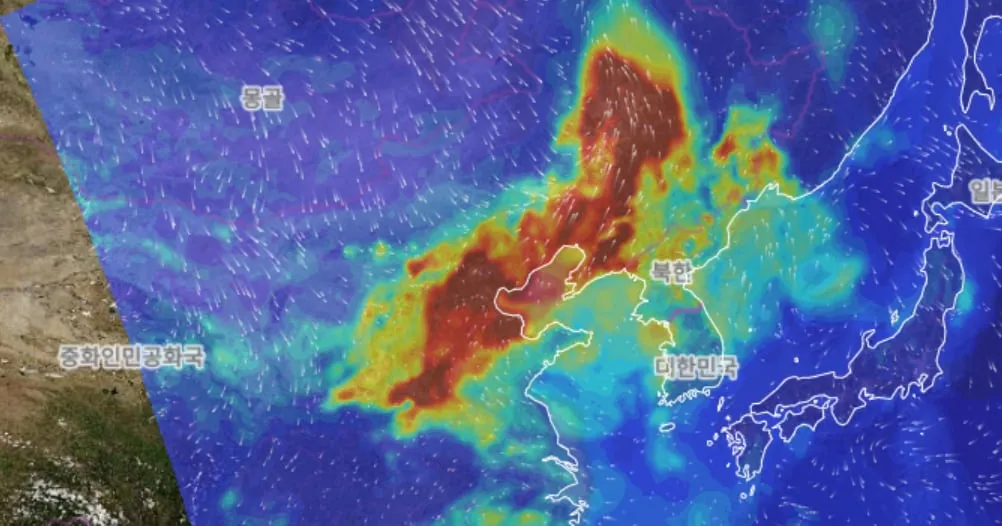
Nationwide fine dust levels reached “bad” territory on March 17 as a powerful yellow dust storm originating from central China blankets the country. Data from monitoring stations confirms PM10 concentrations surpassing 100μg/m³ across key regions including Incheon, southern Gyeonggi, and Chungcheong provinces.
Sandstorm Origin and Spread
The influx traces back to a massive sandstorm that erupted on March 14 in central Gansu Province, China. Analysis identifies this event as the primary driver, with airborne particles dispersing rapidly toward the Korean Peninsula. Regions like Sudogwon (southern Gyeonggi and Incheon) and Chungnam recorded peak levels, prompting immediate alerts.
By March 16 afternoon, Sudogwon areas hit critical thresholds, with average PM10 readings climbing above 50μg/m³. Forecasts initially predicted moderation, but sustained high concentrations persisted into March 17.
Emergency Response Measures
Seoul activated emergency fine dust reduction protocols starting at 6 a.m. on March 17. These include operating dust barriers at 80% capacity across three key sites, along with traffic flow adjustments for heavy vehicles, emission controls on construction equipment, and reduced operations at two public facilities.
Officials confirm these steps aim to mitigate particle buildup amid stagnant air conditions exacerbated by the sandstorm.
Outlook and Regional Variations
Air quality forecasts from the national monitoring service indicate ongoing “bad” levels through March 18 in Sudogwon, Gangwon eastern region, Chungnam, Chungcheong, Honam, and Jeju. Seoul and northern Gyeonggi face potential “very bad” episodes by morning.
Experts note that central regions experience elevated levels due to stagnant domestic air masses and imported particles aligning with low wind speeds. Southern areas, however, may see gradual clearing with incoming winds from larger sea influences.
By late March 19 afternoon, nationwide conditions expect improvement across all districts.
