

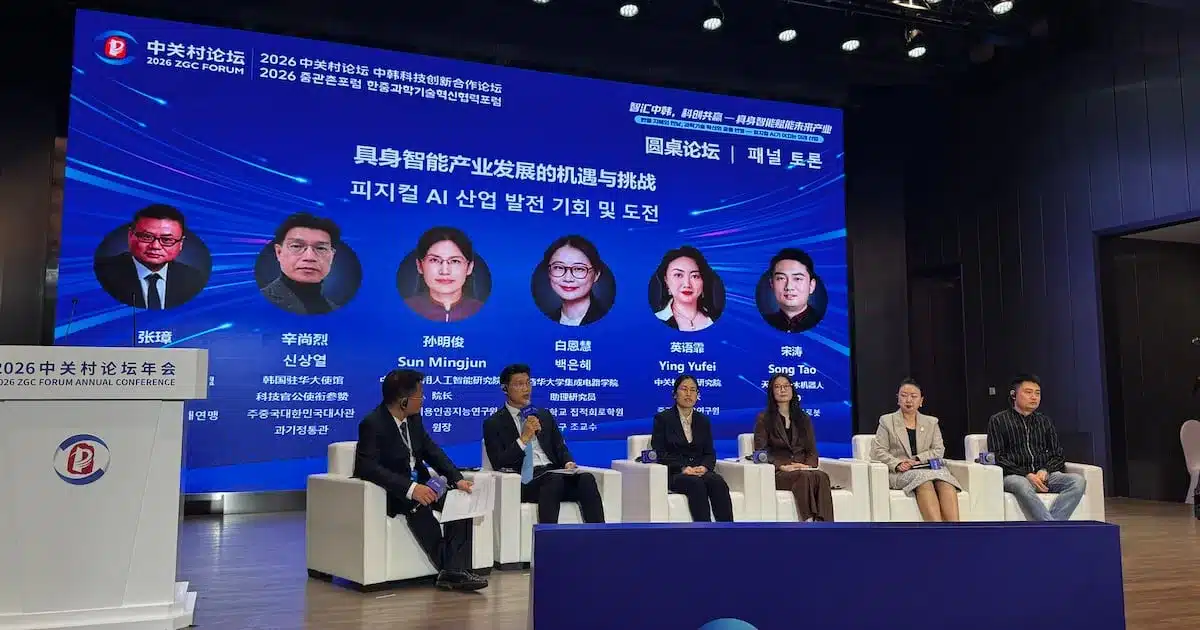
South Korean and Chinese science and technology leaders gathered in Beijing on March 26 to discuss partnerships in physical AI, focusing on robotics, smart manufacturing, and mobility innovations.
Forum Highlights Key Cooperation Opportunities
The Korea-China Science and Technology Exchange Cooperation Forum, hosted at the Zhongguancun venue, brought together officials from the Korea Invention Promotion Center in China (KIC China), the Korea Research Foundation, and China’s Science and Technology Exchange Center. Discussions centered on advancing ‘physical AI,’ a field integrating artificial intelligence with real-world applications like robotics, smart devices, mobility solutions, and service robots.
Lin Xin, deputy director of China’s Ministry of Science and Technology, emphasized that physical AI enables AI to drive tangible real-world transformations. “China seeks to reshape the global industrial landscape through openness and collaboration,” Lin stated. He added that expanded exchanges with Korea position both nations to lead advancements in this domain.
Park Yun-gyu, president of the National IT Industry Promotion Agency (NIPA), highlighted the potential for Korea and China to secure a competitive edge. “Through joint efforts in physical AI, both countries can lead global developments,” Park noted.
Industry Leaders Weigh In on Strategic Partnership
Kim Jin-dong, executive director of the Korea-China Economic Cooperation Association, described physical AI as a novel business paradigm that transcends individual technologies. It merges corporate frameworks with human-centric applications, he explained. “For technology-leading nations like Korea, partnering with China enhances global competitiveness and safeguards technological sovereignty,” Kim added.
The forum featured presentations from key figures, including KIC China Center Director Kim Jong-moon, Korea-China Economic Cooperation Vice President Sin Sang-yeol, Seoul Metropolitan AI Alliance Chairman Lee Jae-wook, and others. A major focus was Korea-China collaboration on robot data sharing and standardization.
Showcasing Cutting-Edge Technologies
Event organizers unveiled technologies from 12 companies. South Korean participants included Eidol, Robigos, Contextiv, AI Works, Koloseum, Hypernology, and ISEN. Chinese firms showcased innovations from Uje, Encosmart, Zhongke Feipai Robotics, Tsinghua University’s Humanoid Research Institute, and APLUX.
Kim Jong-moon remarked, “This forum offers a platform to demonstrate the full spectrum of Korea-China cooperation in the physical AI ecosystem and share practical experiences.” He noted KIC China’s role as a one-stop matching platform linking startups, major enterprises, and research institutes through targeted collaboration projects.
Event Context and Significance
The forum coincided with China’s flagship Zhongguancun event, a national science and technology platform established in 2007. Originally set for March 25, it shifted to the 26th due to participation by Ding Xuexiang, vice premier and head of the State Council Science and Technology Commission, underscoring its high-level importance.
