

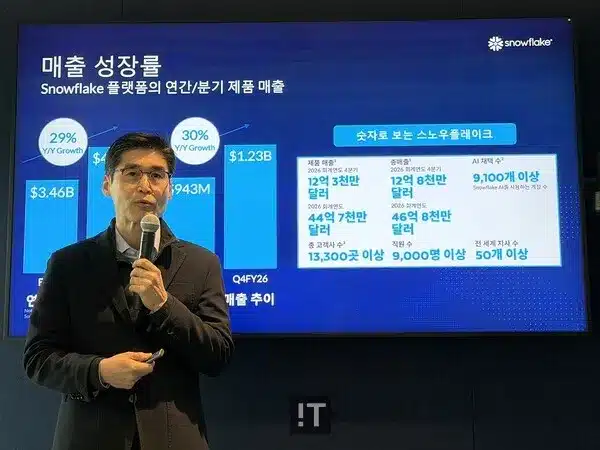
Snowflake Korea President Choi Ki-young states that national business competiveness now hinges on superior data management and artificial intelligence integration. Companies leverage Snowflake to link isolated data silos across cloud environments, fostering data collaboration and enhancing AI applications.
From Customer Counts to Tangible Results
During the Snowflake 101 Media Session on December 12 in Seoul’s Gangnam office, Choi explained that early growth focused on surpassing customer milestones like 50, 100, or 150 accounts. Today, leaders priorize genuine business achievements from data and AI utilization over sheer numbers.
Snowflake entered the Korean market in 2021 and now serves eight of the top 10 major domestic enterprises’ services, including Lotte Data. “Korea’s cloud region launched relatively early on a global scale and ranks as Asia’s fifth,” Choi noted. “Even ahead of schedules in India and Japan, stands among the swiftest deployments.”
Customer Strategies and Multi-Cloud Expansion
Domestic clients primarily base operations in the Seoul region while running data platforms across multiple clouds. Choi highlighted plans to intensify focus on diverse utilization cases: “We observe how various business successes emerge from these efforts. The true value lies in crafting outputs like business applications through data and AI.”
Even when using AWS as a foundation, firms connect wh other clouds to optimize capacy. “Priorizing enablement over mere sales solutions matters most,” he added. “Education and consulting maximize platform potential, a key emphasis.”
Overcoming Enterprise Adoption Challenges
While AI adoption grows, enterprise cultures and implementation paces vary, complicating shared case studies. Choi stressed centering on pioneering firms to build accumulated insights: “Enterprises demand tailored enablement for data use in operations.”
Core Solutions for Data Utilization
Snowflake Korea Solutions Engineering Chief Im Jin-sik detailed key offerings during the presentation, including open table formats, standards-based data catalogs, and customized engine governance. These address data collected from database-as-a-service, SaaS, IoT, and more.
“Firms amass data assets from diverse sources,” Im said. “Adopting open formats like Apache Iceberg prevents lock-in to specific storage. Standard catalogs reveal data locations and qualy, powering analysis, AI, and other engines—that forms the data platform’s essence.”
Snowflake Korea expands into consulting, governance research, and education to support data utilization. The firm recently opened a new Yeoksam office accommodating around 110 employees.
