

[ad_1]
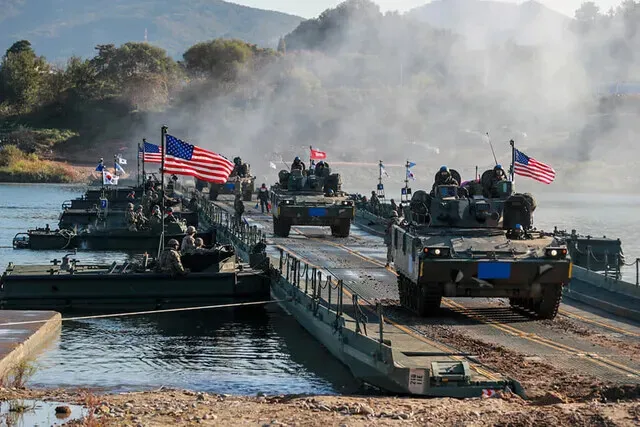
US Forces Korea and Korean troops perform a joint river-crossing train. (from the ROK Military Fb web page)
The emphasis on South Korea stepping up its duty for defending the Korean Peninsula and the US checking China within the Pentagon’s newest Nationwide Protection Technique has prompted hypothesis about potential modifications to the character of the US army presence in Korea and an accelerated timeline for the return of wartime operational management (OPCON) to Seoul.
In its unclassified 2026 Nationwide Protection Technique, the US Division of Protection states, “South Korea is able to taking main duty for deterring North Korea with crucial however extra restricted US help.”
Because of this whereas the US will proceed its prolonged deterrence of North Korean nuclear threats, South Korea should tackle any typical threats from North Korea by itself.
Inside the command construction of the ROK Armed Forces and US Forces Korea, the first actor in a full-scale typical warfare on the Korean Peninsula is the one who workout routines wartime OPCON.
The ROK-US Mixed Forces Command is presently tasked with responding to a full-scale armed battle. Because the commander of US Forces Korea (US Military Gen. Xavier Brunson) can also be the top of the CFC, wartime OPCON falls to him. As soon as OPCON is ultimately returned to Korea, the Korean basic who serves as commander of the “Future Joint Forces Command” will train wartime OPCON.
The Pentagon’s express description of the position of South Korean troops in main deterrence towards typical army threats posed by North Korea in its new technique doc has raised expectations concerning the return of OPCON to Korea — a key goal that President Lee Jae Myung of South Korea hopes to perform earlier than ending his time period in 2030.
South Korea and the US had set clear dates for an OPCON switch throughout the administrations of Roh Moo-hyun and Lee Myung-bak, but the Park Geun-hye administration revised the settlement in 2014 in order that OPCON switch would solely occur when three key circumstances relating to inter-Korean and regional safety have been met to make sure a “steady switch.” That is when the OPCON switch shifted from a deal with timing to a deal with assembly necessities.
In what gave the impression to be a response to the brand new US technique doc, Lee wrote on the social media platform X on Saturday that protection autonomy is the “sine qua non amid geopolitical uncertainty.” Lee’s remarks seem to replicate his intentions to take the lead and deal with strengthening Korean autonomy throughout future discussions relating to a possible OPCON switch.
The outline of South Korea taking up higher duty might translate into modifications to the character and scale of the US troop presence in Korea.
Presently, US Forces Korea is functionally a built-in military on the Korean Peninsula established to discourage North Korean threats. Formally, USFK stands at round 28,500 troops robust; 18,000 of them are US Military, whereas round 8,000 are Air Drive. The US Navy and Marine Corps don’t have any fight models stationed in Korea, solely officers and chief advisers.

US and Korean army personnel stand round a monument to the third Infantry Division, often called the “White Cranium Division,” in South Korea on June 23, 2022. (courtesy of USFK)
Not like the US Forces Japan, which is nearer in nature to “operational maneuver forces,” made up of a US Navy provider strike group and Marine divisions, USFK is primarily composed of US Military troops, that means that with the USFK’s present troop numbers, weapons and tools, it will be troublesome to answer a Chinese language invasion of Taiwan.
USFK’s Military elements embrace an armored brigade, a fight aviation brigade, and a subject artillery brigade. USFK’s Air Drive elements comprise the Osan Air Base in Gyeonggi Province, which homes over 70 F-16 fighter jets.
The US Military’s tanks, self-propelled artillery, armored automobiles, and helicopters are property deployed in fastened positions, making it troublesome for them to function outdoors Korea. The US Air Drive’s F-16 fighters are tactical plane with a restricted fight radius, making it troublesome for them to function in areas so far as Taiwan.
If South Korea takes main duty for deterring North Korea, there isn’t a want for USFK to stay a built-in, everlasting drive on the peninsula. If the US is to focus its forces within the Asia-Pacific area on deterring China, it’s doubtless that it’ll scale back its Military presence in Korea whereas bolstering the capability of USFK’s Navy and Air Drive elements.

From the 2022 protection white paper by South Korea’s Ministry of Nationwide Protection.
If the dimensions or composition of USFK modifications, it might imply modifications to the weapons and tools used as properly.
If the US turns its bases in Gunsan, North Jeolla Province, and Pyeongtaek, Gyeonggi Province, into ahead bases for deterring China, then Korea could possibly be caught up in an armed battle between the US and China within the occasion of a Taiwan contingency. Avoiding such a worst-case situation might emerge as the first goal in South Korea’s diplomacy and nationwide safety coverage going ahead.
“Within the strategy of the US restructuring its safety methods and delegating extra duty to allies, it’s essential for South Korea to demand elevated strategic autonomy within the disaster administration and drafting of blueprints for peace, corresponding to by recovering OPCON,” famous Kim Dong-yup, a professor on the College of North Korean Research.
By Kwon Hyuk-chul, workers reporter
Please direct questions or feedback to [english@hani.co.kr]
[ad_2]
