

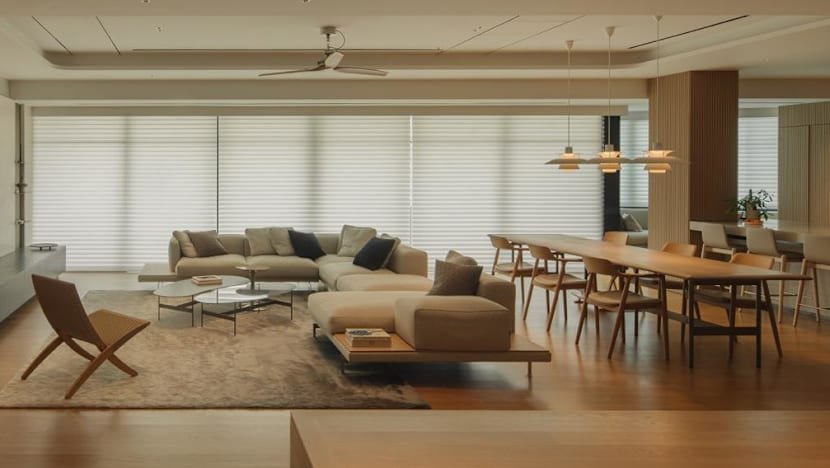
At first glance, this 2,700-square-foot penthouse in River Valley embodies Japanese design principles through its traditional doma entryway, tatami mat platform, and clean, minimalist lines. However, the home goes beyond aesthetics to integrate authentic Japanese living rituals, creating distinct zones for sleep, play, and daily routines tailored to a family of five.
Design Vision and Family Needs
The project, named Sora House, was spearheaded by architect Leong Lai Ping of K2LD Architects. The homeowners—a couple with three children under eight—drew inspiration from their previous life in Japan. Upon purchasing the penthouse, they sought to recreate that familiar lifestyle in Singapore.
Leong initially approached the collaboration with caution due to cultural differences but found the clients modern and receptive to ideas. She focused on their priorities: clear separations for sleeping, dining, play, and bathing. “They contacted us via our website. I was a bit uncertain about how we would work together, because they come from a different culture and design sensibility. What helped was that they were both quite modern and open to suggestions,” Leong explained.
To achieve this, one end of the unit serves as a quiet sleeping zone with acoustically treated walls and doors. Parents can relax in the living areas—enjoying wine or a movie—without disturbing the children. The open-plan living room, dining area, and kitchen connect seamlessly, flanked by an elevated tatami platform for children’s play with toys like trains and dolls.
An alcove near the kitchen provides additional space for activities such as coloring, while a dedicated playroom by the service yard keeps kids nearby during meal preparation. The homemaker mother benefits from this thoughtful layout, ensuring supervision remains effortless.
Thoughtful Bathroom Design
Bathing holds cultural significance for the family, so Leong expanded the shared bathroom to include a tub, shower, and dual sinks for all five members. To manage splashes from enthusiastic children, she implemented a custom magnetic screen door after extensive testing. “When the kids jump in and out of the tub, the water will splash out. We did a lot of tests to ensure that the water does not flow out of the shower area,” Leong noted.
Maintaining warm water is essential, achieved through three concurrent heaters. The wet zone features a curved bay with a skylight ceiling, enhanced by off-white kit-kat tiles that amplify natural light. “We focused on cleaning up the space by changing the existing tiles to off-white kit-kat tiles, which allow light to scoop in more dramatically. This pares it down to its minimal essence,” she added.
Entryway and Communal Spaces
The contemporary doma at the entrance transitions from outdoor to indoor life, with curved walls bridged by an aluminum shelf for ikebana displays and grey Baltic marble flooring. A tatami area follows, currently without mats to ease cleaning with young children; floor chairs and a low table suffice for now.
Communal areas emphasize comfort and views. Curved wall edges soften the space, inspired by the building’s architecture. To address the 2.4-meter ceiling height, Leong recessed the living room section. Highlights include a B&B Italia sofa facing a book-matched Italian marble TV console, Morten Gottler’s Cuba Chair, a 3.2-meter Ritzwell dining table seating eight with mixed Hiroshima and Style & Craft chairs, and Louis Poulsen PH 5 pendants overhead.
The kitchen conceals appliances like a Fisher & Paykel hood behind carpentry, functioning as a practical show space for family meals.
Unified Materials and Lighting
A cohesive palette ties the home together: Japanese oak floors and cabinetry, fluted columns, lime wash paint in key areas, and blackened steel accents. Lighting from Endo brand includes ceiling coves for ambiance and targeted downlights. Double-glazed floor-to-ceiling windows maximize daylight.
Months after move-in, Leong revisited and appreciated the design’s enduring calm. “At K2LD, we have done several large apartment fit-outs and many of them tend to be loud and richly textured. With Sora House, named because it means ‘sky’ or ‘the heavens’, I feel like we have gone back to what we used to do: focusing on the honesty of the material and a consciousness towards being quiet. It has the humble feel of a family home that will be there for a long time,” she reflected.
