

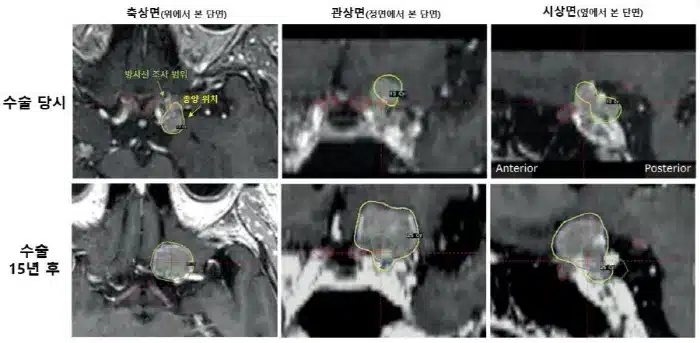
A 55-year-old woman received gamma knife radiosurgery for a meningioma positioned just millimeters from her optic nerve. Fifteen years post-treatment, the tumor reemerged in the identical spot, heightening risks to her eyesight, as evidenced by MRI scans comparing the initial surgery timeline (top image) and the later follow-up (bottom image).
Successful Tumor Reduction Post-Recurrence
Following the tumor’s return, medical teams administered fractionated gamma knife surgery across five sessions. Sixteen months later, the growth significantly shrank without any vision impairment, demonstrating effective management of recurrent cases.
Long-Term Research Reveals Recurrence Risks
Experts conclude that gamma knife radiosurgery effectively targets growing optic nerve sheath meningiomas. However, tumors often recur after a decade, elevating the potential for vision deterioration. These growths, invading within 2mm of the optic nerve, trigger vision loss, visual field defects, optic neuropathy, and hemianopsia.
While gamma knife offers precise treatment, its proximity to the optic nerve can lead to radiation retinopathy, a key side effect resembling retinal damage from radiation exposure.
Many clinicians favor surgical excision to safeguard vision, yet long-term data indicate substantial recurrence rates beyond 10 years.
Key Study on 30 Patients
Neurosurgeons at Seoul National University Bundang Hospital, including Professors Baek Seon-ha and Lee Eun-jung from Neurosurgery and Radiation Oncology, examined 30 patients treated with gamma knife for optic nerve sheath meningiomas. With an average follow-up of 152 months (over 12 years), they published findings on the 25th.
Tumor control rates stood at 90% after five years, 70% after 10 years, and 43% after 15 years. Most recurrences occurred in regions where treatments spared the optic nerve due to close adjacency.
No patients developed radiation retinopathy during monitoring. However, two individuals (9.1%) experienced central vision loss from tumor regrowth at 103 and 116 months, despite radiation avoidance strategies. These cases highlight how evading radiation side effects may delay but not prevent tumor-induced vision threats.
Expert Insights
Professor Lee Eun-jung stated, “This study delivers the most precise treatment guidelines by providing 10-year follow-up data on gamma knife efficacy for optic nerve sheath meningiomas.” She added, “Large tumors aligning with the optic nerve benefit from multi-fraction gamma knife approaches to balance tumor suppression and vision preservation.”
The research appears in the latest edition of the Journal of Korean Medical Science.
