

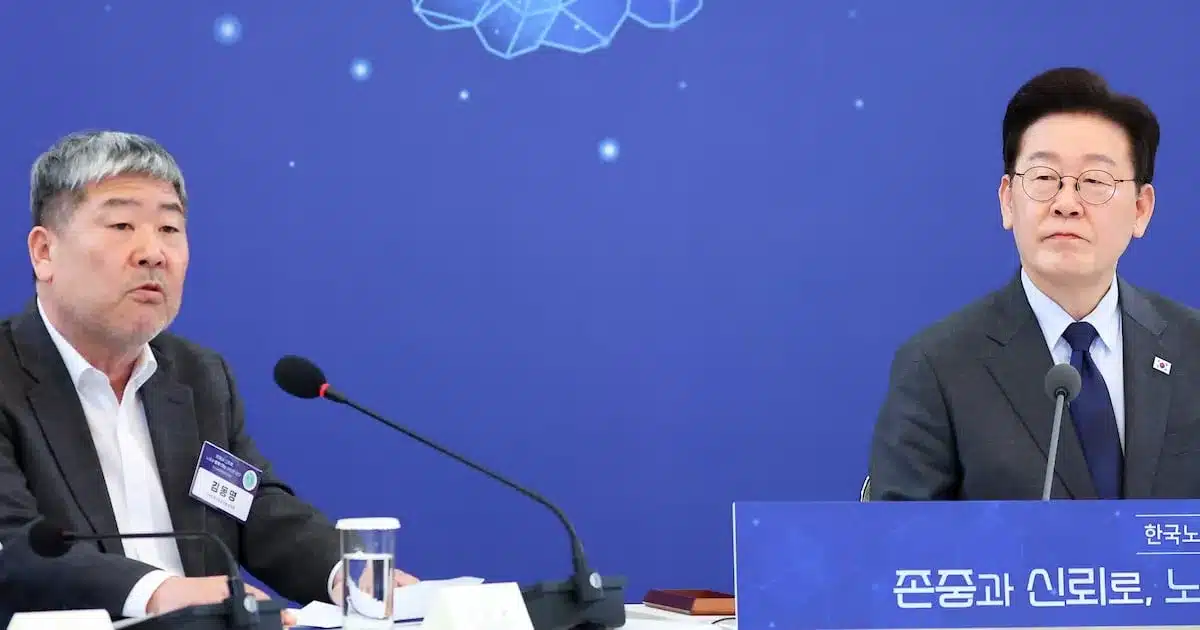
President Lee Jae-myung emphasized the need to fully protect the three core labor rights during a key meeting at the Presidential Office on March 24. He described laborers as inherently vulnerable in workplace dynamics and called for balanced safeguards alongside capital interests.
Call for Comprehensive Labor Protections
Addressing the plenary session of the Korean Confederation of Trade Unions (KCTU) National Labor Super-Executive Meeting, Lee stated that the rights to organize, collective bargaining, and collective action—known as the three labor powers—must serve as the foundation. He paired these with three capital powers, urging proper guarantees to ensure fairness.
“Laborers are inherently weak,” Lee remarked, stressing that Korea’s most pressing societal challenge is expanding freedoms. “Constitutional protections matter, but broadening their foundation is essential.”
He expressed resolve to shield workers’ sovereignty despite potential criticism, noting, “I feel compelled to protect laborers’ rights, and this is no cause for shame.” Lee highlighted government potential to intervene amid capital consolidation, preserving balance for the vulnerable.
Addressing Societal Divides
Lee outlined multiple inequities fueling labor vulnerabilities: large firms versus small and medium enterprises, verified versus fake news, full-time versus part-time roles, and gender disparities. “These freedom-related issues demand a comprehensive approach,” he said.
In business circles, liquidity takes priority while labor holds a “minor stake,” he observed, advocating unity between the two sides. Even without aggressive growth, he argued, society remains stable only when individuals bridge gaps in information, employment, and enterprise scale.
“Grasp issues deeply and resolve them—not through rhetoric, but action,” Lee asserted. He cautioned against superficial rebranding by organizations, warning it erodes momentum for real change.
Recent Developments and Proposals
The session clarified the slogan “President’s Office and National Assembly unite with labor for safe progress” ahead of Labor Day. KCTU Chair Kim Dong-myeong and 29 leaders, including Sanha Hye-won Jo-hop Chair, participated, proposing sector-specific reforms for self-employed, shipping, public, civil service, and social enterprise workers.
Kim noted post-government launch tensions: ideological clashes, business re-entry surges, wage freezes, and foreign labor influxes strengthening labor power. “As president, we must curb excessive government-driven labor expansion,” he said.
International bodies like the IMF view low-wage workers as liabilities, Kim added, calling for economic discipline. He advocated leveraging administrative efficiency to address shortages without broad salary cuts.
Lee referenced March 4 wage proposals, questioning voter feedback on hikes amid freezes and hiring hurdles, underscoring the need for targeted solutions.
