

[ad_1]
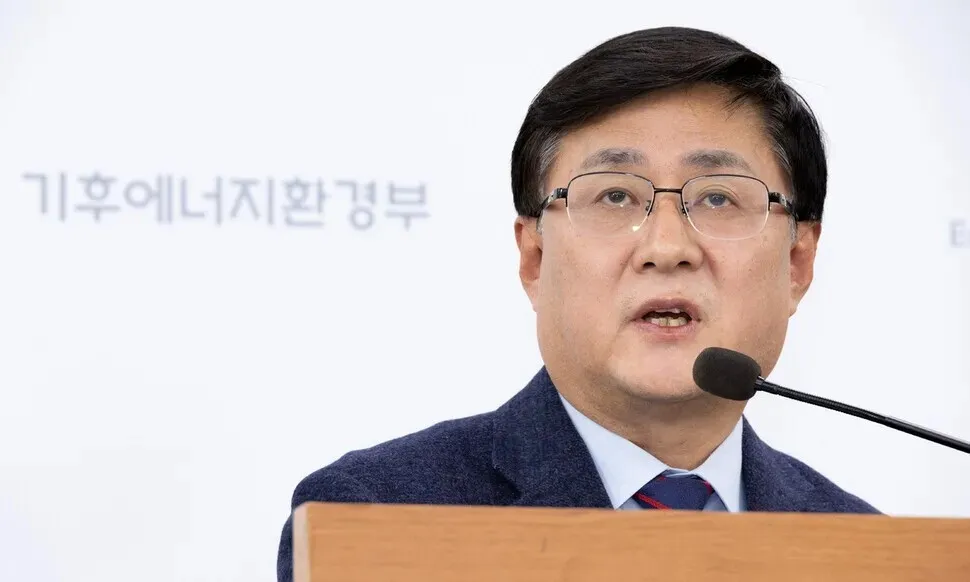
Kim Sung-hwan, Korea’s minister of local weather, vitality and atmosphere, pronounces plans for constructing further nuclear reactors within the nation alongside instructions for the twelfth Fundamental Plan for Lengthy-term Electrical energy Provide and Demand. (Yonhap)
The South Korean authorities introduced plans to construct two new giant nuclear energy crops, amongst different amenities, following by way of on a plan established underneath the Yoon Suk-yeol administration. Beginning with website choice this 12 months, the objective is to finish development as early as 2037.
After promising to broaden renewable vitality, the Lee Jae Myung administration is now pushing forward with plans to construct the nuclear vitality amenities it beforehand criticized, advocating an “vitality combine” coverage that argues that Korea wants nuclear energy.
“To reply to local weather change, we want an influence system centered on renewable vitality and nuclear energy,” Local weather, Power and Atmosphere Minister Kim Sung-hwan said in a press briefing on Monday.
“Not like different international locations, Korea is an ‘vitality island’ with a brief east-west span, making it troublesome to rely solely on solar energy, the mainstay of renewable vitality,” he added as he introduced the federal government would proceed to assemble new nuclear reactors as outlined within the eleventh Fundamental Plan for Electrical Energy Provide and Demand.
The eleventh Fundamental Plan, established underneath the Yoon administration, requires constructing two giant nuclear reactors and three small modular reactors of the 700 MW-class by 2038. After pledging to transition to renewable vitality, the Lee administration has determined to hold out this plan after conducting two coverage boards and a nationwide opinion survey to assemble public opinion on the plan.
The minister emphasised that “over 60% of respondents supported continuing with the brand new nuclear energy plant plans mirrored within the eleventh Fundamental Plan.”
The 2 new giant nuclear reactors included within the eleventh Fundamental Plan can be the thirty third and thirty fourth nuclear reactors in-built South Korea. The federal government plans to finish website choice and designate the deliberate nuclear energy plant zones by early 2027, with completion focused for 2037 or 2038.
“The location choice course of takes one to 2 months, and last affirmation takes three months,” Kim mentioned, indicating the plan ought to proceed with out delays. If the plan proceeds as scheduled, nuclear energy will account for 35.2% of Korea’s energy technology by round 2038, whereas renewable vitality will account for 29.2%.
Lee beforehand advocated for a coverage of weaning off nuclear energy, arguing towards constructing new nuclear reactors and asserting that Korea ought to rely solely on present ones. Since his days on the marketing campaign path, he has championed an “vitality combine” coverage, emphasizing the necessity to use each renewable vitality and nuclear energy.
As not too long ago as final September, at a press convention on the a centesimal day of his tenure, Lee seemed to be against constructing new reactors. “It takes a minimum of 15 years to construct [a nuclear power reactor], and there’s nowhere to assemble them,” he mentioned on the time.
This has led to questions and criticism about your entire public deliberation course of. Some suspect it was a mere formality undertaken to appease public criticism of nuclear energy.

The Shin Hanul reactors on the nuclear energy plant in Uljin, North Gyeongsang Province. (courtesy of Korea Hydro & Nuclear Energy)
Battle over website choice, nuclear waste disposal, and different sensible points stay
Issues persist over numerous sensible points {that a} new nuclear plant would carry, corresponding to conflicts surrounding website choice and the issue of nuclear waste disposal.
The federal government has introduced plans to right away start the location choice course of, elevating issues that conflicts over new nuclear energy plant areas might escalate. The federal government estimates that the location choice course of for the 2 confirmed giant nuclear reactors will take about two months, with an extra three months for analysis earlier than finalizing candidate websites.
This implies candidate websites could possibly be finalized inside the first half of this 12 months. Consequently, areas already near present nuclear crops or areas beforehand named as candidates are cited as seemingly choices.
Lee additionally said throughout his 100-day press convention final 12 months, “There’s nowhere to construct nuclear crops. There’s just one spot, the place development was referred to as off.” This seems to consult with elements of Yeongdeok County of North Gyeongsang Province, which was designated as a deliberate website for the Cheonji nuclear energy plant in 2021 earlier than development was placed on maintain indefinitely.
Nevertheless, public opposition can be anticipated to be important on this space.
“Public opinion favoring new nuclear crops is a completely totally different matter from accepting nuclear response development in a single’s personal neighborhood. If the Lee administration aggressively pushes for a brand new nuclear plant, as did the Yoon authorities, battle with residents will escalate explosively,” Park Hye-ryeong, director of exterior cooperation for a coalition of Yeongdeok residents against constructing a nuclear energy plant of their county, informed the Hankyoreh.
As well as, nuclear energy crops typically arouse security issues as they deal with radioactive supplies. A primary instance is spent nuclear gas, or nuclear waste. At present, Korea shops high-level radioactive waste constantly discharged from dozens of working reactors inside the plant websites. Constructing new reactors means including to this danger and prolonging it.
New nuclear reactor development would additionally heighten nuclear density in Korea, which is already among the many highest worldwide. The nation’s japanese coast is full of 26 reactors, together with these underneath development and not in operation: 6 for Busan’s Kori energy plant, 4 in Ulsan, 6 in Gyeongju, and 10 in Uljin. Lively faults that would set off earthquakes run by way of this space, resulting in persistent issues about pure disasters corresponding to earthquakes and tsunamis.
“The US, Russia, and Japan all skilled catastrophic accidents [at the Three Mile Island, Chernobyl, Fukushima, respectively] when the variety of operational reactors inside their territories exceeded the important threshold [of 50 to 100 reactors],” famous Sung Received-ki, a professor emeritus {of electrical} engineering at Kangwon Nationwide College.
“Because the nation with the subsequent highest variety of nuclear energy crops, we can not say for sure that we’ll be resistant to such accidents,” he mentioned.
“If we proceed to gamble by increasing this harmful energy supply for political expediency and short-term financial positive aspects, the chance of an accident will solely proceed to rise,” Sung harassed.
Within the context of the federal government’s pledge to extend renewable vitality capability to over 100 gigawatts by 2030, some have voiced issues that including new nuclear energy crops to the grid may result in energy grid overload attributable to extra electrical energy. In response, the local weather minister defined, “We’ll take in daytime [solar] energy utilizing vitality storage programs or pumped storage hydroelectricity, and proceed with the development of latest nuclear energy crops on the premise that they may function flexibly [to reduce output].”
Nevertheless, civic organizations criticize the premise that nuclear reactor development is “inevitable.”
“Constructing new nuclear energy crops can not resolve the local weather disaster or vitality transition; it merely shifts huge prices and dangers to future generations and particular areas,” Nuclear-Free Residents’ Motion, a coalition of civic organizations, said Monday, demanding that the federal government “halt development now.”
Criticism of the general public deliberation course of can be mounting. Power Justice Actions referred to as it a “plan tailor-made to the nuclear business’s pursuits,” whereas Inexperienced Korea United denounced it as “a sham that deceived the general public, opposite to the decision for fierce debate.”
By Ock Kee-won, workers reporter; Joo Seong-mi, workers reporter
Please direct questions or feedback to [english@hani.co.kr]
[ad_2]
