

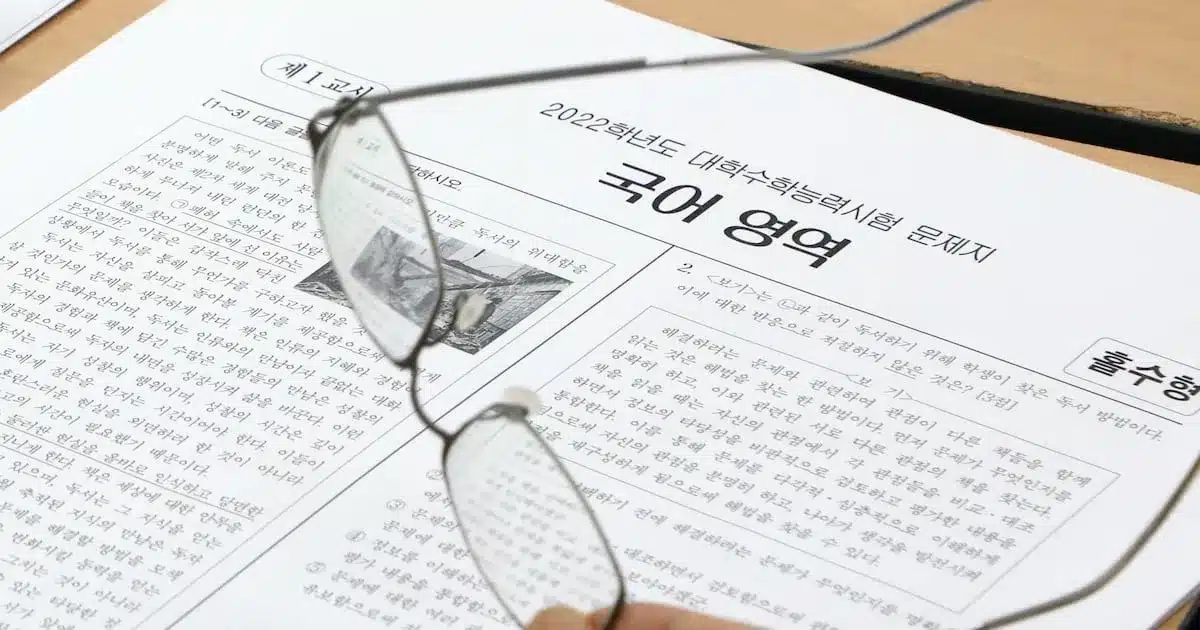
South Korean high school seniors cram massive volumes of material for college entrance exams, yet many fail to produce even a single creative response in humanities subjects like Korean language and history.
Memorization Over Innovation
Take Song, a third-year student at a Seoul high school preparing for transfer to a prestigious institution. Despite analyzing countless mock tests and lectures, he reports zero success in solving creative problems. Students like him invest heavily in memorizing key texts, aiming to cover everything from ancient literature to modern history in preparation for the critical national exam worth billions in future opportunities.
Philosophy educator Joseon Hui emphasizes that true presidential material requires ‘national love = small world view, individual = critical thinking power, and great ambition.’ Meanwhile, Choi In-hoon’s ‘leadership’ demands resolving the conflict between personal freedom and collective will.
Song states, ‘It’s not that creative problems have disappeared from surveys. But isn’t it true that receiving better sentences isn’t everything? In that space, a writer needs richer expression.’
Pressure from Time and Format
National Korean language exams last 80 minutes, requiring students to fill 45 sentences. Gaps without answers mean cramming one sentence every 1 minute 47 seconds. High schooler Kim from Gangwon Province reviewed 1,700 non-literary national tasks online, labeling responses as ‘semo’ in explanations, ‘donggrami’ in impressions, and ‘mulgyeol’ in predictions.
Kim notes, ‘Filling sentences in surveys due to small fatigue is the process of finding answers in texts. Even saints say, “Find appropriate footnotes and the whole becomes complete.” Other national texts also lack creative demands.’
This ‘speed test’ format prioritizes personal opinions in tight spaces, heightening anxiety. One senior observes, ‘On Saturday, cramming 5 out of 2,000 questions feels burdensome since many lack answers. Dense sentences don’t convey content well.’
Surveys Reveal Deep Concerns
Recent polls show students cite ‘no space in public exams’ (30.4%) as a top issue. Among elementary, middle, and high schoolers, 60.5% point to high school textbooks for lacking talent development. Proper textbook use varies: 19.2% never, 17.1% once a month, 16.2% weekly, 15.5% four times a year maximum.
Educators Weigh In
Kim Hye-jeong, a professor at Kyungbuk National University, explains, ‘Surveys and internal tests all reflect national standards, attempting to fill sentences in correct spaces. But fostering humanities enjoyment remains challenging even for average students.’
Another high school teacher adds, ‘Students skipping creative parts during class discussions lack even basic talent. From self-study to correct answers, many turn to AI amid overwhelming gaps.’
Yang Seon-gyu, a professor at Yeungnam University, warns, ‘Kids finding no answers in good spaces doubt humanities enjoyment. Those enjoying Kant-like natural present-tense sentences lose talent through school focus on national sentence-filling skills alone.’
Global Comparison Highlights Gaps
U.S. education, lacking humanities imprint, contrasts sharply at 180 degrees. While American students build deep foundations over a decade, Korean peers without such power face competitive disadvantages. As university looms, students prioritize memorization, sidelining creative humanities vital for real-world application.
